Battle of Hafrsfjord
Three bronze swords, each ten meters tall, stand driven into the granite shore of Hafrsfjord near Stavanger. The monument Sverd i fjell -- Swords in Rock -- was unveiled in 1983, and its meaning is unambiguous: this is the place where Norway became Norway. Sometime between 872 and 900, the Viking chieftain Harald Fairhair fought a naval battle in this fjord that crushed the last organized opposition to his rule. When the fighting was over, he declared himself the first king of the Norwegians, uniting a patchwork of petty kingdoms under a single crown for the first time.
A Vow and a War
The story, as told by Snorri Sturluson in the Heimskringla more than 300 years after the fact, is that Harald controlled much of southeastern Norway before the battle. His opponents -- primarily chieftains from Rogaland and the Sognefjord area in the southwest -- had refused to submit. The Battle of Hafrsfjord was the final confrontation, a naval engagement that may well have been the largest fought in Norway up to that time and for centuries afterward. Snorri gives a vivid account of the clash, describing fleets locked together in the narrow waters of the fjord, warriors boarding enemy ships, and the sea running red. But how much of Snorri's account is history and how much is literary embellishment remains an open question. He wrote in the 13th century about events in the 9th, drawing on oral tradition, earlier sagas, and a court poet's ballad.
The Date Nobody Knows
The exact year of the battle is one of Norwegian history's most debated puzzles. No contemporary chronicle recorded it -- the Christian calendar had not yet been adopted in Scandinavia, and the sagas counted time by winters elapsed since an event. In the 1830s, the historian Rudolf Keyser worked backward from the Battle of Svolder as recorded in Heimskringla and arrived at 872. His calculation was popularized by the historian P. A. Munch, and when the millennial anniversary of Norwegian unification was celebrated in 1872, no one had yet challenged the date. A half-century later, the historian Halvdan Koht applied stricter source criticism to the sagas and pushed the date to around 900. In the 1970s, the Icelandic scholar Olafia Einarsdottir placed it between 870 and 875. Most current scholars settle on the 880s, though certainty remains out of reach.
The Exodus to Iceland
Harald's victory had consequences beyond the fjord. Many chieftains who refused to submit to his rule chose exile over subjugation. They loaded their families and followers onto ships and sailed west, across the open North Atlantic, to Iceland. This wave of emigration became a founding chapter in Icelandic history -- the settlement of an uninhabited island by people who preferred the risks of an unknown land to the certainty of living under a king they had not chosen. The connection between Hafrsfjord and Reykjavik is one of the great through-lines of Scandinavian history: a battle fought in a Norwegian fjord seeded a new society a thousand miles away.
Monuments in Stone and Steel
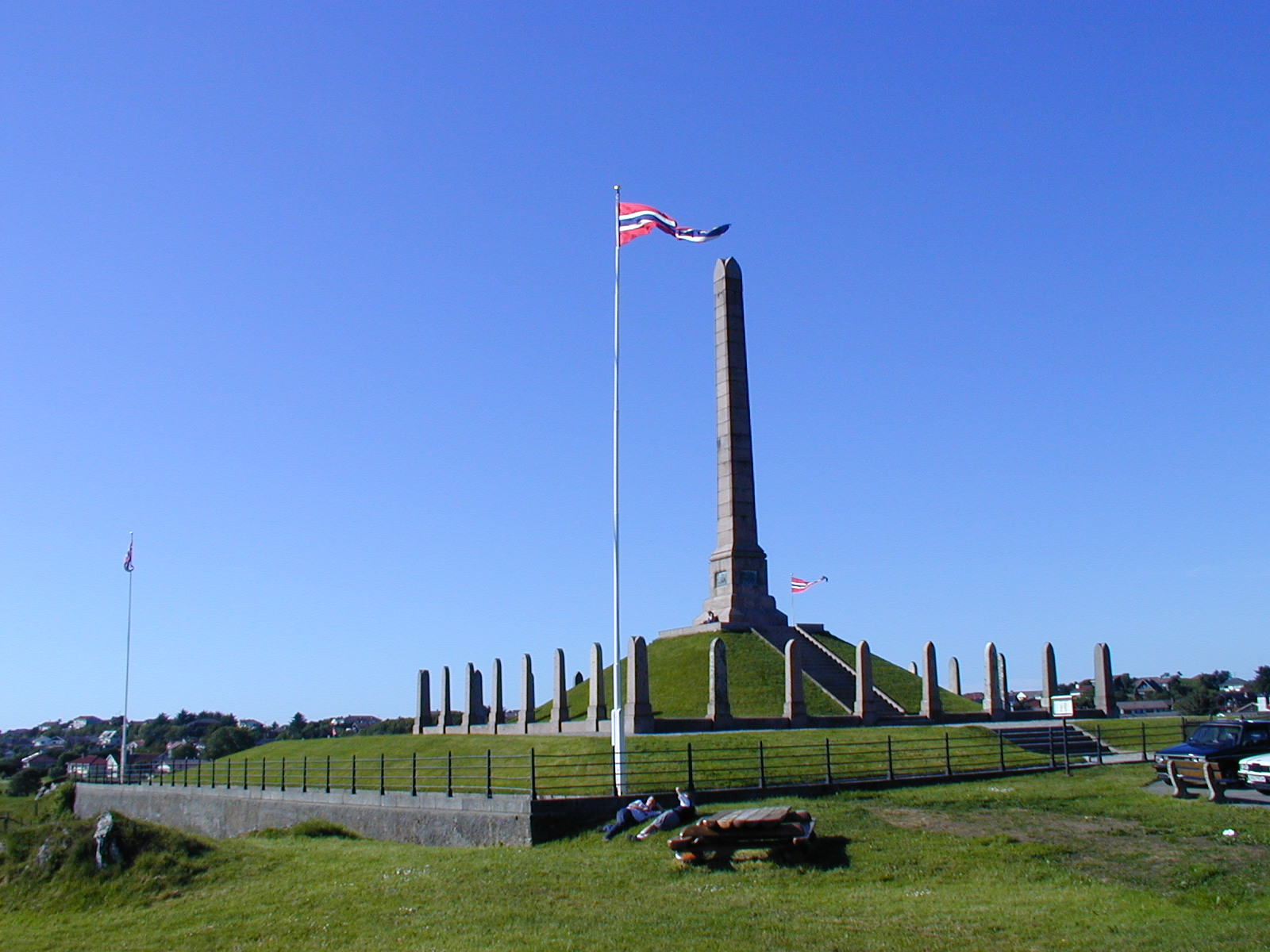
Norway has commemorated the battle twice on a national scale. In 1872, the monument of Haraldshaugen was raised at Haugesund to mark the supposed thousandth anniversary of Norwegian unification. More than a century later, in 1983, the sculptor Fritz Roed created Sverd i fjell at the shore of Hafrsfjord itself. The three swords -- representing the three districts whose chieftains fought in the battle -- are planted blade-down in the rock, a gesture of peace: swords put away after a conflict has ended. The largest sword represents the victor, Harald. The monument has become one of Norway's most recognizable landmarks, drawing visitors to a shore that looks much as it must have looked eleven centuries ago -- a sheltered fjord ringed by low hills, its waters still and dark, giving no sign of the violence that once decided the fate of a kingdom.
From the Air
Located at 58.94N, 5.67E at Hafrsfjord, a sheltered inlet southwest of Stavanger, Norway. The Sverd i fjell (Swords in Rock) monument is visible on the eastern shore. Nearest airport: Stavanger Airport, Sola (ENZV), approximately 5 km south. The fjord is clearly visible from standard approach patterns to ENZV. Fly at 1,500-2,000 ft over the fjord for views of the monument and the narrow waters where the battle was fought.