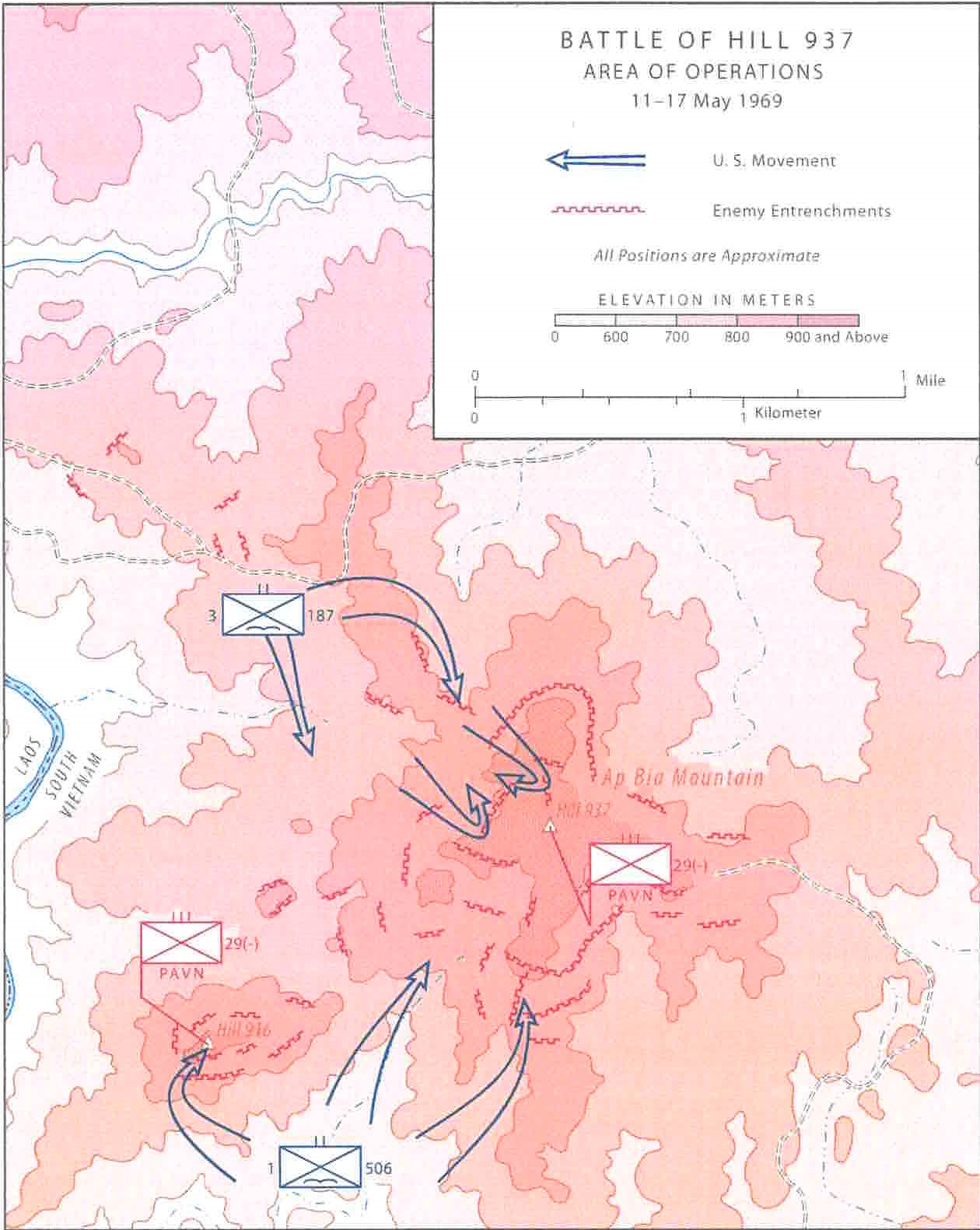
Battle of Hamburger Hill
"Have you ever been inside a hamburger machine?" a sergeant asked after descending from Hill 937. "We just got cut to pieces by extremely accurate machine gun fire." The local Degar tribesmen called the mountain Ap Bia -- "the mountain of the crouching beast" -- but the American soldiers who fought there in May 1969 gave it a name that stuck in the national conscience. Hamburger Hill. The implication was blunt: the men sent up this jungle-covered slope were being ground into meat, and the hill they were dying to capture had no strategic value at all.
The Crouching Beast
Dong Ap Bia rises 937 meters above sea level from the floor of the A Shau Valley in central Vietnam, barely two kilometers from the Laotian border. It is a solitary massif, disconnected from the surrounding Annamite Range, its slopes blanketed in double- and triple-canopy jungle, dense bamboo thickets, and waist-high elephant grass. Ridges snake down from the summit like fingers, the largest extending southeast to 900 meters and south to a 916-meter peak. In May 1969, the PAVN 29th Regiment -- nicknamed the "Pride of Ho Chi Minh" and veterans of the 1968 Battle of Hue -- had fortified the mountain with concentric rings of well-constructed bunkers. Rather than withdraw as US commanders expected, they chose to stand and fight.
Ten Days on the Slope
The battle began on May 13 as part of Operation Apache Snow, a campaign to disrupt North Vietnamese supply routes through the A Shau Valley. Lieutenant Colonel Weldon Honeycutt, a protege of General Westmoreland known for his aggressiveness, led the 3rd Battalion, 187th Infantry of the 101st Airborne Division up the mountain. What was expected to be a routine reconnaissance in force became a grinding siege. Narrow trails funneled attacking companies into kill zones where PAVN platoons had prepared overlapping fields of fire. Small arms engagements happened at close range, often within 20 meters. The jungle was so thick that American units could not support one another, and PAVN soldiers struck freely from flanks and rear. The terrain provided few helicopter landing zones, and enemy fire downed or damaged numerous aircraft. On four separate occasions, friendly Cobra gunships mistakenly attacked American positions, killing seven soldiers and wounding 53.
The Hill That Changed a War
On May 16, Associated Press correspondent Jay Sharbutt reached the battle and asked the commanding general a question that would reverberate across the United States: why was infantry being used as the primary weapon on a hill with no strategic value? The term "Hamburger Hill" entered the headlines. On May 18, Company D of the 3/187th fought to within 75 meters of the summit before losing all of its officers to casualties. A thunderstorm with zero visibility ended that assault. The Americans pulled back down the mountain yet again. When the hill was finally taken on May 20, it required five infantry battalions, ten batteries of artillery, 272 Air Force missions delivering more than 1,200 tons of ordnance, and nearly 20,000 rounds of artillery fire. Fifty-six American soldiers were killed and 367 wounded. US estimates placed PAVN dead at 630.
Abandoned Ground
The hill was abandoned on June 5, barely two weeks after its capture. Major General John M. Wright, who replaced Zais as commander of the 101st Airborne, saw no reason to hold it. Zais himself had said it plainly: "This is not a war of hills. That hill had no military value whatsoever." The controversy reached the US Congress, where Senators Edward Kennedy, George McGovern, and Stephen M. Young delivered severe criticism of military leadership. In its June 27 issue, Life magazine published photographs of 242 Americans killed in one week in Vietnam -- a watershed moment in public opinion against the war. Though only five of those pictured had died on Hamburger Hill, many Americans believed they all had.
The Weight of a Name
Hamburger Hill became a turning point not because of what it achieved militarily, but because of what it revealed politically. The battle forced a reappraisal of American strategy in Vietnam. General Creighton Abrams replaced Westmoreland's policy of "maximum pressure" -- seeking combat wherever the enemy could be found -- with "protective reaction," engaging only when troops were directly threatened. President Nixon simultaneously announced the first troop withdrawal from South Vietnam. The name itself carried an indictment: soldiers sent to die on ground their commanders would not hold, in a war whose logic was unraveling. Today the mountain stands quiet in the jungle near the Laotian border, its bunkers collapsed and overgrown, its ridges reclaimed by the same triple-canopy forest that once concealed the soldiers on both sides.
From the Air
Located at 16.253N, 107.175E in the A Shau Valley of central Vietnam, approximately 2 km from the Laotian border. The mountain rises to 937 meters ASL from the valley floor. From cruising altitude, the A Shau Valley is visible as a long corridor running northwest-southeast between the ridges of the Annamite Range. The nearest significant airport is Phu Bai International Airport (VVPB) near Hue, roughly 70 km to the east. The terrain is heavily jungled mountainous territory. Da Nang International Airport (VVDN) lies about 100 km to the southeast.