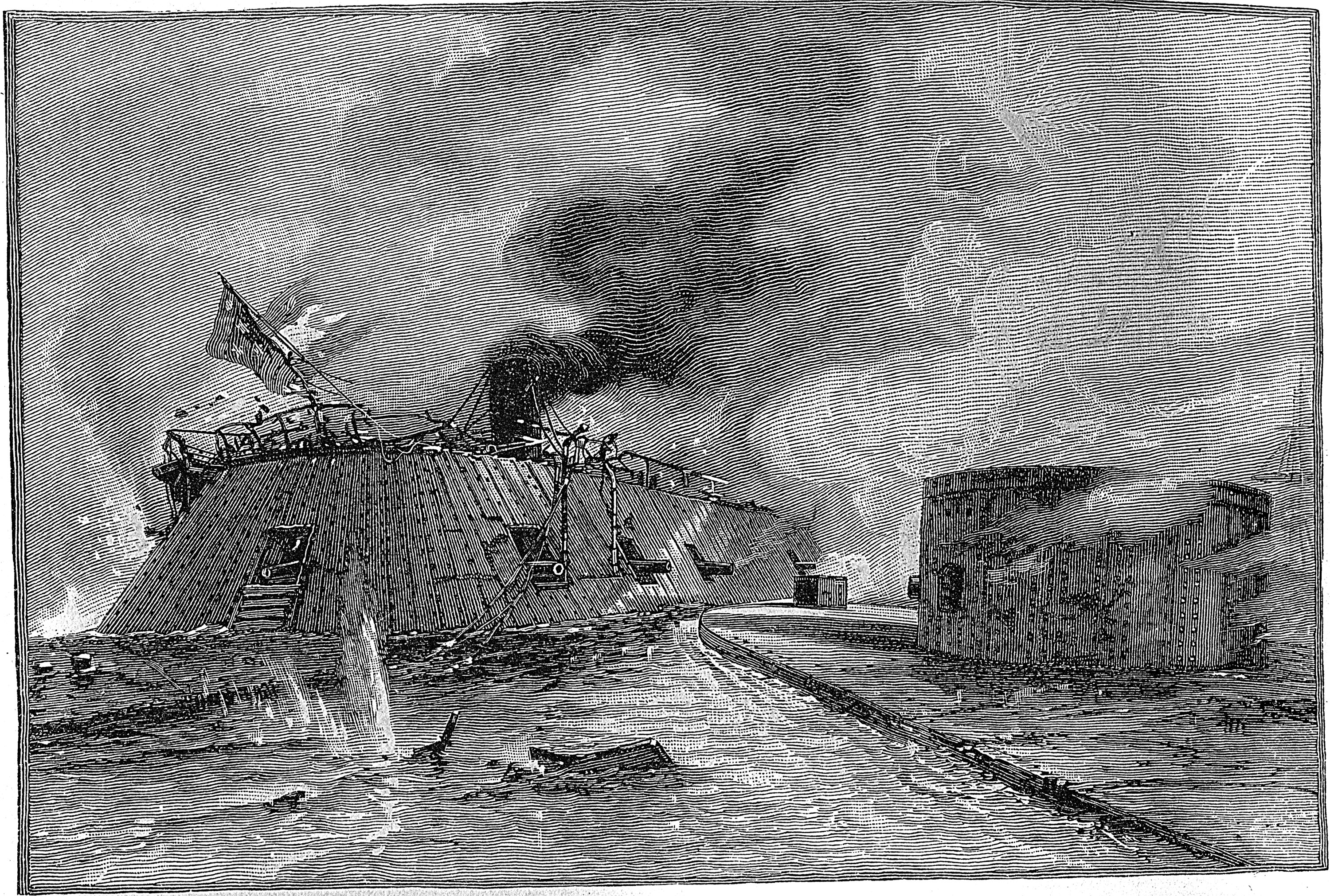
Battle of Hampton Roads
One Confederate sailor mocked it as "a cheese on a raft." The strange, flat vessel that slipped into Hampton Roads on the night of March 8, 1862, looked nothing like a warship. USS Monitor sat so low in the water that only her revolving gun turret rose above the surface. She had been rushed south from Brooklyn to face an equally bizarre opponent: CSS Virginia, an ironclad ram built from the burned-out hull of a Union frigate, bristling with ten guns behind sloped iron plating. The next morning, the two ships circled each other for three hours in the shallow waters where the James River meets the Chesapeake Bay. Neither could sink the other. The battle ended in a stalemate - and nothing about naval warfare would ever be the same.
The Day the Wooden Navy Died
Virginia struck first. On the morning of March 8, the ironclad steamed out of the Elizabeth River and headed straight for the Union blockade fleet anchored in Hampton Roads. The wooden warships USS Cumberland and USS Congress waited in the channel near Newport News. Their cannon fire bounced harmlessly off Virginia's iron plates.
Virginia rammed Cumberland below the waterline. The sloop sank rapidly, her crew firing their guns until the barrels slipped beneath the surface. One hundred and twenty-one sailors went down with her. Virginia's bow ram lodged in Cumberland's hull so deeply that the sinking ship nearly dragged the ironclad under with her. Virginia tore free, her ram snapping off.
She turned on Congress next. After an hour of devastating fire, Congress surrendered. Buchanan ordered her set ablaze with red-hot cannonballs. She burned through the afternoon and into the night before her magazine exploded near midnight, sending her to the bottom. Between the two engagements, more than 240 Union sailors were killed. It was the worst day the United States Navy had suffered - a record that would stand until Pearl Harbor.
A Cheese Against a Barn Roof
Panic gripped Washington. Secretary of War Edwin Stanton warned Lincoln's cabinet that Virginia might steam up the Potomac and shell the White House. Navy Secretary Gideon Welles calmed his colleagues: Virginia drew too much water for the river. And the Union had its own ironclad.
Monitor arrived in Hampton Roads that night to defend the grounded frigate USS Minnesota. She was the brainchild of Swedish inventor John Ericsson, built at his Brooklyn yard in just four months. Her design was radical: two heavy Dahlgren guns mounted in a cylindrical revolving turret, operated by steam, controlled by one man. Instead of tall masts and broad hulls, she presented almost no target above the waterline.
At dawn on March 9, Virginia returned to finish off Minnesota. Monitor intercepted her. For three hours, the two ironclads circled each other, firing at close range. Shells clanged off armor plates and splashed into the water. Neither ship could penetrate the other's protection. The battle ended when a shell from Virginia struck Monitor's pilothouse, driving iron fragments through the viewing slits and temporarily blinding her captain, Lieutenant John Worden.
The Shockwave Heard Round the World
The two-day battle ended without a clear victor. Virginia returned to the Gosport Navy Yard in Portsmouth for repairs. Monitor held her station defending Minnesota. The Union blockade remained in place. Both sides claimed victory in their newspapers.
But the real significance traveled far beyond Hampton Roads. Navies around the world recognized instantly that wooden warships were finished. Great Britain and France halted construction of wooden-hulled vessels. Russia began building its own monitors as soon as Ericsson's plans reached St. Petersburg. What followed was described as "Monitor mania" - a global arms race in armored ships that transformed every major fleet on Earth.
Monitor gave her name to an entire class of warship. Her revolving turret became the template for naval gunnery, evolving over the next half-century into the gun turrets of modern battleships. The era of wooden ships of the line, which had dominated naval warfare since the Age of Sail, ended in a single weekend in the waters of Hampton Roads.
Where the Iron Ships Rest
Neither combatant survived 1862. When Confederate forces abandoned Norfolk in May, Virginia's deep draft trapped her in the harbor. Rather than let the Union capture her, her crew set her afire on Craney Island. She burned through the day and night before her magazine exploded at dawn. Monitor lasted until December, when she was ordered south to join the blockade at Beaufort, North Carolina. Caught in rough seas off Cape Hatteras - the low-sided design that made her nearly invulnerable in combat made her dangerously unseaworthy in open water - she took on water and sank in the early hours of December 31. Sixteen men went down with her.
Monitor lay undiscovered on the ocean floor for 111 years until scientists located her wreck in 1973, upside down off Cape Hatteras. In 1987, the site became the first shipwreck designated a National Marine Sanctuary. Her turret, guns, anchor, and engine were recovered and transported back to Hampton Roads, to the Mariners' Museum in Newport News, where they remain on display. A $400 million bridge-tunnel now crosses the waters where the ironclads fought, less than a mile from the site of the battle.
From the Air
Located at 36.98°N, 76.32°W in the waters of Hampton Roads, Virginia, where the James River meets the Chesapeake Bay. The battle site lies in the broad roadstead between Newport News to the northwest and Norfolk to the southeast. Fort Monroe at Old Point Comfort and Fort Wool on its artificial island mark the entrance to Hampton Roads - both visible from altitude. The Monitor-Merrimac Memorial Bridge-Tunnel (I-664) crosses less than one mile from the battle site. Key landmarks: Norfolk Naval Station (the world's largest naval base) on the south shore, Newport News Shipbuilding on the north shore. Nearest airports: Norfolk International (KORF) 8nm southeast, Langley AFB (KLFI) 6nm north, Newport News/Williamsburg (KPHF) 10nm northwest. The Mariners' Museum in Newport News houses recovered Monitor artifacts.