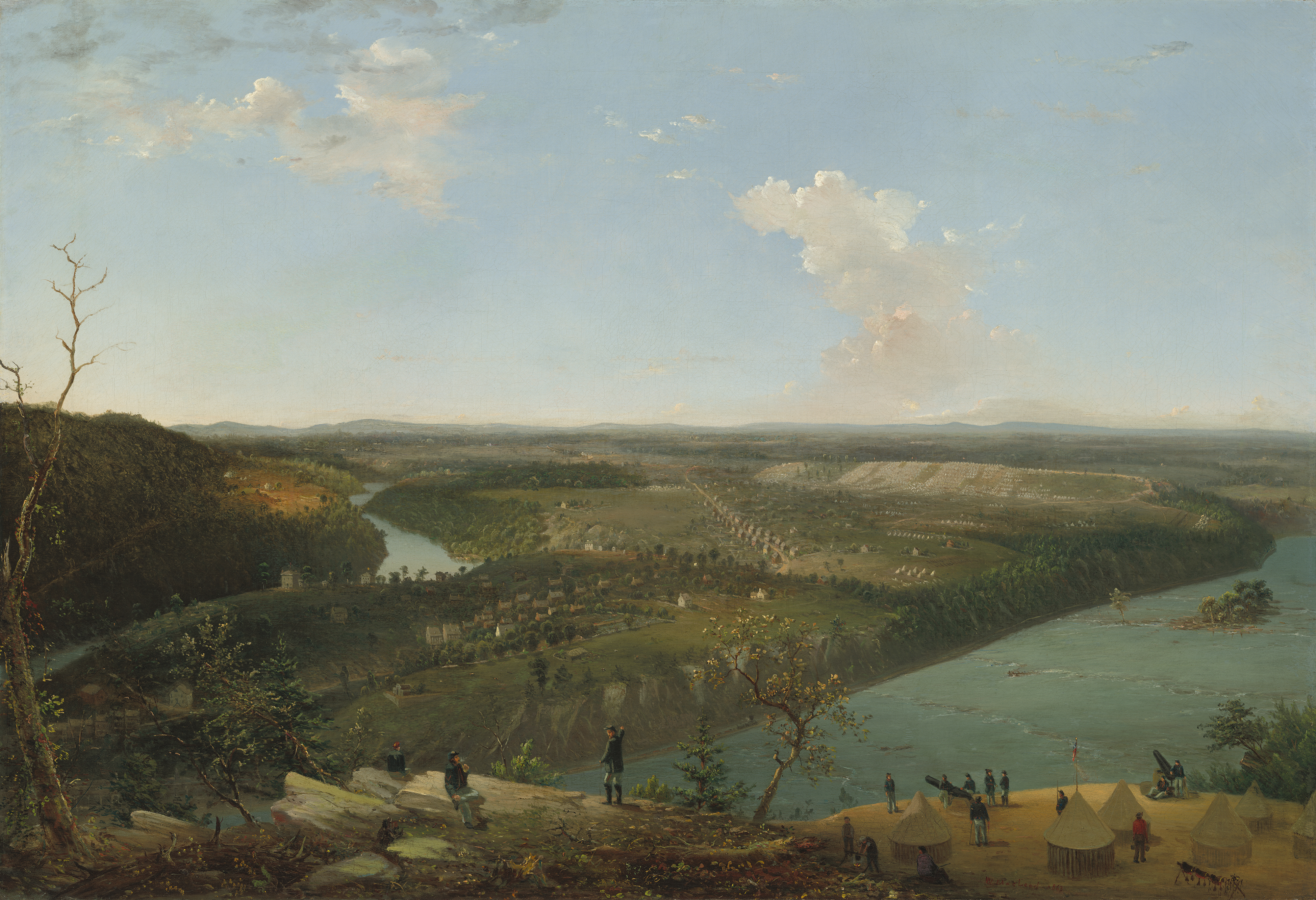
Battle of Harpers Ferry
A Federal soldier once wrote that if the surrounding heights could not be held, Harpers Ferry would be "no more defensible than a well bottom." In September 1862, Robert E. Lee gambled on that geography. While his Army of Northern Virginia pushed into Maryland, Lee made the audacious decision to split his already outnumbered force, sending three separate columns under Stonewall Jackson to converge on the Union garrison trapped where the Potomac and Shenandoah rivers meet. What followed was a four-day siege that produced the largest surrender of United States troops until the fall of Bataan eighty years later.
Lee's Dangerous Gamble
Lee's Maryland Campaign of 1862 depended on a bold calculation: that George McClellan would pursue slowly enough to allow the Confederate army to divide and reassemble. Lee needed Harpers Ferry eliminated because its garrison of nearly 14,000 men sat astride his supply line back to Virginia. So he split his 40,000 troops into four pieces, sending Jackson with 11,500 men to loop west around the town, Lafayette McLaws with 8,000 to seize Maryland Heights from the northeast, and John Walker with 3,400 to take Loudoun Heights from the south. The plan called for simultaneous attack on September 11, but delays plagued every column. Walker's engineers failed to demolish the Monocacy Aqueduct, and Jackson was held up at Martinsburg. The timetable slipped by two full days, stretching the window in which McClellan might discover and destroy Lee's scattered forces.
A Commander at the Bottom of a Well
Colonel Dixon Miles, the Union commander at Harpers Ferry, was a 38-year Army veteran haunted by disgrace. A court of inquiry had found him drunk during the First Battle of Bull Run, and he had sworn off liquor before being posted to what was expected to be a quiet backwater. Miles refused to place troops on the commanding heights that ringed his position, insisting the town could be held from Bolivar Heights alone. When his officers begged him to retake Maryland Heights after Confederate troops drove the green soldiers of the 126th New York from the crest on September 13, Miles swore: "I am ordered to hold this place and God damn my soul to hell if I don't." His stubbornness sealed the garrison's fate. By that evening, Jackson's three columns had arrived to find every dominant position undefended.
Grimes Davis Rides Free
On the night of September 14, with nearly 50 Confederate guns positioned on the surrounding heights, Colonel Benjamin "Grimes" Davis proposed the one move that might salvage something from the disaster: a cavalry breakout. Miles dismissed it as "wild and impractical," but the fiery Davis intended to leave with or without permission. Leading 1,400 horsemen across a pontoon bridge over the Potomac, Davis guided his column along a dark road at the base of Maryland Heights. In one of the war's great cavalry exploits, the riders encountered Longstreet's reserve ammunition train rolling south from Hagerstown. Davis's men tricked the Confederate teamsters into following them and captured more than 40 ordnance wagons without losing a single trooper in combat.
White Flags and Falling Shells
At dawn on September 15, Jackson unleashed a devastating artillery barrage from Maryland Heights, Loudoun Heights, and the ridges to the west. The crossfire raked the Union lines on Bolivar Heights from three directions. Miles, his ammunition dwindling and no relief in sight, agreed with his officers to raise the white flag. A captain of the 126th New York begged him not to surrender: "Don't you hear the signal guns? Our forces are near us. Let us cut our way out." Miles replied, "They will blow us out of this place in half an hour." Moments later, an artillery shell shattered his left leg. He died the next day. Some historians have speculated he was struck by deliberate fire from his own disgusted men. The formal surrender of 12,419 troops, 13,000 small arms, and 73 artillery pieces fell to Brigadier General Julius White.
The Reckoning
Jackson had won at trivial cost: 39 killed and 247 wounded, mostly from the fighting on Maryland Heights. His Confederate soldiers feasted on Union rations and helped themselves to fresh blue uniforms, clothing that would cause deadly confusion in the days ahead. As Jackson rode into town, Union prisoners lined the road for a look at the famous Stonewall. One studied his dirty, threadbare uniform and remarked: "Boys, he isn't much for looks, but if we'd had him we wouldn't have been caught in this trap." By early afternoon, an urgent message from Lee arrived. Jackson left A.P. Hill to parole the prisoners and marched his exhausted men seventeen miles north to Sharpsburg, where the bloodiest single day in American history was about to begin at Antietam Creek.
From the Air
The battlefield is centered at 39.32N, 77.73W, at the confluence of the Potomac and Shenandoah rivers. From the air, the three heights that defined the siege are clearly visible: Maryland Heights (1,476 feet) to the northeast across the Potomac, Loudoun Heights to the south across the Shenandoah, and Bolivar Heights stretching west from town. The town of Harpers Ferry sits in the narrow wedge where the rivers meet. Much of the battlefield is preserved within Harpers Ferry National Historical Park. Nearest airports: Eastern WV Regional Airport (KMRB) 12nm west, Frederick Municipal Airport (KFDK) 18nm east. Recommended viewing altitude: 3,000-5,000 feet AGL for best perspective on the surrounding terrain.