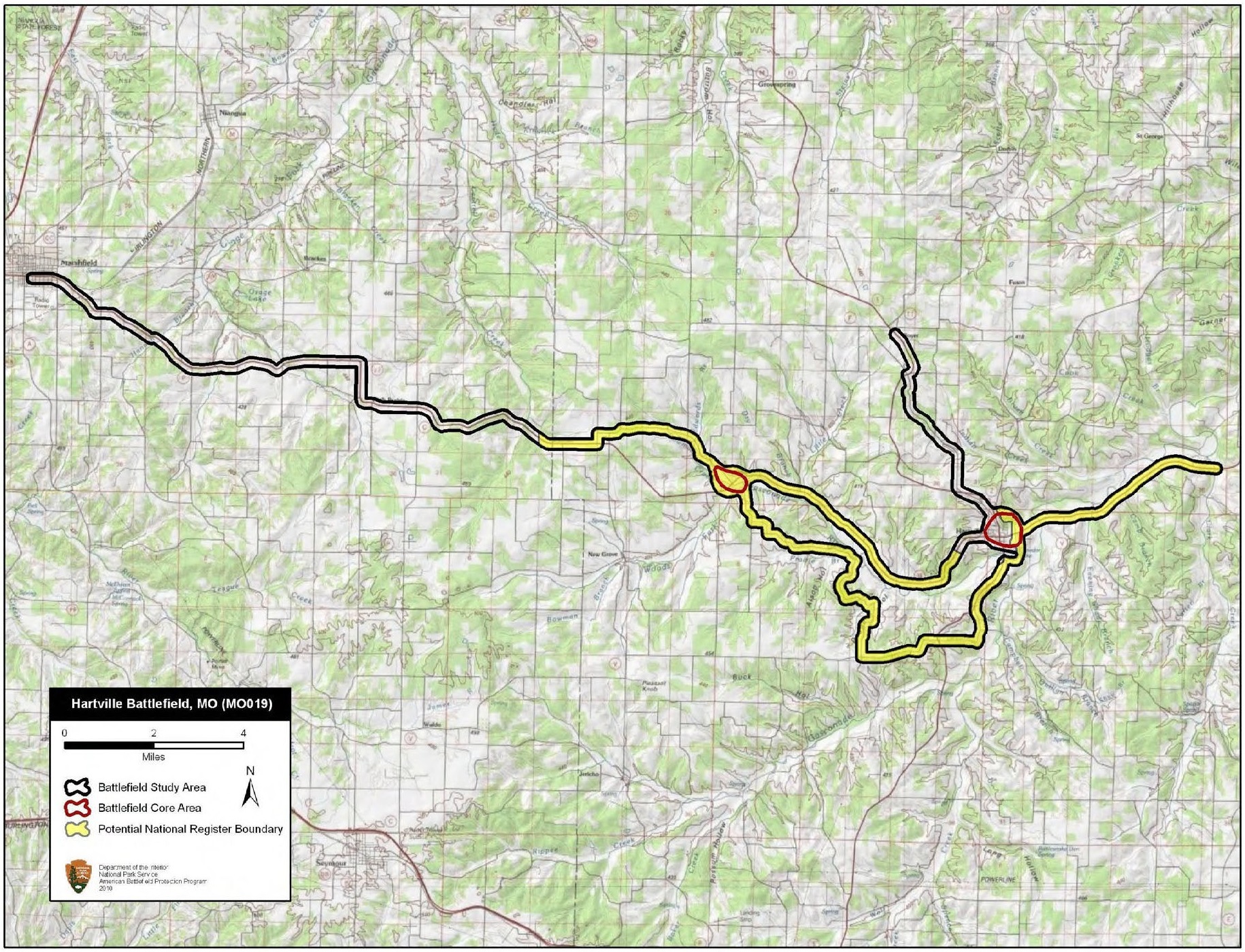
Battle of Hartville
Both armies claimed they won at Hartville. Both armies retreated. In the bitter cold of January 11, 1863, Confederate Brigadier General John S. Marmaduke hurled his raiders against a Union force entrenched on high ground west of the Wright County courthouse. Over four hours, assault after assault was repulsed. When it was over, the Confederates held the town and the Federals had left the field -- but Marmaduke had lost a brigade commander and three other senior officers killed or mortally wounded, and was forced into a punishing winter retreat to Arkansas. The Battle of Hartville remains one of the Civil War's most stubbornly disputed engagements, a fight where tactical results pointed in opposite directions depending on which side you asked.
Two Columns Through the Ozarks
Marmaduke's first expedition into Missouri was a winter raid designed to disrupt Union supply lines and overrun isolated outposts across the Ozarks. The Confederate force moved in two prongs. Colonel Joseph C. Porter led his Missouri Cavalry Brigade out of Pocahontas, Arkansas, toward Hartville, while Marmaduke himself pushed along a separate route. On January 9, Porter sent a detachment ahead that captured Hartville's small militia garrison without a fight. Porter then moved toward Marshfield, raiding other Union installations along the way. On January 10, his men linked up with Marmaduke's column east of Marshfield. Meanwhile, Colonel Samuel Merrill was marching a Union relief column from Houston, Missouri. Arriving at Hartville on the morning of January 10 and finding the garrison already surrendered, Merrill pushed on toward Springfield. That evening, his force camped along Wood's Fork of the Gasconade River.
Sharps Carbines Behind the Courthouse
Early on January 11, Confederate scouts made contact with Merrill's outposts and skirmishing began. Marmaduke, believing he was being pressed by multiple Union forces, diverted both Porter's and Shelby's columns toward Hartville on a different road. Merrill, observing this movement, marched his men directly into town and occupied a strong defensive position on covered, high ground west of the courthouse. His battle line stretched 650 yards with no reserve -- every man on the line. Shelby's and Porter's brigades attempted to dislodge the Federals but found them too well positioned. Then a critical error changed the shape of the battle. Lieutenant Dick Collins, observing from a bluff east of town, mistakenly reported a Union wagon train retreating toward the Lebanon Road. Porter formed his men into a column to pursue the supposedly fleeing enemy -- and marched straight into devastating fire from the 3rd Missouri and 3rd Iowa Cavalry, concealed on the far Union left, their Sharps carbines spitting four to five rounds per minute.
Four Hours of Futile Courage
Porter's advance dissolved under the unexpected fire, and the fighting shifted eastward as Shelby's men surged forward to support their beleaguered comrades. Over the next four hours, the Confederates launched assault after assault against Merrill's entrenched line. Each was repulsed. The Union position on high ground with concealed flanking fire proved too strong to crack by frontal attack alone. The cost in Confederate leadership was devastating: brigade commander Colonel Joseph C. Porter was mortally wounded, as were Colonel Emmett MacDonald, Lieutenant Colonel John Wimer, and Major George R. Kirtley. Eventually, Merrill withdrew most of his force, though a third of his men under Lieutenant Colonel Dunlap never received the order and stayed on the field until nightfall. As darkness fell, both sides watched the other pulling back.
Victory for No One
The aftermath was a study in conflicting narratives. The Union command could point to having repulsed every Confederate assault and inflicted severe casualties, including the deaths of four senior officers. But the Federals had abandoned the field. Marmaduke could claim he had united his scattered forces, briefly controlled Hartville, and established a field hospital in town. But he was compelled to make a rapid winter retreat into Arkansas and an arduous trek to his winter camp, his raiding force badly mauled. The larger raid had achieved some of its objectives: numerous small Union outposts across the Ozarks were overrun, destroyed, or abandoned, and Federal forces in the region were thrown into disruption. But the major prize -- the Union supply depot at Springfield -- remained firmly in Federal hands. What Marmaduke's expedition did prove was the vulnerability of Union-held Missouri to fast-moving cavalry raids. It was a lesson that Confederate commanders would exploit repeatedly in the months and years to come, even as the war's larger tide turned decisively against them.
From the Air
Located at 37.25N, 92.51W in Wright County, deep in the Missouri Ozarks. Hartville is the county seat, visible from altitude as a small town amid heavily wooded, rolling Ozark terrain. The courthouse area and surrounding high ground west of town mark the Union defensive position. Nearest airports include West Plains Regional Airport (KUNO, roughly 40nm southeast) and Springfield-Branson National Airport (KSGF, roughly 50nm west). Recommended viewing altitude: 3,000-5,000 ft AGL. The Gasconade River and its tributaries are visible navigational references. Terrain is rugged and forested.