Battle of Hatteras Inlet Batteries
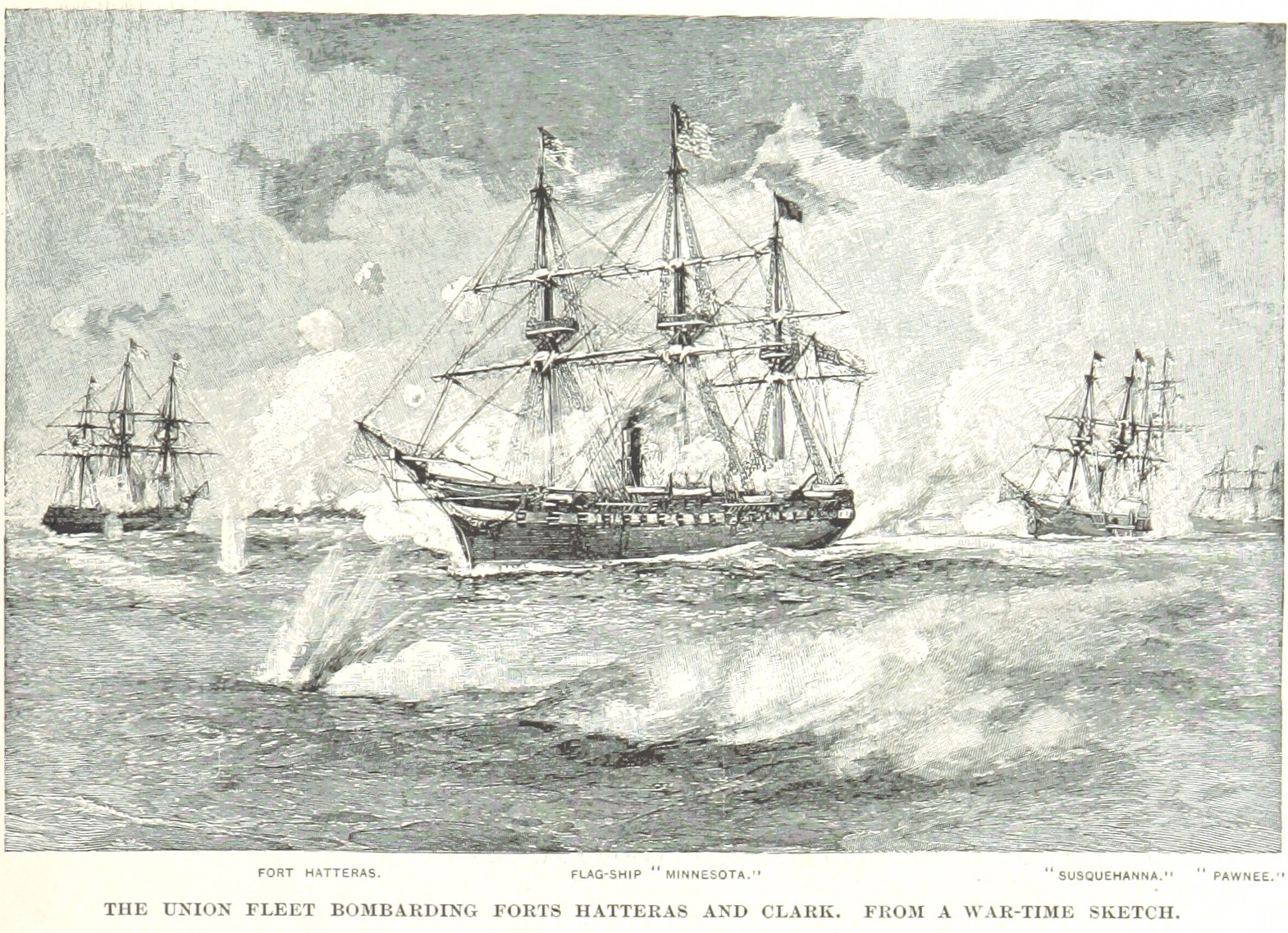
On the morning of August 28, 1861, the crew of Fort Clark watched seven Union warships swing around Cape Hatteras and drop anchor in full view. What followed over two days at this narrow inlet on the Outer Banks would become the Union's first significant victory of the Civil War, a tactical innovation that rewrote the rules of naval warfare, and a turning point that sealed Confederate access to the North Carolina sounds. No trace of the battle survives on this wind-scoured barrier island today, yet the decisions made here sent ripples through the rest of the war.
A Politician, a Flag Officer, and a Plan
The expedition was born from an unlikely partnership. Flag Officer Silas Stringham, commander of the Atlantic Blockading Squadron, had argued from the start that sinking old ships to block Hatteras Inlet was pointless. Tidal currents would sweep away any obstruction, and new channels would scour open within weeks. The only way to deny Confederate raiders access to the sounds was to take the forts. That required soldiers, and the Army offered up Major General Benjamin Butler, a Massachusetts politician with more ambition than military skill. Butler assembled 880 men: 500 German-speaking troops from the 20th New York Volunteers, 220 from the 9th New York, 100 from the so-called Union Coast Guard (actually the 99th New York), and 60 artillery regulars. They boarded two purchased transports so suspect that objections were raised about surviving a Hatteras storm. The answer was pragmatic: the expedition could only proceed in fair weather anyway.
The Moving Broadside
Early on August 28, the USS Wabash, USS Cumberland, and USS Minnesota opened fire on Fort Clark. Stringham ordered his ships to keep moving in a continuous loop, delivering broadsides as they passed the fort, then pulling out of range to reload before circling back. This simple innovation proved devastating. The Confederate gunners could not adjust their aim between shots against a moving target, neutralizing the traditional advantage that shore batteries held over naval guns. The British and French had used a similar tactic at Sevastopol during the Crimean War, but this was the first time the U.S. Navy employed it. Fort Clark's return fire fell short or sailed overhead, hitting nothing. By 12:25 in the afternoon, the fort's defenders had exhausted their ammunition completely and fled toward Fort Hatteras or took to boats. Colonel Max Weber's troops rushed in to claim the empty position, though the fleet, unaware of the ground advance, kept firing for another five minutes. One soldier was wounded by a shell fragment before troops waved a large American flag to signal the ships to stop.
A Supperless Night and a Bitter Dawn
The capture of Fort Clark was only half the job. Rising winds churned the surf into swamping waves that capsized the landing boats, stranding Colonel Weber with just 318 men ashore. They had a few field pieces dragged through the surf, enough to fend off a counterattack but far too few to assault Fort Hatteras. As darkness fell, the fleet withdrew against threatening weather, and the Federal troops tried to sleep without supper, their water dwindling. Confederate reinforcements arrived after dark. The gunboat CSS Warren Winslow brought garrison troops from Fort Ocracoke, and Flag Officer Samuel Barron assumed command, confident that more men from New Bern would let him retake Fort Clark by morning. Dawn destroyed that hope. The weather calmed enough for Stringham's warships to return, and they drove off the transport carrying additional troops. The fleet discovered it sat beyond the range of the fort's guns entirely, so the ships anchored and poured continuous fire with no danger of reply.
The White Flag at Eleven
For three hours, the men inside Fort Hatteras could do nothing but endure the relentless shelling. Casualties were surprisingly light, with reported dead numbering between four and seven and wounded between 20 and 45, but the situation was hopeless. Barron called a council of officers, and they voted to seek terms. Shortly after 11:00 a.m. on August 29, the white flag appeared above the ramparts. Butler insisted on unconditional surrender, and Barron agreed. The prisoner roll listed 691 names. Both Butler and Stringham departed immediately, Butler for Washington and Stringham escorting prisoners to New York. Critics accused them of racing to claim credit, but both argued they were lobbying to abandon the plan to block the inlet with sunken ships. In Union hands, the inlet offered Federal forces a gateway into the sounds, and it became the staging point for Ambrose Burnside's North Carolina Expedition the following year.
Echoes Across the War
Stringham's moving broadside did not end at Hatteras. Flag Officer Samuel Francis Du Pont adopted the same tactic two months later at the Battle of Port Royal in South Carolina, where it proved equally effective. The practice forced a reassessment of shore defenses versus naval gunnery that influenced coastal warfare for decades. The Confederates quickly abandoned their batteries at Ocracoke and Oregon, judging them indefensible. Today, no physical remnant of the forts exists on this ever-shifting barrier island. The battlefield lies within Cape Hatteras National Seashore, where wind and tide have erased the earthworks. But the sand that buried the batteries could not bury the significance: here, in the summer of 1861, the Union learned to combine naval and ground forces in amphibious warfare, a lesson that echoed from the Carolina sounds to the end of the conflict.
From the Air
Located at 35.18N, 75.73W on the Outer Banks barrier islands of North Carolina. The battlefield site lies within Cape Hatteras National Seashore at Hatteras Inlet, visible as the narrow waterway separating Hatteras Island from Ocracoke Island. Best viewed at 2,000-4,000 feet AGL. No physical remains of the forts are visible. Nearest airport: Billy Mitchell Airport (KHSE) on Hatteras Island, approximately 12 nm northeast. Cape Hatteras Lighthouse is a useful visual landmark to the north.