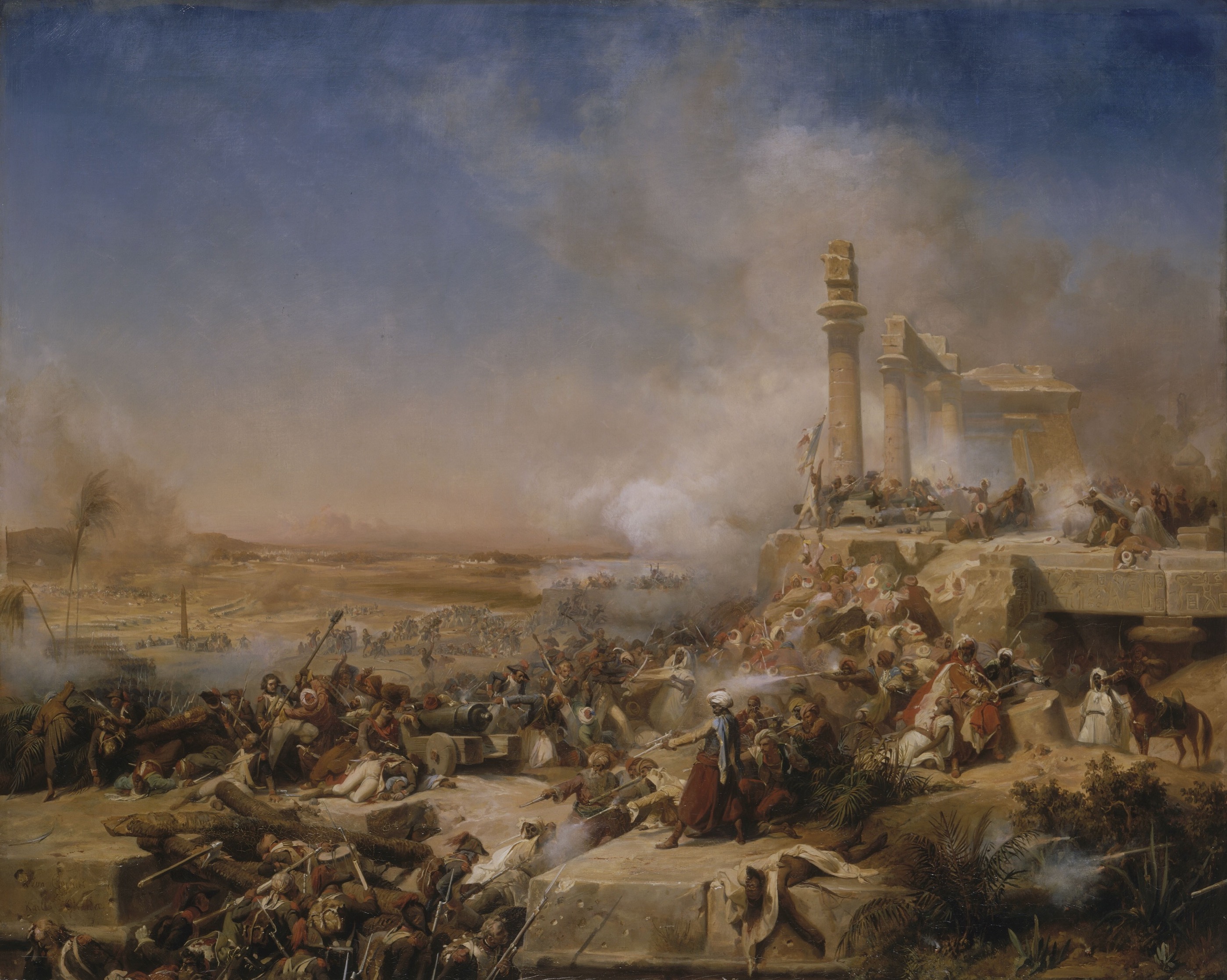
Battle of Heliopolis (1800)
General Jean-Baptiste Kleber had been betrayed by diplomats and abandoned by allies, and he was furious. In January 1800, he had negotiated the Convention of El Arish, a deal that would have let his exhausted French army leave Egypt with dignity and return to the European war. British Admiral Lord Keith then informed him that London refused to recognize the agreement. Kleber, outraged, chose to fight rather than surrender. On the morning of 20 March, he marched his 10,000 men toward an Ottoman force several times their number near the ancient ruins of Heliopolis, northeast of Cairo. By nightfall, the Ottomans were fleeing toward Syria, leaving behind as many as 10,000 dead or wounded. The French lost roughly 600.
A Broken Promise and a General's Rage
Napoleon Bonaparte had already left Egypt by the time the battle took place, sailing for France in August 1799 and leaving Kleber in command of a stranded army. The soldiers of the Armee d'Orient were far from home, battered by disease and short on supplies. Kleber, a pragmatist, opened negotiations with the British and Ottomans to arrange a dignified withdrawal. The resulting Convention of El Arish, signed on 23 January 1800, seemed to offer a way out. But the agreement unraveled when the British government disavowed it -- the dithering of Sultan Selim III and disputes among British commanders made it politically impossible to honor. For Kleber, the broken promise was a personal insult. He told his troops they would answer the betrayal with victory, and he prepared to meet the Ottoman army that was already marching on Cairo, where the local population had risen in revolt.
Squares Against the Storm
Kleber organized his outnumbered force into four infantry squares, a Napoleonic formation designed to resist cavalry charges from any direction, with artillery and grenadiers anchoring each corner. General Jean Reynier commanded the left wing, General Louis Friant the right. Kleber himself took the center, with Pierre Leclerc d'Ostein leading the light cavalry. He had called on the Mamluk warlord Murad Bey to bring his horsemen in support, but Murad mustered his riders and then simply rode away -- declining to fight for either side. The French advanced toward Mataria, near modern-day Heliopolis, where Ottoman Janissaries waited. Reynier's division struck the Janissaries head-on while Friant maneuvered to cut off their retreat. The elite Ottoman infantry crumbled faster than anyone expected. As the French pressed toward the main Ottoman camp at Heliopolis, Nassif Pasha launched a counterattack that quickly disintegrated under concentrated cannon fire. What began as an assault dissolved into a rout, and the Ottoman army fled east toward Syria.
Victory's Short Shadow
The disparity in casualties was staggering: roughly 600 French killed or wounded against 9,000 to 10,000 on the Ottoman side. Kleber had salvaged French control of Egypt in a single afternoon. He moved quickly to suppress the Cairo revolt that had erupted while the Ottomans advanced, retaking the city and restoring order. In a move of shrewd realpolitik, he recruited Egyptian auxiliaries and forged an alliance with Murad Bey, the very Mamluk leader who had abandoned him before the battle. For a few months, the French position in Egypt seemed stronger than it had been since Napoleon's arrival. But Kleber's triumph proved tragically brief. On 14 June 1800, less than three months after Heliopolis, a young Syrian student named Suleyman al-Halabi stabbed the general to death in Cairo's garden of his headquarters.
A Forgotten Inscription on the Arc
Kleber's successor, Jacques-Francois Menou, lacked his predecessor's military talent and political instinct. The French position in Egypt deteriorated steadily, and by 1801 British and Ottoman forces had compelled the Armee d'Orient to surrender and leave. The Battle of Heliopolis, once celebrated as a masterpiece of tactical audacity, faded from popular memory. Yet the name remains inscribed on the Arc de Triomphe in Paris, among the great victories of the Revolutionary and Napoleonic Wars. The battlefield itself, once open desert northeast of Cairo, has been swallowed by the modern suburb of Heliopolis -- a district of apartment towers and traffic that gives no hint of the morning when squares of French infantry held against an army that outnumbered them many times over.
From the Air
Located at 30.17N, 31.33E on the northeastern outskirts of modern Cairo. The ancient battlefield near Mataria is now entirely urban, absorbed by the Heliopolis district. Cairo International Airport (HECA) lies approximately 5 km to the east. At altitude, the Nile Delta fans out to the north, and the sharp line where irrigated green meets desert sand is clearly visible. The Pyramids of Giza are roughly 25 km to the southwest.