Battle of Hembrillo Basin
In April 1880, more than 500 American soldiers and tribal scouts attempted to trap Chief Victorio in Hembrillo Basin, a remote canyon in New Mexico's San Andres Mountains. Victorio, a Mimbres Apache leader, had been waging a guerrilla war across New Mexico, Texas, and Mexico for nearly a year, evading armies from two nations with rarely more than 200 warriors. At Hembrillo Basin, the U.S. Army believed they finally had him surrounded. They were wrong. Victorio held the high ground, controlled access to the only water, and fought from position to position with such discipline that modern archaeologists reconstructing the battle from cartridge evidence call it a masterclass in defensive tactics. The Buffalo Soldiers of the 9th Cavalry - African-American troops who formed the backbone of the force - took casualties but could not dislodge him. When it was over, Victorio had evacuated his families and escaped. It was the largest battle of Victorio's War, and he won.
The War Chief
Victorio refused to die in an Arizona reservation. In 1879, faced with forced relocation from his homeland in New Mexico to the disease-ridden San Carlos Reservation, he led approximately 80 warriors and their families into the mountains and began a running guerrilla campaign that would last over a year. His force grew as Mescalero and other Apache joined him, but rarely exceeded 200 fighting men. Against him, the U.S. Army deployed thousands of soldiers and hundreds of Apache and Navajo scouts. Mexico sent its own forces. Victorio fought dozens of engagements, raiding for horses and ammunition, striking and vanishing, using the vast terrain of desert and mountain to nullify American advantages in numbers and firepower. His sister Lozen was a warrior who rode with him, and his lieutenant Nana, though over 70 years old, commanded raids with legendary ferocity.
The Trap
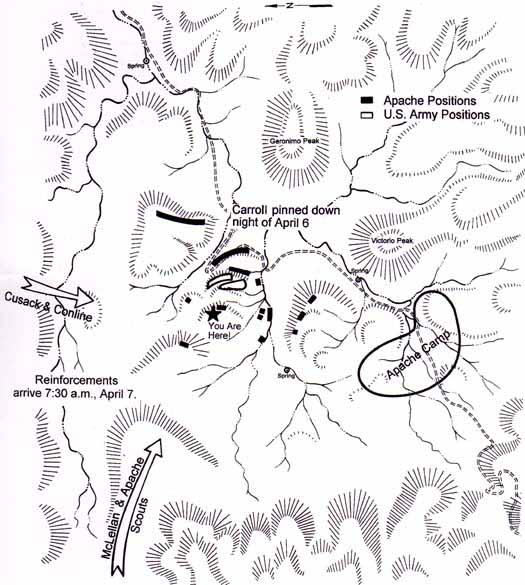
By March 1880, Pueblo scouts had located Victorio's camp in Hembrillo Basin on the western slopes of the San Andres Mountains. Colonel Edward Hatch devised an ambitious plan: four separate columns would converge from different directions, surrounding the Apache with overwhelming force. Captain Carroll would advance from the west with Buffalo Soldiers of the 9th Cavalry. Major Morrow would attack from the north. Captain McClellan would strike from the south with soldiers and Apache scouts. Captain Hooker would block escape to the east. The attack was scheduled for April 8. But war rarely follows schedules. Morrow's northern column was delayed by lack of water. Carroll, unaware of this, advanced early on April 5, stumbling into Victorio's scouts. The element of surprise was lost, and what followed was three days of fighting in which the trap became a siege that Victorio controlled.
The Battle
Carroll's 29-man advance patrol ran into 35 to 50 Apache warriors the morning of April 5. Victorio himself led the counterattack. Carroll pushed forward the next day, entering the basin with two companies, where he found himself surrounded on lower ground with Apache controlling the heights and access to the only water. He spent a waterless night under sniper fire. Relief came April 7 when McClellan arrived with more Buffalo Soldiers, 40 tribal scouts, and 100 White Mountain Apache - enemies of Victorio's Chiricahua. Now facing nearly 400 soldiers, Victorio executed a masterful withdrawal. He positioned warriors with Winchester repeaters at the springs to deny water. Riflemen on the ridges kept soldiers at long range. As his women and children escaped, his rear guard held the Americans at bay, retiring from position to position until darkness fell.
The Evidence
In 1988, archaeologists surveyed Hembrillo Basin and discovered what military historians had missed: the physical evidence of Victorio's tactical genius. Over 800 cartridges were GPS-tagged and analyzed. Forensic examination identified 147 unique rifles and 39 separate pistols among the Apache positions. The distribution showed extraordinary discipline: short-range repeaters at the springs, long-range rifles on the heights, systematic movement from ridge to ridge during the withdrawal. 'Victorio's Apache were doing what they did best,' archaeologists concluded, 'fighting a defensive battle with a mountain at their back.' Two Buffalo Soldiers died, and five more were wounded, including Captain Carroll. Apache losses were minimal. Today, officers from nearby White Sands Missile Range study the battlefield as a model of small-unit tactics against overwhelming odds.
Aftermath
Victorio escaped Hembrillo Basin but his war was nearing its end. Mexican forces killed him at Tres Castillos in October 1880, though his people continued resistance under Nana and eventually Geronimo. The battle site today lies within White Sands Missile Range, inaccessible to the public except through occasional ranger-led tours. The Buffalo Soldiers who fought there received little recognition at the time - army records downplayed their role - but they formed the majority of American forces engaged. Several earned the Medal of Honor during Victorio's War. The San Andres Mountains remain as wild and remote as they were in 1880. Somewhere on those ridges, cartridge cases still surface after desert rains - the last physical traces of a war chief who, for one year, held two nations at bay.
From the Air
Located at 32.92°N, 106.64°W in the San Andres Mountains of south-central New Mexico. The basin is visible from altitude as a canyon system on the western slopes of the mountains. The site is within White Sands Missile Range and inaccessible to the public. White Sands National Park lies to the west. The Jornada del Muerto desert stretches south. El Paso International Airport (ELP) is 80 miles south. Albuquerque (ABQ) is 150 miles north.