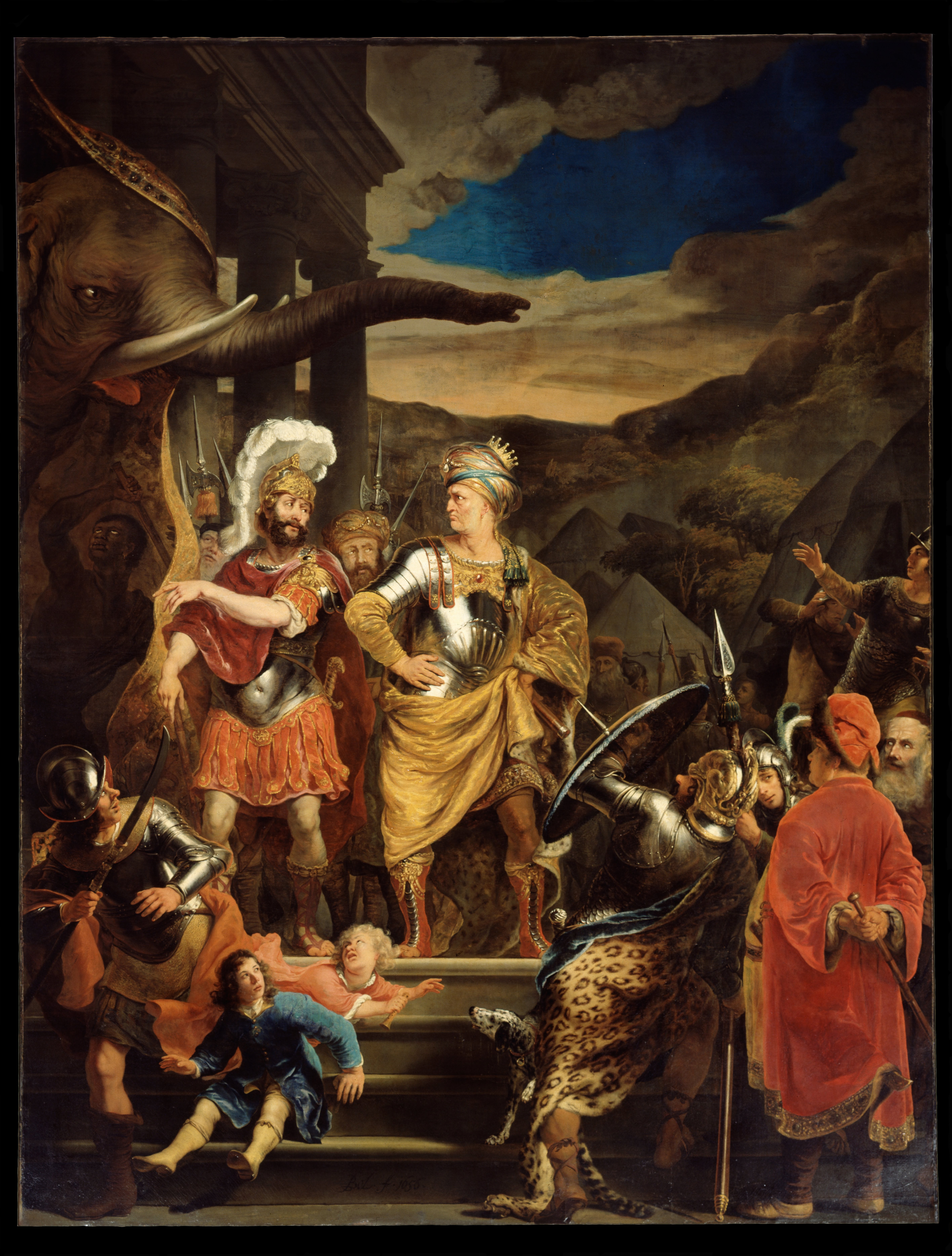
Battle of Heraclea
The Roman soldiers had never seen an elephant. When Pyrrhus of Epirus unleashed his war elephants on the plain near the river Siris in 280 BC, the Roman cavalry horses panicked and bolted, dragging the most disciplined infantry in the ancient world into chaos. Pyrrhus won the Battle of Heraclea that day, but the price was so staggering -- perhaps 4,000 to 13,000 of his own men dead on a field far from home -- that his name has been used for twenty-three centuries to describe a victory that feels like defeat. A Pyrrhic victory. It was coined here, in the dust of southern Italy, where two military systems that had never met collided for the first time.
Greek Colonies, Roman Ambition
The road to Heraclea began with Tarentum, a Greek colony on the heel of Italy that had watched Roman expansion with mounting dread. After the Third Samnite War ended in 290 BC, Rome planted colonies throughout Apulia and Lucania, the most significant at Venusia. By 282 BC, Roman troops had entered the Greek cities of Croton, Locri, and Rhegium. Tarentum's democratic faction understood what this meant: once Rome finished subduing the Gauls, Etruscans, and Samnites, it would turn to them. The flashpoint came during a festival of Dionysus, when Tarentines spotted ten Roman warships entering the Gulf of Taranto in violation of a treaty. They attacked, sinking several ships and capturing one. Knowing they could not withstand Rome alone, they sent for the one man ambitious enough to fight the Republic on its own ground -- Pyrrhus, King of Epirus, a brilliant general with debts to repay and a throne to reconquer.
The Phalanx Meets the Legion
Pyrrhus arrived in Italy in the spring of 280 BC with an army of 25,000 to 35,000 men, including Macedonian and Thessalian cavalry, archers from Rhodes, and -- crucially -- war elephants supplied by Ptolemy II of Egypt. Rome mobilized 80,000 soldiers divided into four armies. Consul Publius Valerius Laevinus marched toward Heraclea with roughly 42,000 men, aiming to cut Pyrrhus off from the Greek colonies of Calabria. On a plain between the city of Heraclea and the settlement of Pandosia, near the river Siris, two military traditions that had conquered their respective halves of the Mediterranean came face to face for the first time: the Macedonian phalanx, bristling with six-meter sarissa pikes, against the Roman legion, built for flexibility and relentless assault. It was a clash that would determine whether the future of the western Mediterranean belonged to Greece or Rome.
Seven Charges, Then the Elephants
The Romans crossed the Siris at dawn, their cavalry scattering Pyrrhus's light infantry screen. Pyrrhus responded by leading his Macedonian and Thessalian horsemen personally into the Roman cavalry, disrupting their formations before pulling back to let his infantry advance. What followed was a grinding stalemate. The phalanxes charged seven times and could not pierce the Roman lines. The legions attacked seven times and could not break the phalanx. Neither force had ever encountered an opponent this stubborn. When a rumor spread that Pyrrhus had been killed -- he had swapped armor with a bodyguard, who was then cut down -- the Greek line began to waver. Pyrrhus responded with a gesture of extraordinary personal courage, riding bare-headed along his ranks to prove he lived. His men rallied with a roar. But the battle remained deadlocked until Pyrrhus played his final card. The war elephants thundered into the Roman cavalry. Horses that had never seen or smelled such creatures bolted in terror, crashing through the infantry behind them. Pyrrhus sent his Thessalian cavalry into the confusion, and the Roman army broke.
Victory Tasted Like Ash
Ancient historians disagree on the exact toll. Dionysius of Halicarnassus counted 15,000 Roman dead and 13,000 Greek; Hieronymus recorded 7,000 and 4,000 respectively. Either way, Pyrrhus had lost irreplaceable officers, friends, and veterans -- men recruited from across the Greek world who could not be replaced by local conscription. Reinforcements from southern Italian allies swelled his ranks after the battle, and he marched north, capturing towns in Campania and raiding into Latium. His advance halted at Anagni, just two days from Rome, when he met a second Roman consular army under Tiberius Coruncanius. Aware that the forces of Laevinus and Barbula were likely closing in behind him, Pyrrhus withdrew. Rome did not pursue. Both sides had learned something. Rome now knew the phalanx and the elephant. Pyrrhus now knew Rome. He is reported to have said that one more victory like Heraclea would ruin him completely -- a remark that proved prophetic five years later when he was finally driven from Italy for good.
From the Air
Located at 40.22N, 16.67E near the ancient site of Heraclea in Lucania, in the modern region of Basilicata, southern Italy. The battlefield lies on a plain near the Sinni River (ancient Siris), between the sites of ancient Heraclea and Pandosia. From altitude, the flat river plain contrasts with the surrounding mountainous terrain of the southern Apennines. The Gulf of Taranto and the Ionian Sea are visible to the southeast. Nearest airports include Bari Karol Wojtyla (LIBD) approximately 200 km north, and Taranto-Grottaglie (LIBG) approximately 80 km east. The modern town of Policoro is nearby.