Battle of Hill 488
Eighteen Marines against a battalion. The math alone should have ended it quickly. On the night of June 15, 1966, a small reconnaissance platoon from the 1st Reconnaissance Battalion sat atop a nondescript hill in Vietnam's Que Son Valley, designated simply as Hill 488 on their maps. They were there to watch and listen, not to fight. But somewhere in the darkness below, between 200 and 250 soldiers from the People's Army of Vietnam and Viet Cong were climbing toward them, and by morning, the hilltop would be compared to the Alamo -- except that this time, the defenders survived.
Eyes on the Valley
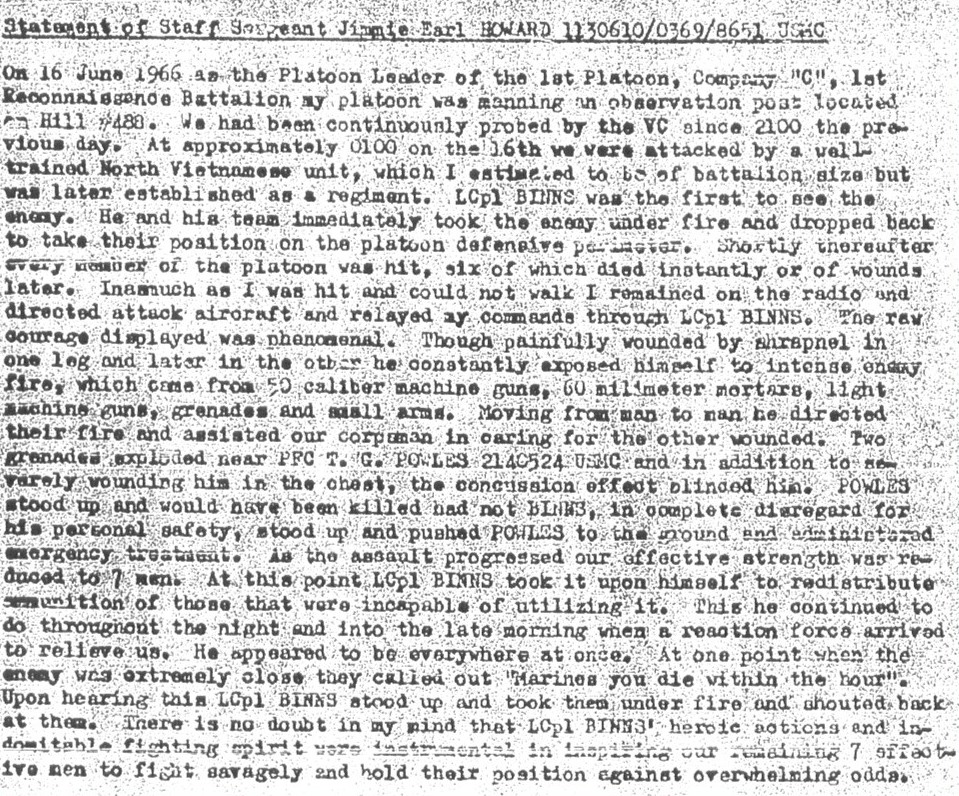
In June 1966, the 1st Marine Division was pushing its area of responsibility northward into Quang Tin Province, probing the rugged terrain between Tam Ky and Hiep Duc District. Brigadier General William A. Stiles had conceived Operation Kansas, an ambitious reconnaissance sweep designed to locate the headquarters of the PAVN 2nd Division somewhere near the Que Son Valley. The plan was methodical: first find the enemy, then engage with eight battalions of Marines and South Vietnamese infantry. Seven reconnaissance teams from the 1st Reconnaissance Battalion deployed into the hills around Nui Loc Son and Que Son on the afternoon of June 13, fanning out to ring the valley with eyes and ears. Most teams slipped in undetected. One was not so lucky -- a scout dog with an enemy patrol caught the scent of Marines near Hill 555, forcing that team into a hasty helicopter extraction back to Chu Lai. The platoon on Hill 488, led by Staff Sergeant Jimmie Howard, settled into their observation post on the rocky knoll and began watching the valley floor below.
The Longest Night
The warning came from an Army Special Forces team leading a patrol nearby. A full enemy battalion -- 200 to 250 fighters -- was moving toward the hilltop. At 10 p.m. on June 15, Lance Corporal Ricardo Binns squeezed the trigger of his M14 rifle and the battle began. What followed was a night of close-quarters violence so intense that fire support could not help without hitting the Marines themselves. The enemy had closed too fast, pressing in from all sides with DShK heavy machine guns and 60mm mortars pinning the Americans to the crest of the hill. Howard's platoon withdrew from their outer observation posts to the main position near a rocky knoll, drawing into a tight perimeter where every Marine could fight within arm's reach of the next. When ammunition ran low, they threw rocks to simulate grenades, buying seconds of hesitation from attackers who could not tell the difference in the dark. The fighting turned hand-to-hand in places, bayonets and rifle butts against an enemy that outnumbered the defenders more than ten to one.
Dawn and Deliverance
Through the night, the Marines held. When daylight finally broke on June 16, reinforcements arrived -- helicopters brought in an infantry company to relieve the battered platoon. The reconnaissance team was evacuated immediately, though the infantry remained to finish clearing the position. Against impossible odds, Howard's eighteen-man platoon had inflicted severe casualties on a force that vastly outnumbered them. Six Marines were killed in the fighting, and every survivor carried wounds. The desperate nature of the engagement, the refusal to give ground even when ammunition was exhausted, drew immediate comparisons to the Battle of the Alamo and the D-Day landings depicted in The Longest Day. But unlike the Alamo's defenders, these Marines walked -- or were carried -- off their hill alive.
The Honors They Earned
The decorations awarded to Howard's platoon reflected the extraordinary nature of their stand. Staff Sergeant Jimmie Howard was promoted to Gunnery Sergeant and traveled to the White House, where President Lyndon B. Johnson presented him with the Medal of Honor on August 21, 1967. A warship commissioned in 2001 would bear his name. Four Marines received the Navy Cross, the second-highest decoration for valor in the Navy and Marine Corps: Lance Corporal Ricardo Binns and Petty Officer Second Class Billee Don Holmes received theirs in person, while Corporal Jerrald Thompson and Lance Corporal John Adams were honored posthumously. The remaining thirteen members of the platoon all received Silver Stars -- four of those also posthumously -- along with two members of Company C who had supported the fight. In all, every single Marine on that hilltop was decorated for valor, a concentration of heroism almost without parallel in the Vietnam War.
A Hill in the Highlands
Today, Hill 488 sits quietly in what is now Quang Nam Province, the jungle long since reclaiming whatever scars the fighting left. The Que Son Valley stretches below, green and terraced with rice paddies, giving no outward sign of the violence that once swept through it. From the air, the hills of central Vietnam roll in endless succession, and there is nothing to distinguish this particular rise from any other -- no monument marks the spot, no plaque records what happened here. The story lives instead in the citations and the memories, in the accounts of Marines who threw rocks when their bullets ran out, who fought hand-to-hand on a hilltop they had no orders to defend but refused to surrender. The coordinates read 15.34 degrees north, 108.29 degrees east. The significance reads differently.
From the Air
Hill 488 is located at 15.34N, 108.29E in the Que Son Valley of central Vietnam, now part of Quang Nam Province. The terrain is mountainous with jungle-covered ridges. Best viewed from 3,000-5,000 feet AGL. Nearest major airport is Da Nang International (VVDN), approximately 60 nm to the north. Chu Lai airfield (former USMC base) is closer at roughly 25 nm southeast. The valley below features rice paddies and scattered settlements visible in clear conditions.