Battle of Hjorungavagr
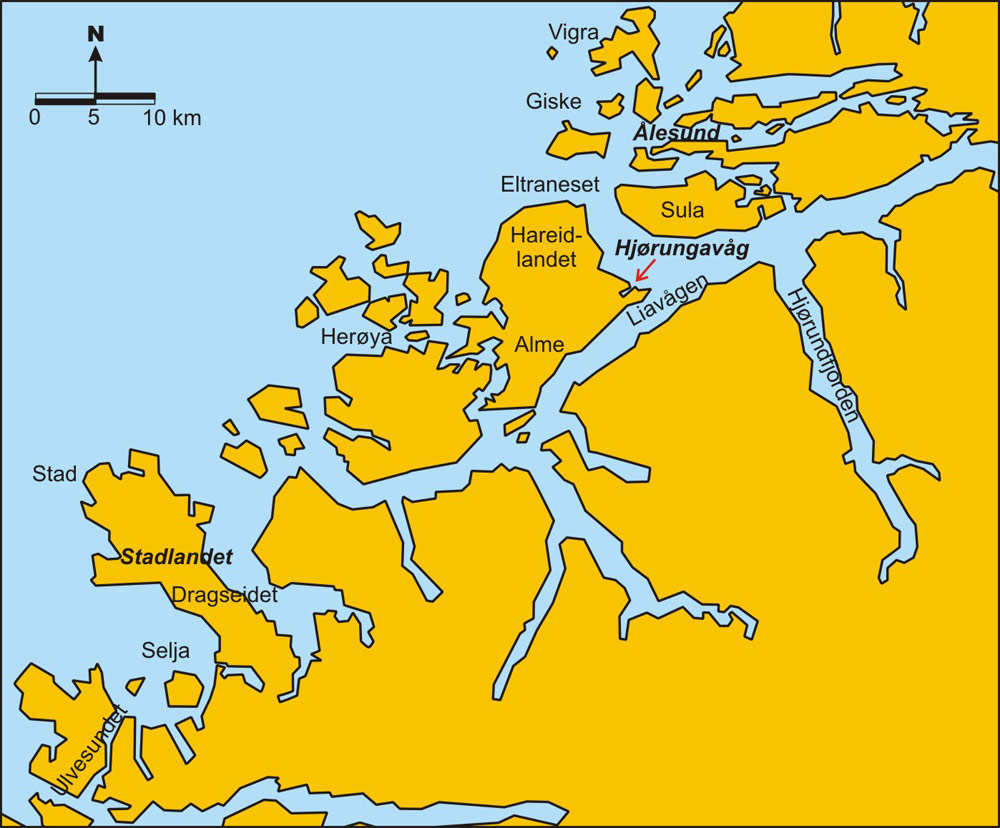
Somewhere in a bay on the coast of Sunnmore, around the year 986, the longships of Haakon Sigurdsson met a Danish invasion fleet led by the Jomsvikings, the most feared warrior brotherhood in Scandinavia. The exact location has been debated for centuries. The Jomsvikinga saga offers two contradictory descriptions: one places the bay on the landward side of the island of Hod, now called Hareidlandet in More og Romsdal; the other situates it between two islands whose names have fallen out of use entirely. What is not in dispute is the outcome. Haakon won, decisively, and Norway's independence from Denmark was secured for roughly fourteen years, until the Battle of Svolder reset the power balance once more.
A Vassal Who Worshipped the Old Gods
Denmark was the dominant Nordic power in the late tenth century. Southern Norway and the Oslo Fjord sometimes fell under direct Danish rule, and Haakon Sigurdsson governed the rest as a vassal of King Harald Bluetooth. In practice, Haakon operated with considerable independence, but the relationship had a breaking point: religion. Haakon was a committed believer in the Norse gods at a time when Harald Bluetooth was aggressively Christianizing his domain. Around 975, when Harald attempted to impose Christianity on his Norwegian vassal, Haakon broke his allegiance. The timing was shrewd. Harald had recently suffered defeat at the hands of Otto II, Holy Roman Emperor, in 974, and his weakened position gave Haakon an opening to act.
The Jomsvikings Sail West
Harald Bluetooth's response came in the form of the Jomsvikings, a legendary band of professional warriors based at the fortress of Jomsborg, whose exact location remains uncertain but is traditionally placed on the southern coast of the Baltic. Whether the Jomsvikings were a historical military order or a later literary invention has been debated by scholars, but the sagas present them as elite fighters bound by a strict code. The fleet they sent against Haakon represented Denmark's attempt to reassert control over Norway by force. The two navies met in Hjorungavagr, a bay surrounded by the islands and headlands of the Sunnmore coast, where the narrow waters would have favored close combat between ships lashed together in the Viking fashion.
Victory in the Bay
The details of the battle come filtered through saga literature rather than contemporary record, though several skaldic poets of the period allude to the fight. Thorthr Kolbeinsson and Tindr Hallkelsson composed verses that reference the engagement, and the Icelandic skald Einarr Helgason celebrated Haakon's triumph in the poem Vellekla. The Jomsvikingadrapa, by Bjarni Kolbeinsson, honors the fallen Jomsvikings. Heimskringla, Saxo Grammaticus's Gesta Danorum, and the Jomsvikinga saga all describe the battle, though they do not agree on every detail. What the sources share is the essential narrative: Haakon's fleet won a convincing victory, the Jomsvikings were broken, and Danish ambitions over Norway were put to rest for a generation.
Between History and Legend
The Battle of Hjorungavagr sits in the uncertain territory between documented history and literary tradition. Scholarly convention dates it to 986, supported by Saxo Grammaticus's placement of the battle during Harald Bluetooth's lifetime. The battle is described in the kings' sagas and has been the subject of poems, plays, and local tradition for a thousand years. A national monument now stands at Hjorungavag on the Sunnmore coast, marking the probable site. The bay itself, wherever precisely it lies among the islands, would have been typical of the landscape that shaped Viking naval warfare: sheltered enough for fleets to gather, narrow enough to force engagement, surrounded by mountains that turned sound back on itself. Haakon Sigurdsson remained Norway's sole ruler until his death around 995, and Denmark's claim was not pressed again until the Battle of Svolder, roughly fourteen years after the longships clashed in Hjorungavagr.
From the Air
Located at approximately 62.36N, 6.10E on the Sunnmore coast of western Norway, near the island of Hareidlandet in More og Romsdal county. The exact battle location is debated but is marked by the Hjorungavag National Monument on the coast. Best viewed below 5,000 ft to appreciate the island-studded coastline and sheltered bays. Nearest airports: ENAL (Alesund Airport, Vigra, approximately 15 nm north) and ENOV (Orsta-Volda Airport, Hovden, approximately 15 nm south). Expect maritime weather with frequent cloud cover. The complex coastline of islands, headlands, and narrow bays is characteristic of this stretch of Norway.