Battle of Holy Ground
Creek prophets drew circles in the dirt and chanted for days, weaving an invisible wall of spiritual protection around the bluff above the Alabama River. No American bullet could cross it, they promised. The warriors of Econochaca believed them. On December 23, 1813, General Ferdinand Claiborne's militia tested that faith with a thousand men, 150 Choctaw allies, and cold steel. The spiritual barrier did not hold. But what happened next -- a desperate horseback leap off the bluff into the river below -- became one of the most legendary escapes in American frontier history.
Sacred Ground Above the River
Econochaca sat on a bluff overlooking the Alabama River in present-day Lowndes County, about 30 miles west of modern Montgomery. The Red Stick Creek faction established the fortified settlement in the summer of 1813 under the direction of Josiah Francis, a prophet and war leader who believed the site could be made invulnerable through ceremony. The name itself carried weight: Econochaca translates not merely as 'holy ground' but more precisely as 'sacred or beloved ground' in the Muskogee language. It was one of three fortified encampments the Red Sticks built that summer, each defended by both physical barricades and spiritual ritual. Creek prophets performed elaborate ceremonies to create what they promised was an impenetrable barrier around the settlement -- a line no white soldier could cross and survive.
A War Born at Burnt Corn
The Creek War of 1813-1814 split the Creek Nation itself. The Red Sticks, traditionalists who rejected American expansion and cultural assimilation, clashed with Lower Creek leaders who sought accommodation. After the Battle of Burnt Corn in July 1813 -- a skirmish that escalated when American militia attacked a Red Stick supply party -- the conflict exploded. The Fort Mims massacre in August, where Red Sticks killed hundreds of settlers and mixed-blood Creeks, sent shockwaves through the Southern frontier. General Thomas Flournoy ordered Ferdinand Claiborne to assemble a force and strike back. By early December, Claiborne had gathered roughly a thousand men, bolstered by 150 Choctaw warriors under their renowned chief Pushmataha, a leader who had allied his people firmly with the Americans.
The Day the Barrier Fell
Claiborne's column reached the outskirts of Econochaca on December 22, making camp just south of the settlement. William Weatherford, the Red Stick war leader defending the site, commanded roughly 320 warriors -- outnumbered more than three to one. When scouts confirmed the American approach, Weatherford ordered the women and children evacuated. The next morning, December 23, Claiborne attacked. The spiritual barrier the prophets had promised proved no match for organized military assault. Between 20 and 30 Red Stick warriors fell. Claiborne lost a single man. The defeat shattered the Creek prophets' credibility as completely as it destroyed the settlement's physical defenses. American forces burned Econochaca to the ground and destroyed the Creek food supplies stored there, a blow that would haunt the Red Sticks through the winter.
Arrow Over the Bluff
As the battle turned, Weatherford found himself trapped on the bluff with American soldiers closing in. What followed became the stuff of frontier legend. Mounted on his grey horse Arrow, Weatherford charged toward the edge of the bluff and launched both horse and rider off the precipice and into the Alabama River below. The drop was estimated at roughly 20 feet. American soldiers fired at him as he fell. Both horse and rider survived the plunge, and Weatherford swam to safety on the far bank. The escape cemented Weatherford's reputation as one of the Creek War's most formidable figures. He would fight on until Andrew Jackson's decisive victory at Horseshoe Bend in March 1814, after which he surrendered personally to Jackson -- another encounter that passed into legend.
What Remains on the Bluff
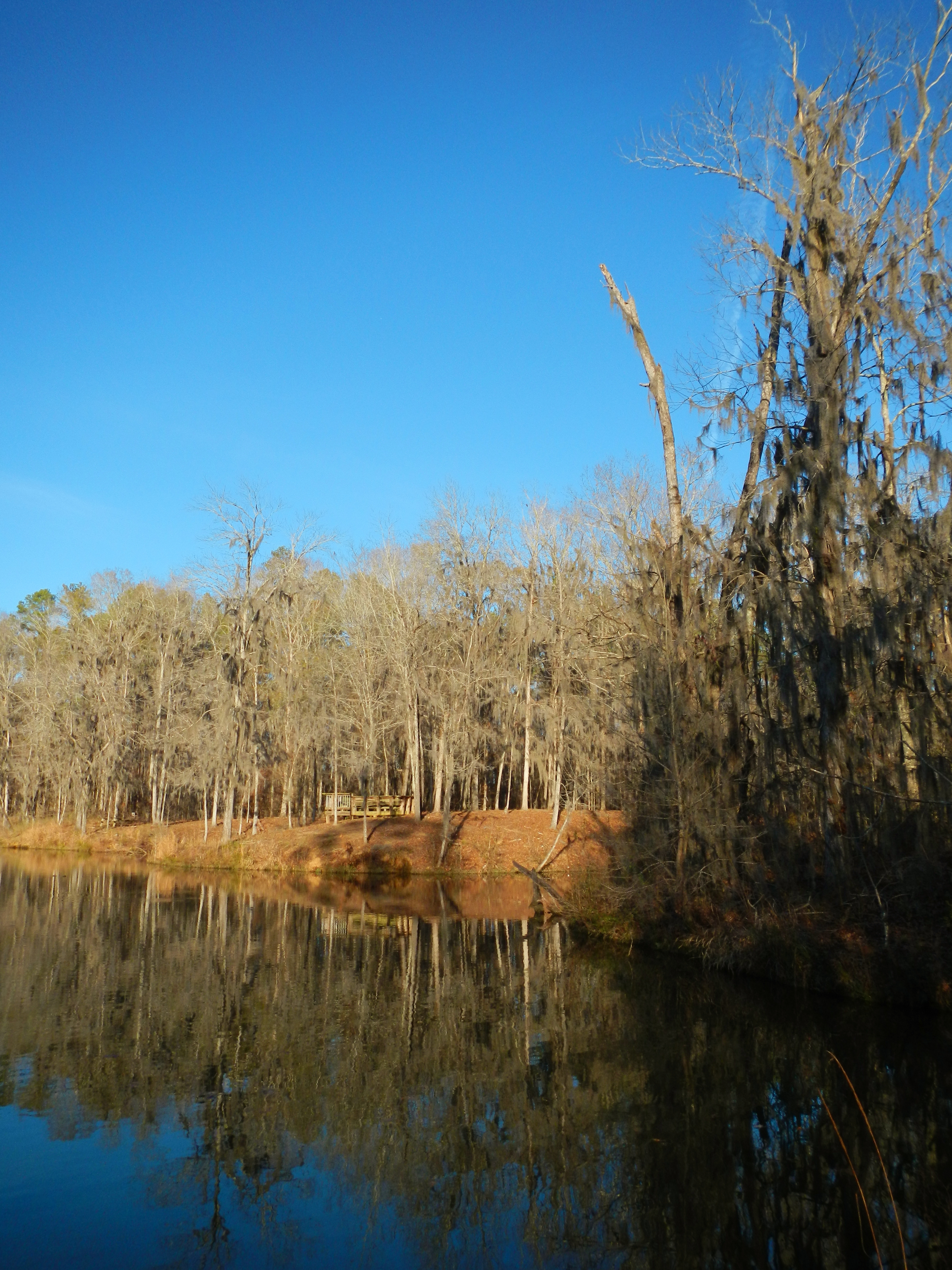
Today the site is preserved as Holy Ground Battlefield Park, maintained by the United States Army Corps of Engineers along the Alabama River. The park was added to the Alabama Register of Landmarks and Heritage on May 26, 1976. The bluff still rises above the slow brown river, and the terrain tells the tactical story plainly: the elevation that made Econochaca defensible also made Weatherford's escape so remarkable. Two active battalions of the Regular Army -- the 1st and 2nd Battalions of the 1st Infantry Regiment -- still carry the lineage of the old 3rd Infantry Regiment that fought here. In the quiet of central Alabama, where the river bends beneath old-growth timber, the ground remembers what the prophets once promised and what December 1813 delivered instead.
From the Air
Located at 32.353N, 86.692W on a bluff above the Alabama River in Lowndes County, approximately 30 miles west of Montgomery. The battlefield site sits along the river's meandering course through central Alabama's rolling terrain. From altitude, look for the river bend and the elevated bluff -- the same topography that shaped the 1813 battle. Nearest airport is Montgomery Regional (KMGM), about 30 miles east. Maxwell Air Force Base (KMXF) is also nearby. Best viewed at lower altitudes where the bluff and river relationship becomes clear.