Battle of Honsinger Bluff
The Ree scout grabbed the reins of Dr. John Honsinger's horse, pointed west, and said the only English words that mattered: "Indians, Indians." Honsinger, the 7th Cavalry's senior veterinary surgeon, heard gunfire in that direction and corrected the scout with the confidence of a man who understood nothing. "Cavalry, cavalry," he replied, and rode on toward the river to water his horse. He was dead within the hour. The Battle of Honsinger Bluff on August 4, 1873, is a footnote in the Indian Wars, overshadowed by the catastrophe that would consume George Armstrong Custer three years later at Little Bighorn. Yet the cast of characters assembling along the Yellowstone River that summer day reads like a dress rehearsal for disaster: Custer, his brother Tom, Sitting Bull, Crazy Horse, Rain in the Face. Many who survived this encounter would not survive the next.
Treaty Lands and Contested Ground
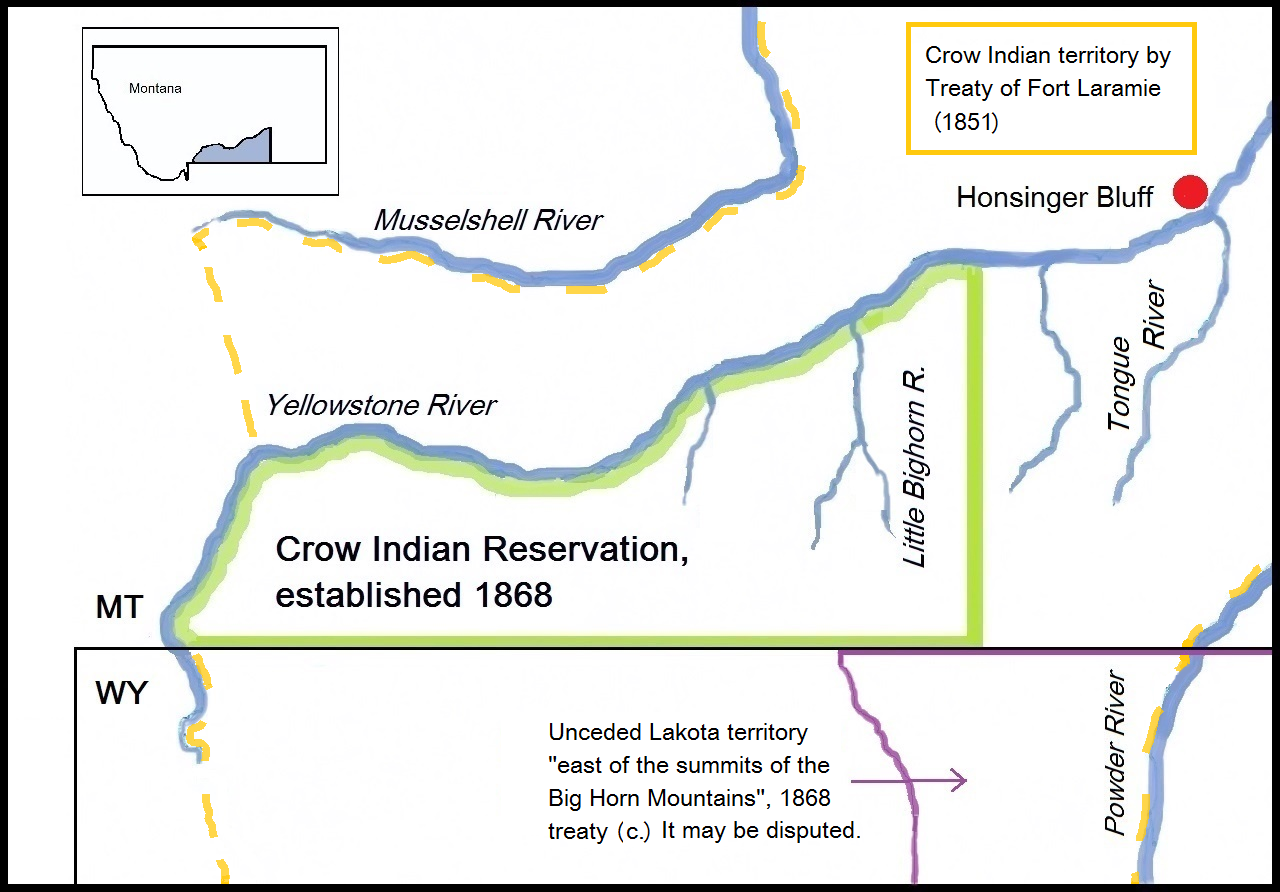
The battlefield near present-day Miles City, Montana, occupied territory with a complicated past. The 1851 Treaty of Fort Laramie had defined this as Crow country, a recognition the Lakota themselves acknowledged. But pressure from eastern tribes pushed westward by white settlement set off a cascade of displacement. The Crow may have settled the Yellowstone Valley only decades before Lewis and Clark arrived in 1804. When the Crow accepted a smaller reservation on May 7, 1868, the land north of the Yellowstone, including the future Honsinger Bluff, became United States territory. Nearly all the battles between the Army and the Lakota in the 1860s and 1870s occurred on lands the Lakota had taken from other tribes since 1851. The fight for the northern plains was a collision of expanding powers, and the massive gravelly hill the locals call Yellowstone Hill, now home to the Miles City Airport, would witness one of its violent episodes.
The Decoy and the Siege
Custer had led 86 men ahead of Colonel David S. Stanley's 1,300-man column, which was escorting a Northern Pacific Railway survey party. By noon on August 4, his troops were resting in a cottonwood grove along the Yellowstone, their horses grazing on the floodplain, some men napping, others fishing. Custer, with his characteristic instinct for danger, posted guard patrols. Scouts from Sitting Bull's village, estimated at 400 to 500 lodges, spotted the resting cavalry. Between 100 and 300 warriors hid in woods a mile west. A small band approached as decoys, luring Custer into pursuit, a tactic that had annihilated Captain William Fetterman's command in 1866. This time, when the hidden force broke from the woods, Custer retreated through a skirmish line his brother Tom had formed. The cavalry fell back to their cottonwood grove and formed a semicircular perimeter along a dry creek channel. For three hours in brutal heat, the Lakota besieged them, trying fire and flanking maneuvers, but the defensive position held.
The Ambush That Named a Bluff
While battle raged miles away, Dr. Honsinger and the regiment's sutler, Augustus Baliran, left the main column to water their horses, possibly to hunt for agates along the river. A New York Tribune correspondent had ridden with Honsinger that morning and described him as a portly, fine-looking man of about 55, devoted to his blooded horse with an extra-professional care that was love for its own sake. Two privates, Ball and Brown, had slipped away from their company to cool off and nap near the river. Rain in the Face and five warriors, serving as lookouts at the base of what is now called Honsinger Bluff, spotted the approaching riders. They hid amid rocks and scrub brush so effectively that they grabbed the reins of Honsinger's horse as he passed, pulling him from his mount and shooting him as he fell. Baliran and Private Ball were killed. Brown woke to witness the ambush, mounted bareback, and galloped toward the column screaming that all down there were killed.
A Vow of Revenge
Rain in the Face kept Honsinger's gold watch and later bragged about the killings. When Custer learned of the boasts, he sent Tom to arrest the warrior at the Standing Rock Reservation. Apprehended and jailed on December 13, 1874, Rain in the Face escaped within months and swore he would cut out Tom Custer's heart and eat it. The threat hung in the air for nearly two years. On June 25, 1876, George Custer, Tom Custer, and their brother-in-law James Calhoun all perished at Little Bighorn. Captain George Yates, who had guarded surveyors at Honsinger Bluff, fell there too. Sitting Bull, Crazy Horse, and Rain in the Face all fought in that annihilation. In later years, Rain in the Face claimed he had made good on his promise, that he had cut out Tom Custer's heart and bitten into it. Henry Wadsworth Longfellow immortalized the legend in his poem, and Dr. Honsinger's name remained attached to the bluff where his journey ended, a reminder of the day when a scout's warning went unheeded.
From the Air
Located at 46.49N, 105.92W near Miles City, Montana. The battlefield sits on the floodplain south of Yellowstone Hill, which now hosts Miles City Municipal Airport (KMLS). The distinctive gravelly hill dominates the landscape and is visible from considerable distance. The Yellowstone River flows to the south and east. Best viewed from the south or west to appreciate the terrain where Custer's forces held their defensive position. Terrain is relatively flat floodplain with cottonwood groves along the river. Elevation approximately 2,400 feet.