Battle of Hormozdgan: The Day Persia Changed Hands
Ardashir arrived early. The two kings had agreed to meet at the end of the month of Mihr -- April, by the modern calendar -- on the plain of Hormozdgan for a battle that would decide who ruled Iran. But Ardashir did not wait. He rode to the field before the appointed date, seized the best ground, dug a defensive ditch, and took control of the only spring. When Artabanus IV finally arrived with his larger army, the advantage had already shifted. On April 28, 224 AD, in a single day of cavalry combat near the Zagros foothills, the Parthian dynasty that had ruled Iran for nearly five centuries was destroyed, and a new empire was born.
A Dynasty Fracturing
The Arsacid Parthian Empire had been weakening from within. Around 208 AD, Vologases VI succeeded his father as king, but by 213 his brother Artabanus IV had launched a civil war. Artabanus prevailed, controlling most of the empire and even winning acknowledgment from Rome. He fought Caracalla's successor Macrinus to a standstill at Nisibis in 217, and a peace treaty left the Arsacids holding Mesopotamia. But while the brothers fought each other, a family from the province of Pars was rising. The Sasanians, based in the Persian heartland that had once produced Cyrus and Darius, began conquering neighboring territories. Their prince, Ardashir I, took Kirman and pushed outward. Artabanus IV did not take the threat seriously until it was too late.
Ten Thousand Against the King
The exact location of Hormozdgan has never been confirmed, but scholars believe it was near modern Ram-Hormoz, sixty-five kilometers east of Ahvaz, where a wide plain stretches at the foot of the Zagros chain. According to al-Tabari, whose account drew from Sasanian sources, Ardashir brought ten thousand cavalry. Some wore flexible chain armor similar to Roman designs. Artabanus commanded a larger force, but his soldiers wore heavy lamellar armor that proved cumbersome in the engagement. Ardashir's son Shapur, the future Shapur I, fought alongside his father. The battle was decided in a single day. Artabanus IV died on the field, and with him died the Arsacid claim to the throne.
King of Kings
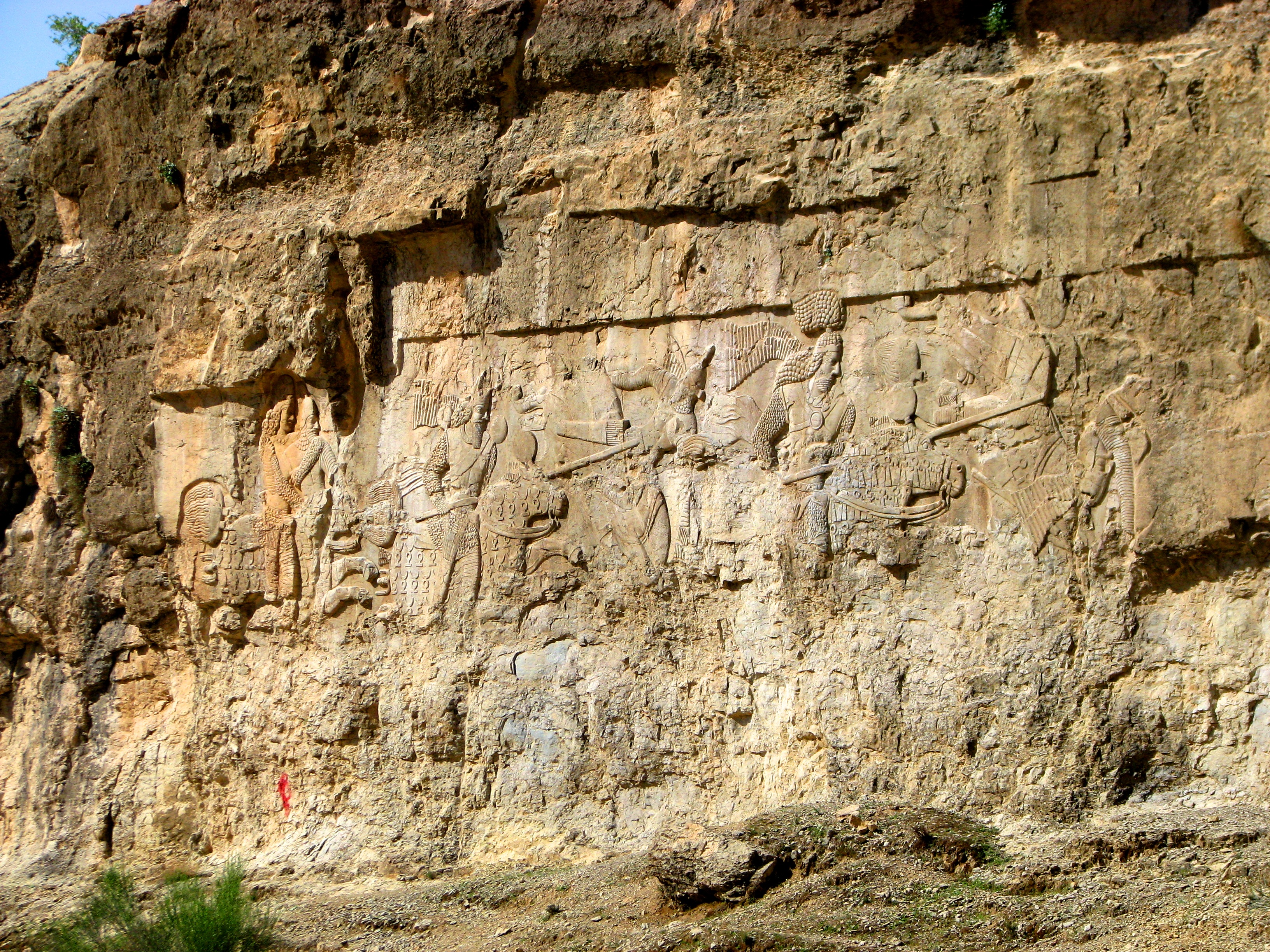
After the killing of Artabanus, Ardashir executed the dead king's chief secretary, Dad-windad, and assumed the title of shahanshah -- King of Kings. He began building what he called Iranshahr, a realm that would eventually stretch from the Euphrates to the Indus. To celebrate his victory, Ardashir commissioned two rock reliefs at his royal city of Ardashir-Khwarrah, present-day Firuzabad in Fars province. The first relief carves three scenes of personal combat into the cliff face: a Persian noble seizing a Parthian soldier, Shapur impaling Dad-windad with a lance, and Ardashir himself unhorsing Artabanus. The second shows Ardashir receiving the badge of kingship from the Zoroastrian god Ahura Mazda over a fire shrine, while Shapur and two other princes watch. These reliefs still survive, carved into the rock at Firuzabad.
An Empire of Persians and Parthians
The transition from Arsacid to Sasanian was less a revolution than a change of management. The Seven Great Houses of Iran, the Parthian noble families that had formed the backbone of Arsacid power, simply transferred their allegiance to the new dynasty. The early Sasanian army was identical to the Parthian one -- the same cavalry, the same nobles, the same tactics. Vologases VI, Artabanus's brother and rival, was driven from Mesopotamia by 228, but the Parthian aristocracy continued to serve. Historians have called the result "the empire of the Persians and Parthians." Memories of the Arsacids never entirely faded. In the late sixth century, Parthian dynasts Bahram Chobin and Vistahm attempted to restore the old empire. They failed, but the attempts show that Hormozdgan did not erase the past so much as redirect it. The Sasanian Empire that Ardashir founded would endure for 427 years, until the Arab conquests of the seventh century.
From the Air
The battle took place near modern Ram-Hormoz (Ramhormoz) at approximately 32.05°N, 48.85°E, in a wide plain at the foot of the Zagros Mountains in Khuzestan province, Iran. The flat terrain east of Ahvaz, ideal for the cavalry engagement described in historical sources, is visible from altitude as open lowland meeting the Zagros foothills. Nearest airport is Ahvaz International Airport (OIAW), about 65 km to the west. The rock reliefs commemorating the battle are at Firuzabad (OIYF area) in Fars province, approximately 350 km to the southeast. Best viewed at 8,000-15,000 feet to appreciate the plain's suitability for mounted warfare.