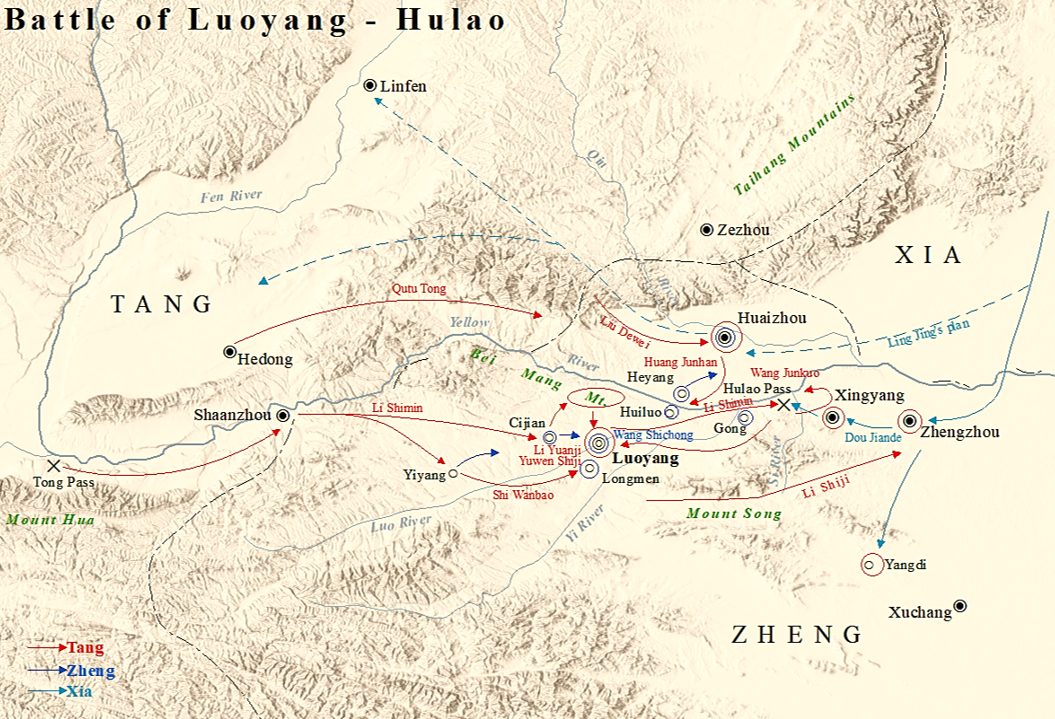
Battle of Hulao
On the morning of May 28, 621 AD, an army of over 100,000 soldiers under Dou Jiande, ruler of the Xia kingdom, arrayed itself for battle on the open plain before the Hulao Pass. Facing them, entrenched in the narrow defile where the mountains met the Yellow River, was a far smaller Tang force commanded by 22-year-old Prince Li Shimin -- the man who would become Emperor Taizong, perhaps the most celebrated ruler in Chinese history. What happened over the next several hours would determine whether China remained a patchwork of warring successor states or became a unified empire once more.
The Tiger's Prison
Hulao Pass -- the name translates roughly as "Tiger's Prison" -- was one of the most strategically important positions in ancient China. Located where the Songshan mountain range meets the Yellow River plain, it controlled the eastern approach to Luoyang, the ancient capital. Li Shimin understood this geography perfectly. In August 620, he had launched his campaign westward, quickly besieging Wang Shichong, the ruler of the rival Zheng state, inside Luoyang. When Zheng's appeals for help brought Dou Jiande's massive Xia army marching from Hebei, Li made a decision that his own generals thought was madness: rather than lifting the siege and retreating to the Tang heartland in Shanxi, he would maintain the siege of Luoyang with the bulk of his army while personally leading a small cavalry force east to block the Xia at the Hulao Pass. He would fight on two fronts simultaneously, outnumbered at both.
The Patience of a Prince
For weeks, the two armies stared at each other across the approaches to Hulao Pass. Li Shimin refused to fight in the open, knowing that his smaller force would be overwhelmed on flat ground. Dou Jiande, for reasons historians still debate, refused to bypass the pass and redirect his offensive northward into Shanxi, where the Tang heartland lay essentially undefended. The stalemate suited Li perfectly. He used the time to study Xia troop movements, probe their formations, and let impatience erode Dou Jiande's army. His strategy was not simply defensive. At the end of May, Li executed a feint, making it appear that a large portion of his cavalry had departed the pass. The ruse was designed to bait Dou Jiande into committing to a full assault -- an assault that would require the Xia army to stand in formation for hours on open ground, waiting for the order to advance.
Noon at the Pass
It worked. On the morning of May 28, Dou Jiande ordered his army into battle formation and issued a challenge. Li did not respond. The Xia troops stood in the sun, weapons ready, as the morning dragged on. By noon, unit cohesion had begun to fray -- soldiers who had been standing at attention for hours were hungry, tired, and losing focus. At that moment, Li launched a cavalry probe. It was not a full charge but a test, a poke at the Xia lines to see how they would react. When the probe revealed that the waiting army was no longer capable of coordinated resistance, the Tang cavalry surged forward in a general attack. The collapse was swift and catastrophic. The Xia army, which had outnumbered the Tang force by perhaps ten to one, disintegrated. Dou Jiande himself was captured. Within days, Wang Shichong -- now besieged in Luoyang with no hope of relief -- surrendered as well. Li Shimin had defeated two rival kingdoms in a single campaign.
The Dynasty That Followed
The Battle of Hulao effectively ended the chaos of the Sui-Tang transition and cleared the path for the Tang dynasty to unify China. Li Shimin, already the most capable military commander in the Tang ruling family, leveraged his battlefield triumphs into political power. Five years later, in 626, he seized the throne from his father and elder brother in the violent Xuanwu Gate Incident. As Emperor Taizong, he presided over one of the most celebrated reigns in Chinese history -- an era of territorial expansion, cultural flourishing, and institutional reform that made the Tang dynasty synonymous with Chinese civilization at its peak. It began here, at a mountain pass overlooking the Yellow River plain, where a young prince bet everything on the proposition that an army's patience would break before his own.
From the Air
Located at 34.84°N, 113.22°E near the Hulao Pass, where the Songshan Mountains approach the Yellow River in western Henan province. The narrow terrain between mountain and river that made this position strategically decisive is clearly visible from altitude. Zhengzhou Xinzheng International Airport (ICAO: ZHCC) is approximately 70 km to the east-southeast. Luoyang Beijiao Airport (ICAO: ZHLY) is about 80 km to the west.