Battle of Ia Drang
Joseph Galloway, the only civilian to receive a Bronze Star for heroism during the Vietnam War, called it "the battle that convinced Ho Chi Minh he could win." In November 1965, at the eastern foot of the Chu Pong Massif in Vietnam's Central Highlands, American and North Vietnamese soldiers fought the first large-scale engagement of the war across a series of jungle clearings designated by letters of the NATO phonetic alphabet. The names LZ X-Ray and LZ Albany would become synonymous with both extraordinary courage and devastating ambush, and the battle's lessons would echo through every firefight that followed for the next decade.
Into the Valley
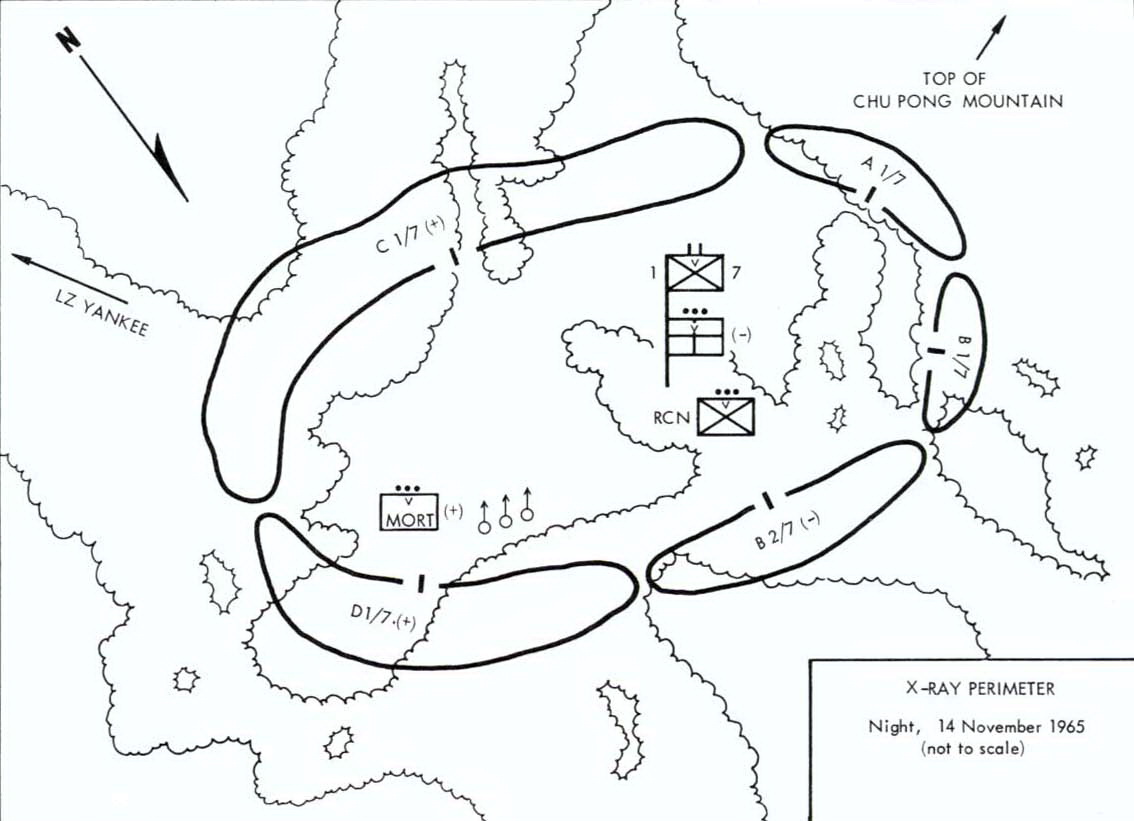
The Ia Drang Valley had already earned its reputation. Vietnamese communist forces had operated in the Central Highlands during the First Indochina War against the French, winning a devastating victory at the Battle of Mang Yang Pass in 1954 that destroyed an entire French mobile group. A decade later, the People's Army of Vietnam had rebuilt military infrastructure across the same terrain. The U.S. command saw the area as an ideal proving ground for a revolutionary concept: air mobility. Helicopters would replace roads, allowing troops to leap over the jungle canopy and strike where the enemy gathered. On November 14, Lieutenant Colonel Hal Moore led the 1st Battalion, 7th Cavalry Regiment into LZ X-Ray, a flat clearing bordered by a dry creek bed at the base of the Chu Pong Massif. His men landed roughly 200 meters from the position of the PAVN 9th Battalion, 66th Regiment. Within minutes, a captured deserter revealed that three North Vietnamese battalions occupied the massif above them, an estimated 1,600 troops against fewer than 200 Americans on the ground.
The Lost Platoon
What followed at X-Ray became one of the most documented small-unit actions in military history. Lieutenant Henry Herrick's 2nd Platoon, B Company, pursuing fleeing PAVN soldiers, pushed too far forward and was cut off from the battalion by roughly 100 meters of jungle. Within 25 minutes, Herrick was dead, along with Sergeants Carl Palmer and Robert Stokes. Command fell to Sergeant Ernie Savage, a squad leader who happened to be near the radio. Eight men were killed and thirteen wounded, the survivors huddled on a small knoll in a clearing. Savage called in artillery strikes around his own position throughout the night, placing the rounds so precisely that the platoon survived three major PAVN assaults without additional casualties. Under a bright moon, PAVN forces probed the American perimeter using bugles to coordinate their movements. The M60 machine gun crews held their fire to conceal their positions, waiting for orders that sometimes came only at the last possible moment. Moore's men held LZ X-Ray for three days, sustained by air power, artillery from Fire Support Base Falcon eight kilometers to the northeast, and the extraordinary flights of helicopter pilots Ed Freeman and Bruce Crandall, who made 14 and 22 volunteer runs respectively into the landing zone in unarmed Hueys while medevac helicopters refused to approach.
Slaughter at Albany
The second engagement proved far more costly. On November 17, the 2nd Battalion, 7th Cavalry, under Lieutenant Colonel Robert McDade, was marching toward LZ Albany, roughly 2.5 kilometers northeast of X-Ray. The column stretched through dense jungle, with little air cover overhead since B-52s were running bombing strikes on the Chu Pong Massif behind them. A reconnaissance platoon leader, Lieutenant Pat Payne, stumbled upon a PAVN soldier resting near some termite hills and tackled him. His sergeant captured a second soldier ten yards away. McDade halted the column and moved forward to interrogate the prisoners personally. That pause proved fatal. PAVN troops of the 8th Battalion ran down the length of the strung-out American column, units peeling off to attack the outnumbered soldiers at close range. At such intimate distances, American artillery and air support became useless. The fighting devolved into hand-to-hand combat. The 2nd Battalion suffered a casualty rate exceeding 50 percent before reinforcements from the 1st Battalion, 5th Cavalry could fight their way through. The total American dead for the campaign reached 305 killed and 524 wounded.
Lessons Written in Blood
Ia Drang established the template for the entire war. The Americans would rely on air mobility, artillery, and close air support, projecting devastating firepower from helicopter-borne positions. The North Vietnamese would counter by engaging at the closest possible range, neutralizing that firepower advantage by staying so near the Americans that bombs and shells could not be used without killing friendly troops. Both sides drew confidence from the battle. American commanders pointed to the kill ratios at X-Ray and the effectiveness of the new airmobile doctrine. The North Vietnamese recognized that by accepting heavy casualties and closing to intimate range, they could negate American technological superiority and inflict losses that would eventually erode American political will. News reporter Galloway, who carried wounded soldiers to aid stations under fire and watched Private First Class Jimmy Nakayama of Rigby, Idaho die two days after being hit, wrote that the death toll spoke for itself: 234 Americans killed, perhaps 2,000 North Vietnamese. Both numbers represented real people, many of them young men who had been civilians months earlier.
Where the Ia Drang Still Flows
In 1994, Moore and Galloway returned to the Ia Drang Valley with veterans from both sides, a journey that took a year to arrange since the United States and Vietnam did not yet have diplomatic relations. The clearings where hundreds had died were quiet jungle again. Moore's account, co-written with Galloway as "We Were Soldiers Once... And Young," became the definitive record of the battle and was adapted into the 2002 film starring Mel Gibson. Freeman and Crandall received their Medals of Honor decades after the fact, in 2001 and 2007 respectively. The valley itself, viewed from the air, reveals little of what happened. The Chu Pong Massif rises to the west, the Ia Drang River winds through its northern edge, and the landing zones have long since been reclaimed by the forest. But the names endure: X-Ray, Albany, Falcon. And on the Vietnam Veterans Memorial in Washington, the names of 2nd Lieutenant John Geoghegan and Private Willie Godbolt appear side by side, as they fell side by side when Geoghegan rushed to help his wounded comrade.
From the Air
Located at 13.58°N, 107.72°E at the eastern foot of the Chu Pong Massif in Vietnam's Central Highlands. The terrain is dense jungle interspersed with clearings, at elevations of 200-700 meters. The Ia Drang River flows roughly 2 km northwest of the former LZ X-Ray site. Nearest major airport is Pleiku (VVPK), approximately 50 km to the northeast. The Cambodian border lies just to the west. Best viewed in the dry season (November-April) when cloud cover is minimal.