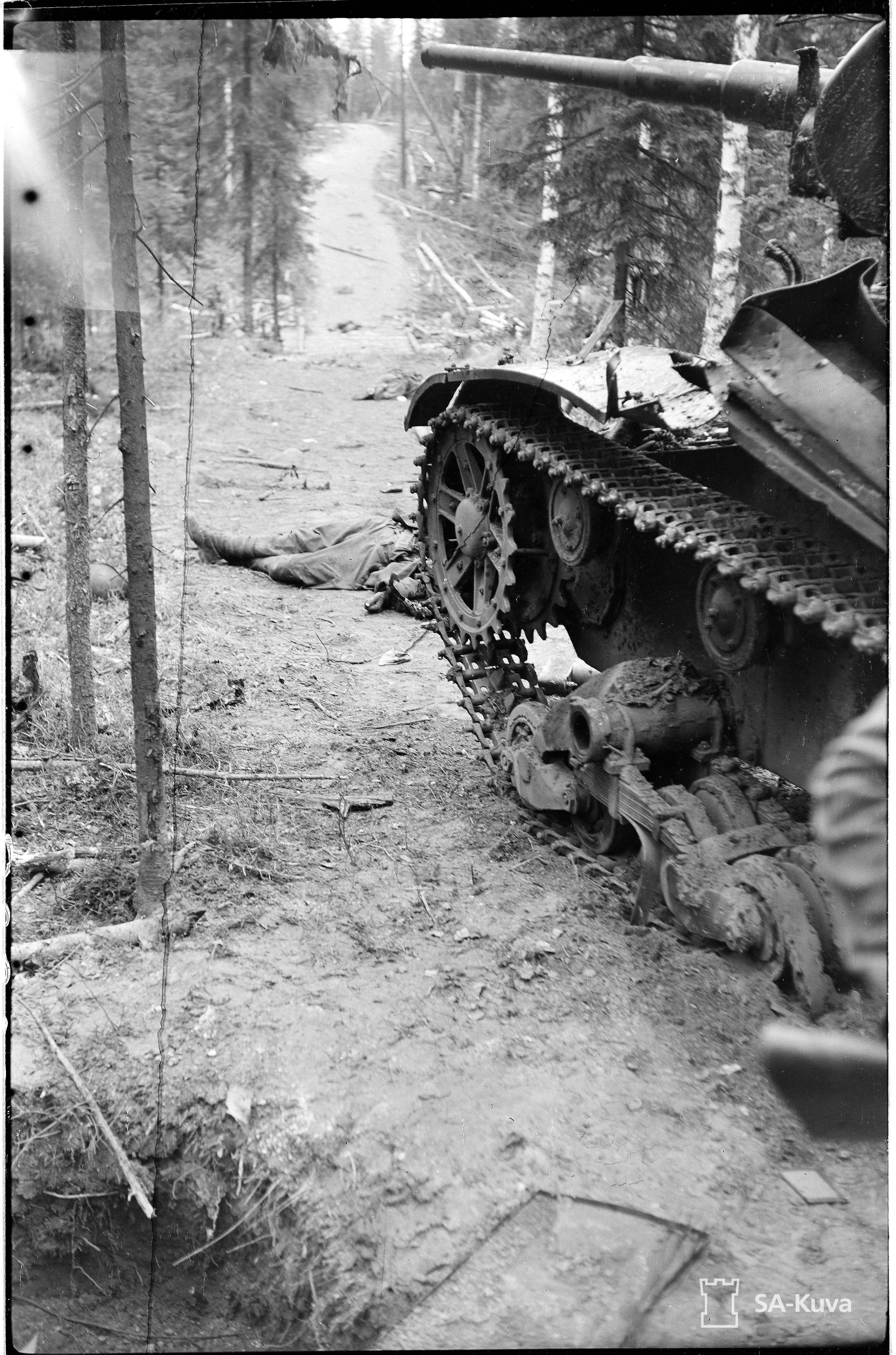
Battle of Ilomantsi (1944)
Among the soldiers fighting in the reconnaissance company at Ilomantsi in the summer of 1944 was a young man named Mauno Koivisto, who would one day become President of Finland. His company commander was Captain Lauri Torni, a war hero and Knight of the Mannerheim Cross who later served in the United States as a Green Beret under the name Larry Thorne. These two men, whose paths would diverge so dramatically after the war, fought together in the forests of North Karelia during the battle that decided whether Finland would survive as a sovereign nation. From 26 July to 13 August 1944, Finnish forces encircled and routed two Soviet divisions in what became the last major engagement of the Continuation War.
The Soviet Tide Reaches Its Mark
The Svir-Petrozavodsk Offensive of summer 1944 was the Soviet Union's attempt to knock Finland out of the war. After the Red Army launched its all-out offensive in June, Finnish forces were pushed back across a broad front. On 21 July, Soviet units reached the Finnish-Soviet border of 1940 for the only time during the entire 1944 offensive -- the furthest the Red Army had advanced since 1941. The sole Finnish unit defending against this push was the 21st Brigade, roughly 7,000 men holding an area 40 kilometers wide and 30 kilometers deep near the village of Ilomantsi. The situation was critical. If the Soviet advance continued, it would unravel Finland's defensive line in the east.
Raappana's Gamble
Major General Erkki Raappana, a Knight of the Mannerheim Cross and one of Finland's most experienced field commanders, was given command of the hastily assembled Group Raappana and tasked with stopping the Soviet advance. When the Cavalry Brigade arrived from the stabilized Karelian Isthmus front, Finnish strength rose to roughly 13,000 men against a combined Soviet force that would eventually exceed 20,000. On 31 July, Raappana launched his counterattack. The plan was audacious: fast-moving battalions from the Cavalry Brigade would drive between the Soviet 176th and 289th Rifle Divisions like a wedge, cutting them off from each other and from their supply lines. It was the same motti encirclement tactic that had devastated Soviet columns during the Winter War five years earlier.
The Encirclement
By 1 August, Finnish forces had cut the sole road leading to the 176th Rifle Division. Two days later, both Soviet divisions were encircled. The Jaeger Battalion 6 fought the opening battles, while the Uusimaa Dragoon Regiment attacked through the Utrio area between the lakes, flanked by Jaeger Battalion 1. Finnish guerrilla detachments disrupted Soviet supply lines with devastating effect. Lieutenant Heikki Nykanen, another Knight of the Mannerheim Cross, led a detachment that destroyed a convoy of 30 trucks carrying artillery ammunition to the front. Without those shells, Soviet artillery fell nearly silent. Raappana's forces fired over 36,000 artillery rounds in ten days; the Soviets managed only 10,000.
Escape Through the Forest
The Soviets deployed three naval infantry brigades with armor support to break open the encirclement, but Finnish forces held the roads. Faced with destruction, the encircled Soviet troops abandoned their heavy equipment -- over 100 pieces of artillery, approximately 100 mortars, and vast quantities of ordnance -- and fled through the dense forests. The Finnish troops guarding the perimeter could not contain organized breakouts in such thick terrain, and many Soviet soldiers escaped to their own lines by 10 August. Over 3,200 Red Army soldiers were killed, with thousands more wounded or missing. The two Soviet divisions were effectively destroyed as fighting formations.
Finland Won the Peace
Ilomantsi was the ninth major Finnish defensive victory in just weeks following the main Soviet offensive of June 1944. Moscow could only conclude that Finland had plenty of fight left. The armistice came in early September, and Finland preserved its independence -- the only continental European country bordering the Soviet Union to do so. Fifty years later, President Koivisto returned to Joensuu to mark the anniversary. The Finns, he said, were extremely hard-pressed but did not capitulate. Prime Minister Esko Aho went further: he saw not defeat in the summer's battles but the victory of a small nation over a major power. Finland was not beaten militarily, he declared. Finland won the peace. The forests of Ilomantsi, where the last Soviet attack was stopped and turned back, remain the quiet ground on which that peace was built.
From the Air
Located at 62.72N, 31.53E near Ilomantsi in North Karelia, eastern Finland, close to the Russian border. The terrain is dense boreal forest with lakes and limited road access. Recommended viewing at 3,000-5,000 feet to see the lake-and-forest corridor where encirclement operations occurred. Nearest airport: Joensuu (EFJO), approximately 70 km southwest. The Finnish-Russian border runs nearby. The landscape of forest, lakes, and narrow road corridors that defined the battle's encirclement tactics is clearly visible from the air.