Battle of Inchon
Every senior military adviser told Douglas MacArthur it could not be done. Incheon's harbor had tidal variations of over 30 feet -- among the most extreme in the world. At low tide, the approaches turned into vast, impassable mudflats extending miles from shore. The channel was narrow, winding, and easily mined. The seawall at the harbor required scaling ladders. And the tidal window allowed landing craft to operate for only a few hours before they would be stranded. MacArthur listened to all of this, and on September 15, 1950, he sent 75,000 troops and 261 naval vessels straight at it. The gamble worked. Within two weeks, Seoul was recaptured and the Korean War had been turned inside out.
A Desperate Calculus
By late summer 1950, the war was going badly. North Korean forces had driven the UN and South Korean defenders into a shrinking rectangle around Pusan on the southeastern tip of the peninsula. The Pusan Perimeter held, but barely. MacArthur, commanding UN forces from Tokyo, conceived an operation of breathtaking audacity: rather than reinforce the perimeter, he would strike 150 miles behind enemy lines at Incheon, the port city serving Seoul. If successful, the landing would sever the North Korean army's supply lines and trap its forces between two fronts. The Joint Chiefs of Staff were skeptical. The Navy was alarmed by the tidal conditions. Even MacArthur's own staff had reservations. The general responded that the very improbability of the attack was what made it viable -- the North Koreans would never expect an assault at such an unfavorable location. He called the operation Chromite.
Over the Seawall
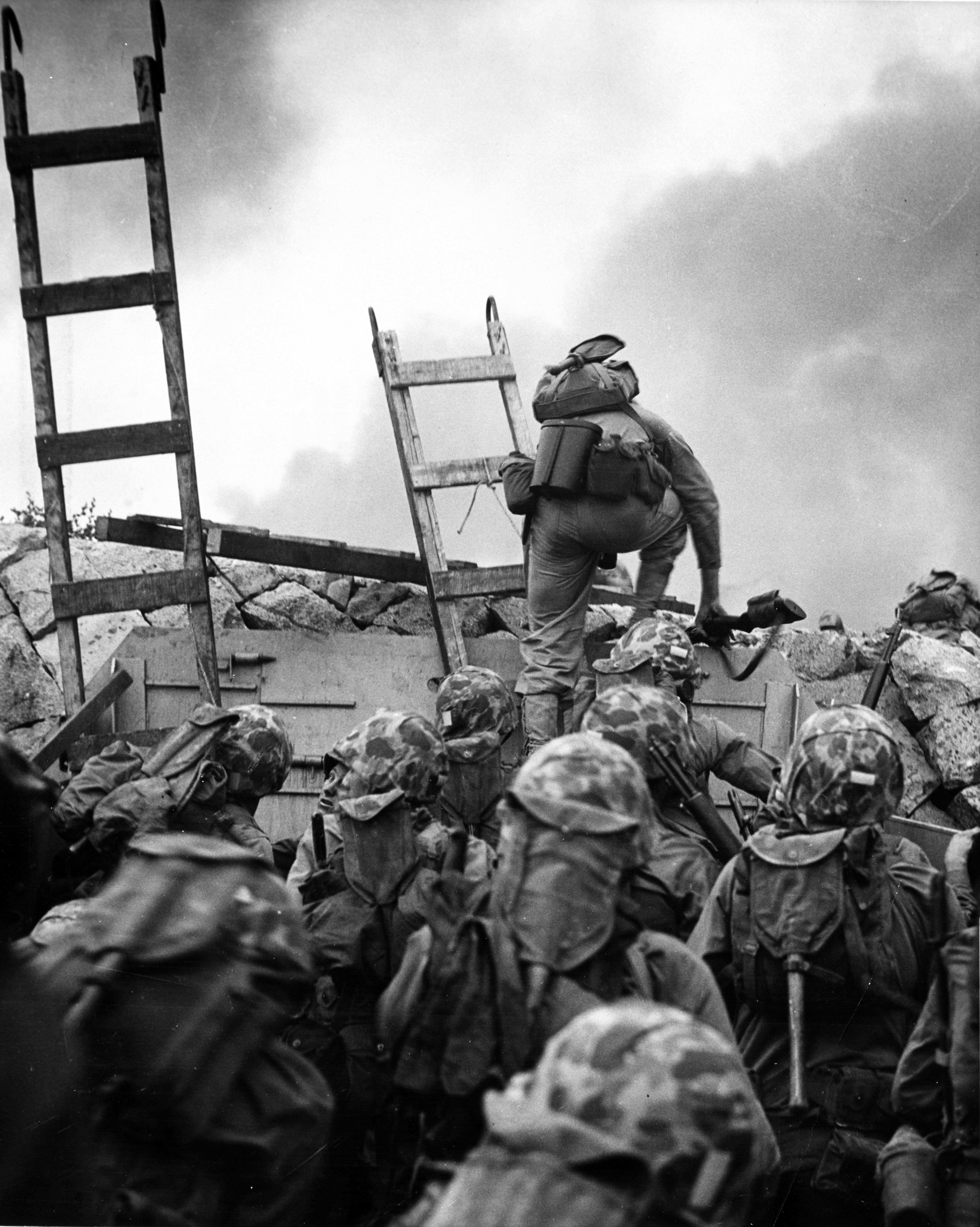
The assault began before dawn on September 15. Marines of the 1st Marine Division hit Wolmi-do, a fortified island controlling the harbor entrance, at morning high tide. Wolmi-do fell within hours, its garrison overwhelmed. Then came the agonizing wait: the tide retreated, stranding the landing force on the island for the entire day while the rest of the invasion fleet sat offshore. When the evening high tide returned at 5:31 PM, the main assault waves hit Red Beach and Blue Beach simultaneously. At Red Beach, Marines charged over the seawall using ladders while naval gunfire and aircraft strikes pounded the defenses. The fighting was fierce but brief. Incheon's garrison of roughly 6,500 troops, a mixture of regular soldiers and impressed laborers, was caught unprepared for an assault that even the Americans had considered nearly impossible. By midnight, the beachheads were secure.
The Collapse
What followed the landing was a strategic avalanche. UN forces pushed inland from Incheon toward Seoul with a speed that shattered North Korean command structures. Kimpo Airfield, one of the largest in Korea, fell on September 17. The battle for Seoul itself was savage -- North Korean defenders fought building by building through the capital -- but by September 28, the city was declared recaptured. Meanwhile, the Eighth Army broke out of the Pusan Perimeter and drove northward. The North Korean army, its supply lines severed and its rear areas in chaos, collapsed. Within a month of the Incheon landing, 135,000 North Korean soldiers had been taken prisoner. The strategic reversal was total. An army that had spent three months advancing to the verge of victory found itself in headlong retreat.
The Weight of Audacity
Incheon stands as one of the most decisive amphibious operations in military history, frequently compared to the Normandy landings for its strategic impact. MacArthur's willingness to stake everything on a single bold stroke transformed a losing war into a rout -- though the triumph would prove temporary. Chinese intervention in November 1950 would reverse fortunes once again, eventually grinding the conflict into the stalemate that persists to this day. The city of Incheon itself bears the scars and the memory. What was a battered port in 1950 has grown into a metropolitan area of nearly three million people, home to South Korea's main international airport. The harbor where Marines scaled seawalls with wooden ladders now handles container ships from around the world. But the tides still come and go as they always have, the mudflats still emerge twice daily, and the geography that made MacArthur's gamble so improbable remains exactly as it was.
From the Air
Located at 37.48N, 126.63E on the western coast of South Korea, roughly 30 km west of Seoul. Incheon International Airport (RKSI), South Korea's primary international airport, is located on reclaimed land in Incheon's harbor area. The port and harbor are clearly visible from altitude, with the tidal mudflats prominent at low tide. Wolmi-do island, site of the initial Marine assault, is connected to the mainland by a causeway. Seoul Air Base (RKSM) and Gimpo International Airport (RKSS) are also nearby. Recommended viewing altitude: 5,000-8,000 feet for harbor overview.