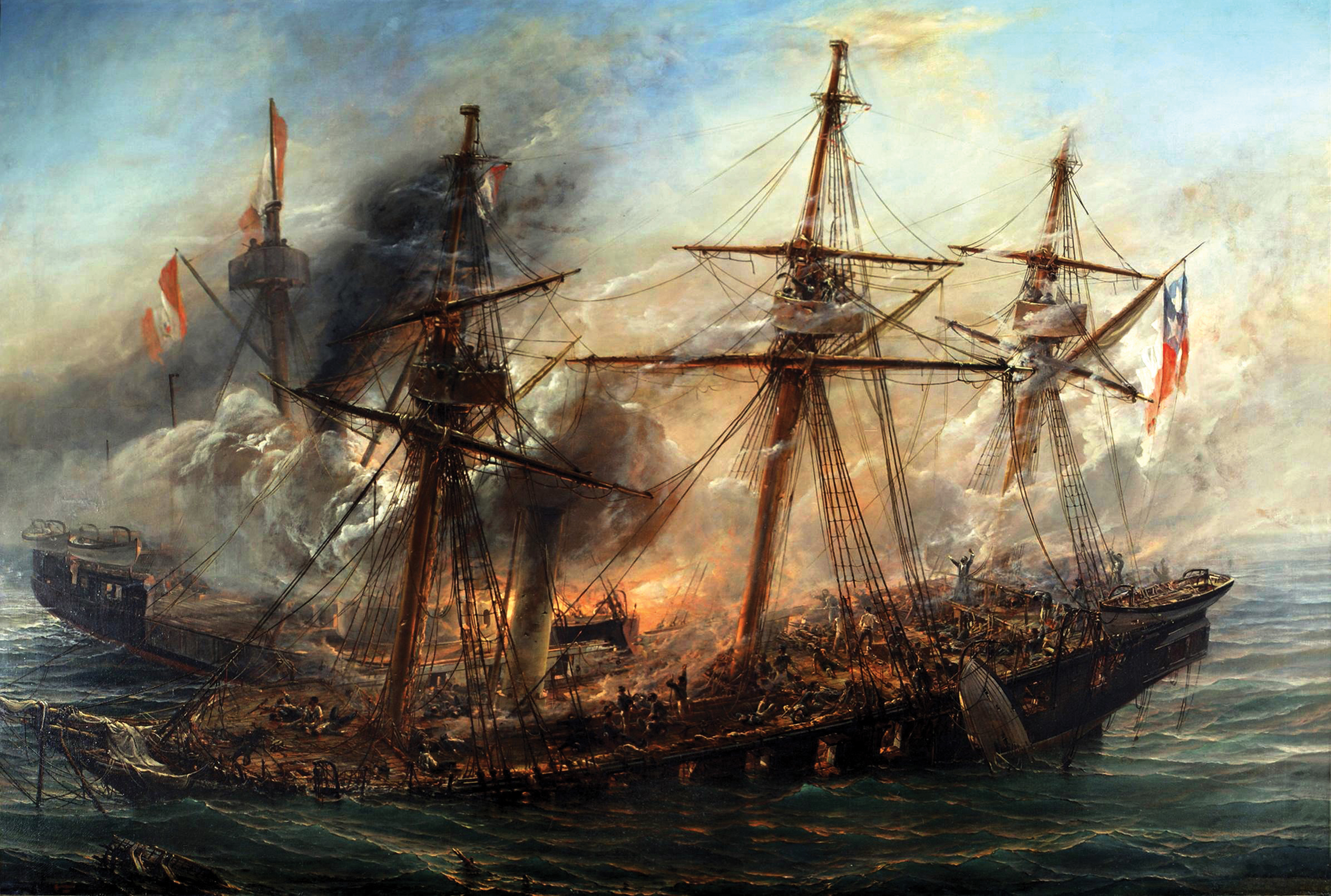
Battle of Iquique
At 12:10 p.m. on May 21, 1879, the Chilean flag nailed to the mizzen mast of the corvette Esmeralda slipped beneath the Pacific. It was the last piece of the ship to disappear. Hours earlier, her captain, Arturo Prat, had jumped onto the deck of the Peruvian ironclad Huascar with sword drawn and been shot dead -- a gesture so reckless, so futile, and so brave that it would define Chilean patriotism for the next century and a half. The newspapers would coin a new word for what he inspired: Pratiotism.
A War Over White Gold
The War of the Pacific began, as South American wars often did, over minerals. When Bolivia threatened to confiscate the Antofagasta Nitrate and Railway Company -- a Chilean and British mining venture -- Chile seized the port of Antofagasta on February 14, 1879. Bolivia declared war. Peru, bound by a secret 1873 treaty, was drawn in. Control of the sea would decide everything: the nitrate fields of the Atacama lay far from any capital, and whoever commanded the Pacific coast commanded the supply lines. Chilean admiral Juan Williams Rebolledo sailed north with his main fleet to challenge the Peruvian Navy at Callao, leaving two aging wooden ships -- the corvette Esmeralda and the schooner Covadonga -- to blockade the Peruvian port of Iquique. It was not intended as a serious fight. But the Peruvian ironclads Huascar and Independencia, commanded by Rear Admiral Miguel Grau, had slipped south undetected.
Fog, Smoke, and a Captain's Promise
Dense marine fog blanketed the harbor that morning. When it lifted at 6:30 a.m., the Covadonga's lookout shouted "Smoke to the north!" -- and through a telescope, her crew identified the approaching silhouettes as the Peruvian squadron. Captain Prat understood immediately what this meant. The Esmeralda, a wooden corvette built in 1854, armed with twelve 40-pound rifled cannons, faced the Huascar, an iron-hulled monitor carrying two 300-pound guns and a Gatling gun. There was no question of winning. Prat gathered his crew and told them: "The struggle will be against the odds, but cheer up, and have courage. Never has our flag been hauled down in the face of the enemy. For my part, as long as I live, this flag will fly in its place, and if I should die, my officers shall know how to fulfill their duties." On the Huascar, Grau rallied his own crew with equal conviction: "No matter what the outcome, Peru will not fall."
Four Hours of Unequal Combat
The fighting began at 8:15 a.m. Prat positioned the Esmeralda close to shore, forcing the Huascar to fire in parabolic arcs to avoid hitting the Peruvian village whose residents had gathered on the beach to watch. For ninety minutes, the Peruvian gunners, inexperienced with their Coles turret, failed to find their target. Chilean cannons pounded the Huascar's armor to no effect. When a boiler explosion reduced the Esmeralda's speed to two knots, Grau ordered the Huascar to ram. The impact killed forty to fifty Chilean sailors. Prat, shouting "Let's board, boys!" leaped across -- but only one man followed him in the chaos. Prat was shot dead on the Huascar's deck. The Esmeralda refused to surrender. Sublieutenant Ignacio Serrano led eleven men in a second boarding attempt; all fell to the Gatling guns. After the third ramming, the corvette finally sank. Midshipman Ernesto Riquelme fired the last cannon shot as the deck tilted beneath his feet.
The Gentleman of the Seas
What happened next shaped two nations' memories. Grau ordered rescue boats deployed to save the fifty-seven Chilean survivors struggling in the water. He collected Prat's personal effects -- diary, uniform, sword -- and returned them to Prat's widow, Carmela Carvajal, with a letter praising her husband's valor. The contrast with events further south was stark: at Punta Gruesa, Chilean commander Carlos Condell ordered his men to fire on the survivors of the grounded Independencia. Grau's chivalry earned him the title "Gentleman of the Seas," honored in both Peru and Chile. He would die five months later at the Battle of Angamos when Chile finally captured the Huascar.
A Defeat That Won a War
Peru won the Battle of Iquique. The blockade was lifted, and the Esmeralda -- one of Chile's oldest warships -- lay at the bottom of the Pacific. But Peru lost the Independencia, one of its most powerful vessels, run aground at Punta Gruesa. And Prat's death ignited something the strategic calculus could not account for. News reached Chile via undersea telegraph cable at Valparaiso, and mass conscription followed within days. Thousands volunteered. Since 1905, May 21 has been commemorated as Dia de las Glorias Navales, a national holiday celebrated across Chile. The battle that Chile lost became the moral foundation for the war it would eventually win.
From the Air
The battle took place in waters off the port of Iquique at approximately 20.20S, 70.16W, along the northern Chilean coast. Diego Aracena Airport (SCDA) is the nearest major airfield, about 40 km south. Flying along the coast at low altitude, the harbor and breakwater are clearly visible. The Esmeralda sank in relatively shallow waters close to shore. The Battle of Punta Gruesa, where the Independencia ran aground, occurred roughly 14 km south. The coastal cliffs and desert escarpment behind the city provide dramatic visual context.