Battle of Jackson
"I am too late." With those four words, telegraphed to Richmond on the night of May 13, 1863, General Joseph E. Johnston sealed the fate of Jackson, Mississippi -- and, many historians argue, of Vicksburg itself. Johnston had just arrived in the state capital to take command of a growing Confederate force, but after a single assessment of the situation, he ordered the city abandoned. By the following afternoon, Union troops from two directions would sweep through Jackson's half-finished earthworks, raise the Stars and Stripes over the state capitol, and proceed to methodically dismantle the rail hub that kept Vicksburg supplied. It was the third Confederate state capital to fall, and it fell almost without a real fight.
A General Who Would Not Stay
Johnston's reluctance began before he even reached Mississippi. Ordered from Tennessee on May 9, he protested that Braxton Bragg's Army of Tennessee needed supervision more than Pemberton's forces at Vicksburg, and claimed old wounds made him unfit for field command -- claims historians debate as genuine or convenient excuses. When he arrived in Jackson on May 13, he found roughly 6,000 troops, including Brigadier General John Gregg's brigade still shaken from its defeat at Raymond the day before. Reinforcements under Brigadier Generals States Rights Gist and Samuel B. Maxey were en route and would have brought his total to around 15,000, but Johnston did not wait. Historian Michael B. Ballard described his withdrawal as "fatal to whatever hopes the Confederacy had of saving Vicksburg." Johnston did send Pemberton a message suggesting coordinated offensive action, but historian Donald L. Miller believes this was calculated to create a paper trail in the official records rather than a genuine plan for cooperation. One of Johnston's couriers was actually a Union spy who delivered the intercepted message directly to McPherson.
Two Columns in the Rain
Grant sent McPherson's XVII Corps from Clinton to the northwest and Sherman's XV Corps from Mississippi Springs to the southwest, coordinating their approach by messengers riding between the two roads. A heavy rainstorm turned both routes to mud. Grant, riding with Sherman's column, later recalled that parts of the march were made through standing water more than knee-deep. McPherson's infantry could not even open their cartridge boxes for fear of ruining their paper cartridges in the downpour. Gregg, still unaware that Sherman was approaching from the southwest, positioned his troops to block McPherson alone. He placed Colonel Peyton Colquitt's 900 men at the O. P. Wright farm outside the city, with W. H. T. Walker's brigade in support. When scouts finally revealed Sherman's advance, Gregg hastily assembled a thousand-man force under Colonel A. P. Thompson -- the 3rd Kentucky Mounted Infantry, Georgia sharpshooters, and a four-gun battery -- to hold the sole bridge over Lynch Creek against Sherman's 10,000 troops. It was an impossible assignment, and everyone knew it.
Paper Cartridges and a Flanking Move
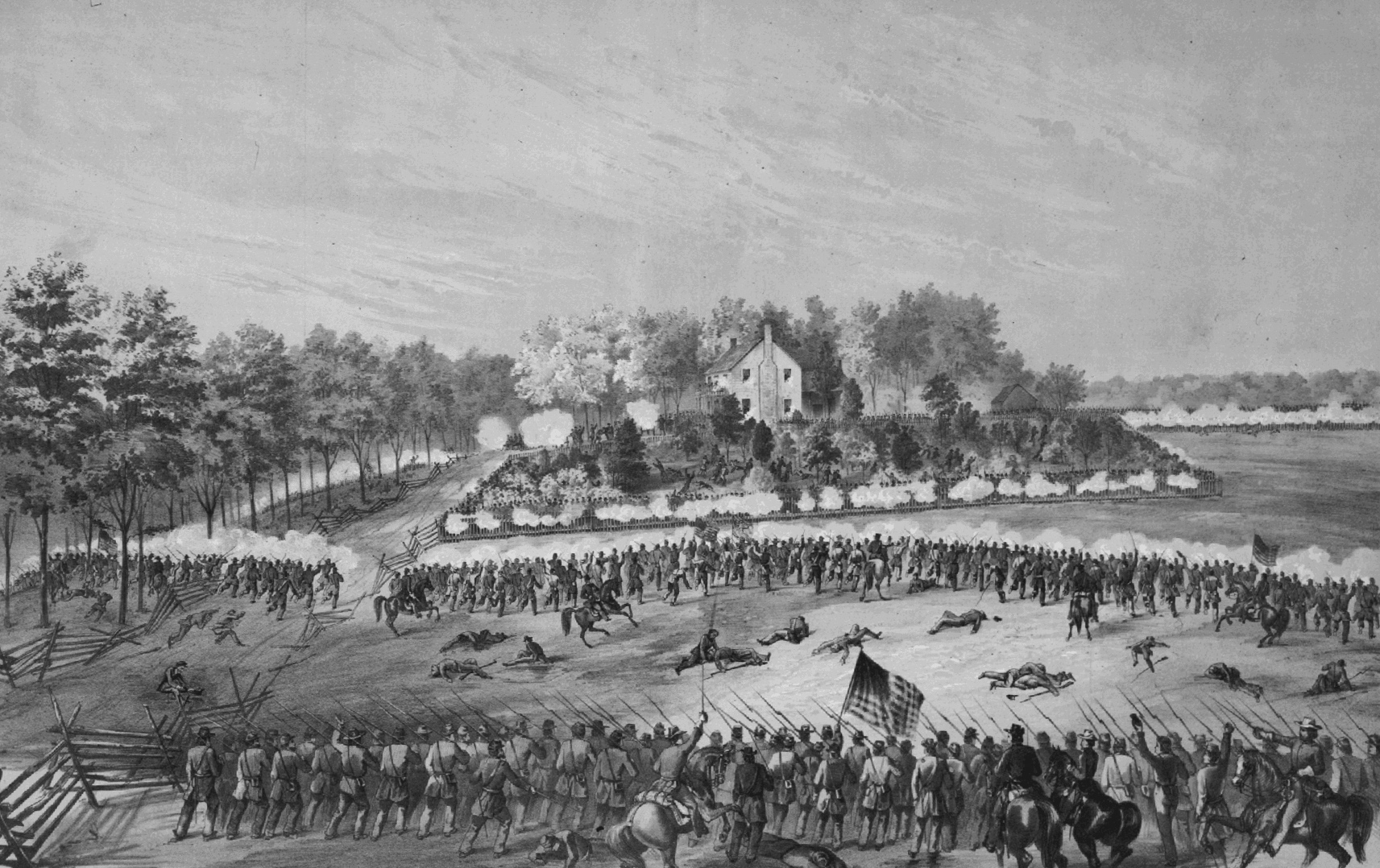
When the rain slackened around 11:00 a.m. on May 14, McPherson attacked. Crocker's division drove Colquitt's defenders from the Wright farm in a charge that saw the 10th Missouri clash hand-to-hand with the 24th South Carolina, wounding the latter's commander, Lieutenant Colonel Ellison Capers. On Sherman's front, Thompson's men could hold the Lynch Creek bridge for only twenty minutes against twelve Union cannons before falling back to the earthworks ringing Jackson. Sherman's assault stalled at 1:30 p.m. when six Confederate guns pinned down Buckland's brigade. Then Captain Julius Pitzman, an engineering officer, led the 95th Ohio Infantry on a flanking probe through the woods. They reached the Confederate defensive line and found it empty -- the main body had already withdrawn. An African American civilian confirmed the evacuation. The 95th Ohio swung behind the remaining Confederate artillery position, capturing fifty-two prisoners and six cannons. By 3:00 p.m., Union troops occupied Jackson. Multiple regiments raced to raise their flag over the state capitol, sparking a debate that continued for decades.
Chimneyville
What followed the battle earned Jackson its grim wartime nickname. Sherman's troops stayed behind on May 15 while the rest of Grant's army turned west to confront Pemberton. Their orders: destroy everything of military value. Railroad ties were burned, and the heated rails bent into twisted loops known as Sherman's neckties. The railroad bridge over the Pearl River went up in flames. Grant and Sherman personally inspected a textile factory before ordering its destruction. But the destruction spiraled beyond military targets. The 31st Iowa held a mock legislature in the capitol building where Mississippi's secession ordinance had been signed. Government buildings, banks, a hotel, a church, and hospitals were torched. Confederate authorities had released the inmates of the state penitentiary before evacuating; the freed inmates promptly burned the prison to the ground. Local civilians joined in the looting. Union soldiers, flush with captured Confederate currency, used the near-worthless bills to pay for what they took. Jackson would be occupied and devastated again in July, cementing its nickname: Chimneyville.
What Remains of the Battlefield
The landscape of the May 1863 battle has largely vanished beneath the modern city. Jackson preserves two small parcels of battleground: Battlefield Park, where a stretch of earthworks survives among the trees, and a site on the campus of the University of Mississippi Medical Center with remains of fortifications from the July siege. As historian Chris Mackowski noted in 2022, interpretive markers at Battlefield Park misidentify the earthworks as Confederate entrenchments from May when they are actually Union works from July. The cannons displayed in the park date to the Spanish-American War, not the Civil War. The Wright farm where McPherson's assault broke through no longer exists. Union casualties totaled about 300, with more than a quarter falling in a single regiment, the 17th Iowa Infantry. Confederate losses are harder to pin down -- estimated between 200 and 300 -- because several units never filed casualty reports. The battle's true cost was strategic: the fall of Jackson severed Vicksburg's rail supply lines and left Pemberton isolated, setting the stage for his defeat at Champion Hill two days later and the surrender of Vicksburg on July 4.
From the Air
Located at 32.29N, 90.20W at Jackson, Mississippi, the state capital. The Pearl River bends through the city and was a key geographic feature of the battle. Battlefield Park is a small preserved area within the urban landscape. Nearest airports: Jackson-Medgar Wiley Evers International Airport (KJAN) approximately 5 nm east, and Hawkins Field (KHKS) approximately 3 nm northwest. The city's railroad corridors are still visible from altitude, tracing the same routes Sherman's troops destroyed. Recommended viewing altitude: 3,000-4,000 ft AGL for overview of the city and river bend.