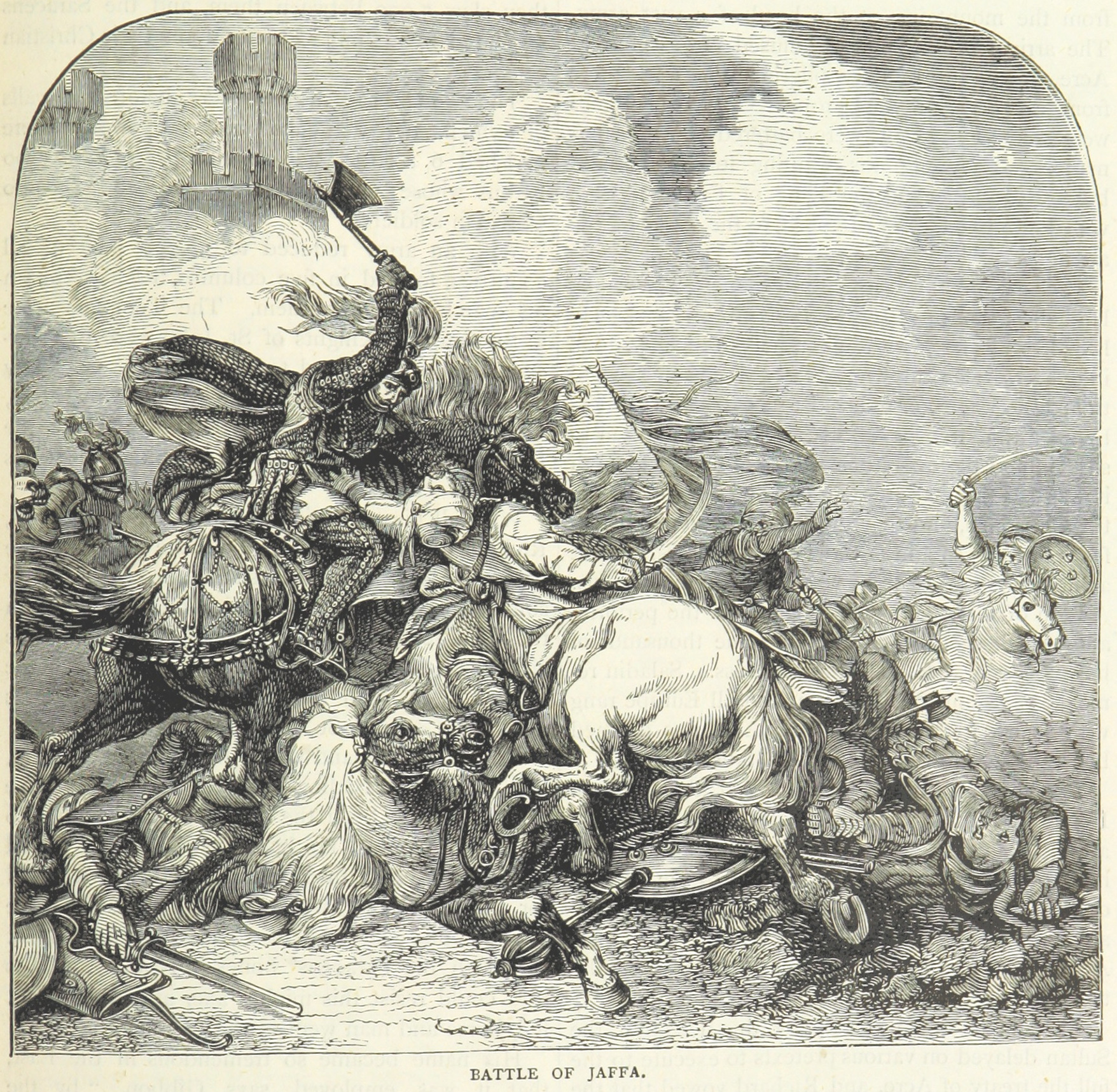
Battle of Jaffa (1192)
Still wearing his sailor's deck shoes, Richard the Lionheart leapt from his flagship into the Mediterranean surf and waded toward the beach at Jaffa. Muslim banners already flew from the city walls. The garrison was nearly finished. But the English king, leading barely fifty-four knights and a ragtag force of Italian crossbowmen, was about to deliver one of the most improbable counterattacks of the entire Crusading era -- and bring eight centuries of legend crashing into the ancient port where it all happened.
A Kingdom Slipping Away
By the summer of 1192, the Third Crusade was running out of time. Richard had twice marched his army within sight of Jerusalem, only to turn back -- once because of terrible winter storms, and again because his fractious coalition of English, French, and Outremer nobles could not agree on strategy. News from home made things worse: his brother John was scheming with Philip Augustus of France to seize his domains. On July 5, Richard began withdrawing from the Holy Land entirely, conceding that Jerusalem was beyond his reach. Saladin saw the opening immediately. Within weeks, the sultan laid siege to the port of Jaffa, the Crusaders' last significant base in southern Palestine. After three days of brutal fighting, his soldiers stormed the walls. Only the citadel still held, its defenders sending desperate word to Richard as Saladin's troops flooded the streets.
A King in the Waves
Richard gathered what forces he could -- a small army heavy on Genoese and Pisan sailors, light on proper knights -- and sailed south. When he arrived offshore, the sight of enemy banners convinced him Jaffa had already fallen. He nearly turned away. Then a lone defender swam out through the harbor to his ship with news that the citadel still held. What followed entered legend. Richard ordered his galleys to beach, jumped into the shallows without bothering to change from his shipboard shoes, and led the charge up the strand. The shock of the sudden attack panicked Saladin's garrison. They assumed Richard's little force was merely the vanguard of a much larger army. Christian prisoners inside the city seized their captors' weapons in the confusion. Within hours, Saladin's troops were in full retreat, unable to regroup until they had fled more than five miles inland.
Dawn Ambush at the Walls
Saladin was not finished. On the morning of August 4, he massed his cavalry around Jaffa under cover of darkness, planning a surprise assault at first light. The plan might have worked, except that a Genoese soldier -- out for an early morning stroll -- noticed the glint of armor and the sound of horses in the predawn stillness. The alarm went up, and Richard scrambled his tiny force into a formation that military historians still study. He ordered his infantry to kneel behind a hedge of shields and spears driven into the ground, with crossbowmen working in pairs behind them -- one loading while the other fired. Sharp tent pegs were hammered into the earth to deter cavalry charges. His mounted knights, perhaps only ten to fifteen in number, waited in reserve. Wave after wave of Turkish, Egyptian, and Bedouin cavalry broke against this bristling wall. The crossbow bolts were devastating; the Ayyubid horses, unprotected, fell in droves.
The Sultan's Fury
After hours of futile charges, Saladin's exhausted horsemen were shattered by a final counterattack led by Richard himself. A flanking force briefly penetrated Jaffa's gates, but the king galloped into the town and rallied every fighting man he could find. By evening, Saladin gave the order to withdraw. The Muslim chronicler Baha al-Din, who witnessed the battle, recorded a striking image: Richard rode the entire length of the Ayyubid line with his lance raised, and not a single soldier dared break ranks to challenge him. The sultan, Baha al-Din wrote, left the battlefield in anger. Recorded Ayyubid losses included 700 dead and 1,500 horses, though, as with many medieval battles, such figures carry significant uncertainty. The Crusader side reportedly lost only two killed, though many were wounded.
The Treaty and Its Shadow
The Battle of Jaffa was the last armed clash between Richard and Saladin. Both commanders were exhausted -- Richard was ill, and Saladin's coalition of emirs was fraying. Within weeks, they negotiated the Treaty of Jaffa, which ended the Third Crusade. Jerusalem remained in Muslim hands, but Christian pilgrims gained the right to visit the holy city, and the Crusaders kept a coastal strip from Beirut to Jaffa. Today the ancient port is absorbed into the southern edge of Tel Aviv, its Crusader-era stones barely visible beneath layers of Ottoman and modern construction. From the air, the coastline that witnessed Richard's desperate charge looks deceptively tranquil -- a Mediterranean shoreline like any other, giving no hint of the day a king in deck shoes waded through the surf to change the course of a holy war.
From the Air
Located at 32.05N, 34.75E on the Mediterranean coast, now part of the Tel Aviv-Yafo metropolitan area. The old port of Jaffa is visible as a headland jutting into the sea on the southern edge of Tel Aviv's coastline. Ben Gurion International Airport (LLBG) lies approximately 10 nm to the southeast. Sde Dov Airport (LLSD, now closed) was closer. Best viewed at 3,000-5,000 ft AGL approaching from the sea to appreciate the coastal geography that shaped the battle.