Battle of Jalalabad (1842)
When the band of the 13th Foot struck up a Scottish tune as George Pollock's relief column marched into Jalalabad on April 8, 1842, the song they chose carried a pointed rebuke: 'Oh but you've been a lang time acoming.' The garrison had been waiting five months. They had survived siege, starvation, and the knowledge that the entire British force retreating from Kabul -- some 16,500 soldiers and camp followers -- had been annihilated in the mountain passes to the west. Jalalabad was supposed to fall next. It did not.
A Wide Place in the Road
Jalalabad in 1842 was little more than a fortified waypoint on the road between Kabul and the Khyber Pass, roughly ninety miles east of the Afghan capital. The garrison holding it numbered about 2,000 troops under General Sir Robert Sale, a veteran officer whose force had been cut off when the broader British position in Afghanistan collapsed. In January 1842, the main British army attempting to retreat from Kabul was massacred -- an event so devastating that for weeks the British believed only a single survivor, Dr. William Brydon, had reached Jalalabad alive. Sale's garrison now stood alone, surrounded by Afghan forces under Wazir Akbar Khan, with no realistic prospect of relief for months. The question was whether to attempt a breakout or hold the walls.
Siege and Sheep
The Afghans launched a series of assaults on the garrison's positions, each beaten back. Inside the walls, conditions deteriorated steadily. Rations dwindled to the point that Sale's men mounted a sortie not to attack the enemy but to raid their flocks, capturing 300 sheep from the besieging force. It was a desperate measure that revealed both the garrison's hunger and its resourcefulness -- soldiers who could not feed themselves but could still fight well enough to steal livestock from an army surrounding them. The garrison repaired earthquake-damaged fortifications, maintained discipline, and waited. Five months is a long time to hold a position when every message from the outside carries only news of catastrophe.
The Sortie of April 7
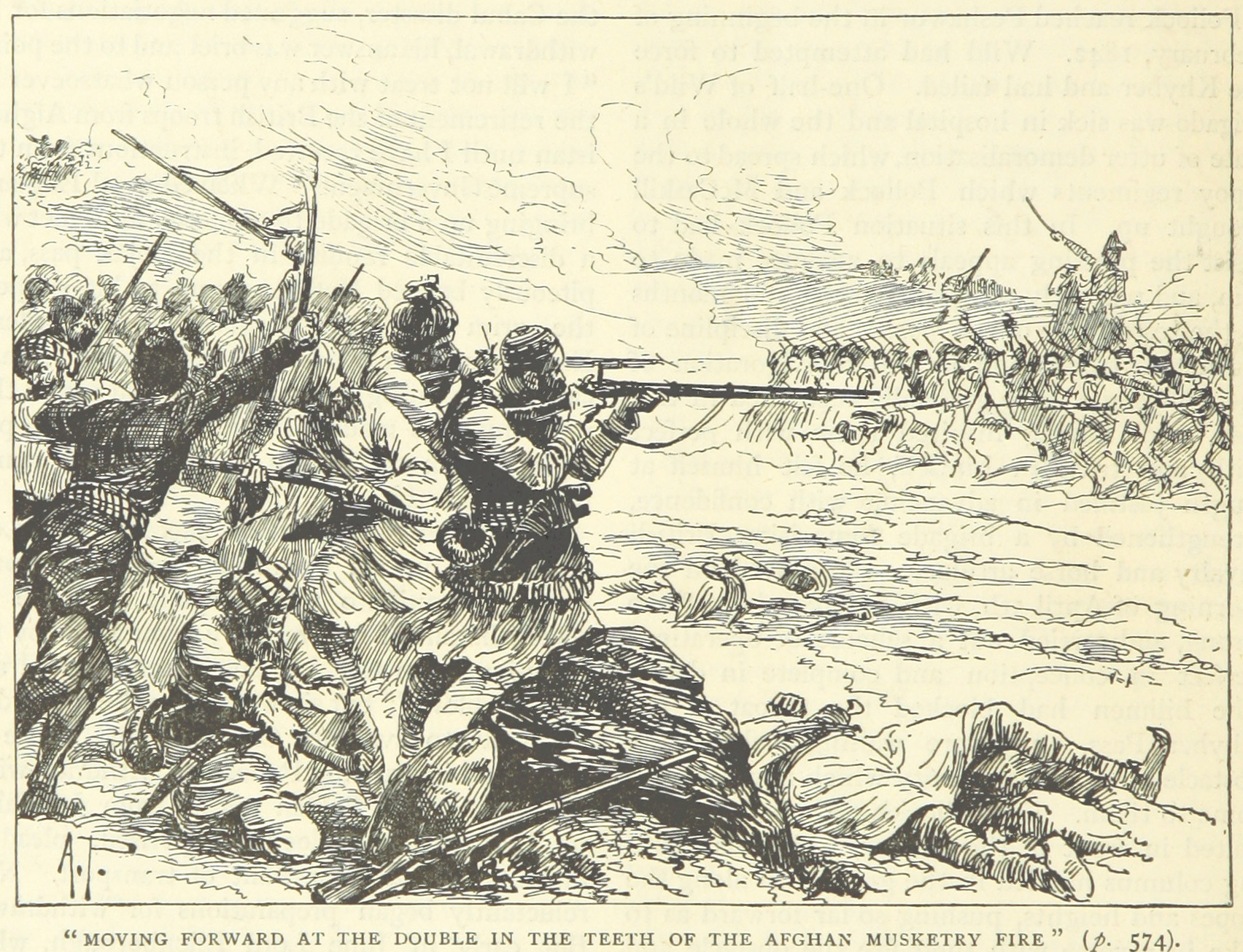
Rather than wait passively for relief or starvation, Sale decided to attack. On April 7, 1842, his garrison sortied against the main Afghan camp. The assault was decisive. British and Indian troops overran the Afghan positions, capturing the entire camp along with its baggage, stores, artillery, and horses. The rout was complete -- the Afghan forces fled toward Kabul, and the siege that had lasted since November was broken in a single morning. The following day, Pollock's Army of Retribution arrived to find a garrison that had already liberated itself. That Scottish air played by the regimental band was not just music; it was a statement. The 13th Foot had not merely survived. They had won.
Heroes of the 13th
The defense of Jalalabad transformed the 13th Regiment of Foot into one of the most celebrated units in the British Army. As the regiment marched back through India toward home, every garrison it passed reportedly fired a ten-gun salute in its honor. Queen Victoria directed that the 13th be redesignated as Light Infantry, carry the additional title 'Prince Albert's Own,' and wear a regimental badge depicting the walls of Jalalabad with the word 'Jellalabad' inscribed upon it. The regiment would eventually become the Somerset Light Infantry, carrying the battle honor through subsequent reorganizations. In Taunton, the county town of Somerset, the army barracks was named Jellalabad Barracks -- and the surrounding neighborhood retains that name to this day, a corner of southwest England forever marked by a siege in eastern Afghanistan.
Afghanistan's Recurring Lesson
The landscape around Jalalabad has scarcely changed since 1842. The Kabul River still winds through the valley. The mountain passes still narrow into corridors where armies become vulnerable. The city sits at the same strategic crossroads it occupied when Sale's garrison held its walls against siege -- a gateway between Kabul and the Khyber Pass, between Afghanistan and the Indian subcontinent. Armies from Alexander the Great to the Soviet Union to NATO have moved through this ground. What happened here in 1842 was one chapter in a pattern that predates it by millennia: foreign forces discovering that holding Afghanistan's cities means little if you cannot hold the roads between them.
From the Air
Located at 34.43N, 70.45E in the Jalalabad valley of eastern Afghanistan, where the Kabul River flows through a broad plain flanked by mountains. Jalalabad Airport (OAJL) is the nearest airfield. Kabul International (OAKB) lies approximately 80 nm to the west via the mountain passes. The Khyber Pass and the Pakistan border are roughly 45 nm to the east. Best viewed from 12,000-15,000 ft AGL. The city and its surrounding irrigated farmland stand out as a green patch against the brown mountain terrain. The old fortification site is within the modern city.