Battle of Jassin
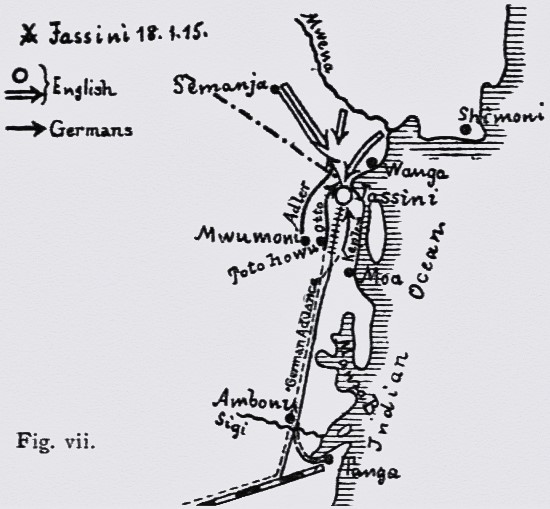
Colonel Raghbir Singh knew his garrison was exposed. Jassin, a small settlement on the German East African side of the border with British East Africa, sat within striking distance of Tanga to the south, and the four companies of Indian troops under his command numbered barely 300 men. On the morning of January 18, 1915, nine companies of German Schutztruppe materialized from the coastal bush to prove him right. What followed over two days was a battle that cost both sides dearly, ended with an act of old-world courtesy between enemies, and convinced the most resourceful German commander in Africa to abandon conventional warfare altogether.
A Border Too Thin to Hold
The British had occupied Jassin to secure the frontier between their East African territory and the German colony. It was a defensive move, meant to shield the border after the humiliating British defeat at Tanga in November 1914, where a far larger British Indian force had been routed. But Jassin was too far forward and too lightly held. The garrison of Indian soldiers, drawn from the ranks of the British Indian Army, found themselves isolated in unfamiliar terrain, the tropical heat of the East African coast bearing down on men trained for different landscapes. Paul Emil von Lettow-Vorbeck, the German commander who had orchestrated the victory at Tanga, saw Jassin not as a border outpost but as an opportunity. If the British could be pushed back here, Tanga's northern flank would be secure.
Two Days in the Coastal Heat
Lettow-Vorbeck assembled nine companies for the assault, a force of Schutztruppe soldiers led by European officers alongside African askaris who knew the terrain intimately. The fighting began on January 18 and stretched into January 19, the attackers pressing through scrub and palm groves while the defenders held their positions with a stubbornness that surprised the Germans. Colonel Raghbir Singh was killed during the battle, one of the first senior officers to fall in the East African campaign. His men, outnumbered and with no prospect of relief, continued to fight until their situation became impossible. Brigadier-General Michael Tighe was rushing a relief column toward Jassin, but he arrived hours too late. The garrison had already surrendered.
An Enemy's Salute
What happened next belongs to a kind of warfare that was already vanishing in the trenches of France and Belgium. Lettow-Vorbeck received British Captains Hanson and Turner after the surrender and congratulated them on the defense their men had mounted. He then released them on their word of honor that they would take no further part in the war. It was a gesture from an older military code, one that recognized the courage of soldiers regardless of which flag they served. The moment stands in stark contrast to the industrial slaughter unfolding simultaneously on the Western Front, where such personal exchanges between commanders had become unthinkable.
The Victory That Changed Everything
Lettow-Vorbeck won at Jassin, but the cost alarmed him. German losses in officers and ammunition were severe enough that he realized he could not afford many more such engagements. The East African theater had no supply line from Germany; every bullet spent was irreplaceable. This recognition transformed his entire strategy. He abandoned the idea of seeking decisive pitched battles against the British and turned instead to guerrilla warfare, striking at the Uganda Railway and other infrastructure before melting back into the bush. It was a decision that would keep his force fighting for the entire duration of the war, tying down far larger British and Commonwealth armies across a vast stretch of East Africa. The British, stung by the loss of Jassin, pulled back and consolidated their positions, postponing the invasion of German East Africa for months.
Echoes on the Coast
Jassin today is a quiet place on the Tanzanian coast, not far from the Kenyan border. The tropical vegetation has long since reclaimed whatever earthworks and positions once marked the battlefield. Few visitors come here looking for traces of a World War I engagement, yet the battle's consequences rippled far beyond this stretch of coastline. It was here that Lettow-Vorbeck's campaign crystallized into the guerrilla war that would make him legendary, and here that Indian soldiers fighting thousands of miles from home gave their lives in a conflict whose African dimensions are still too little remembered. Colonel Raghbir Singh's name appears in the Commonwealth War Graves Commission records, one entry among the thousands who fell in a theater of war that Europe's histories have largely overlooked.
From the Air
Located at 4.68S, 39.18E on the coast of Tanzania, near the Kenyan border. The site is inland from the Indian Ocean coast, in flat to gently rolling coastal terrain. Nearest major airport is Julius Nyerere International Airport (HTDA) in Dar es Salaam, approximately 300 km to the south, or Moi International Airport (HKMO) in Mombasa, roughly 100 km to the north. Best viewed at 3,000-5,000 ft AGL. The Tanga area (HTTG) is approximately 50 km to the south along the coast.