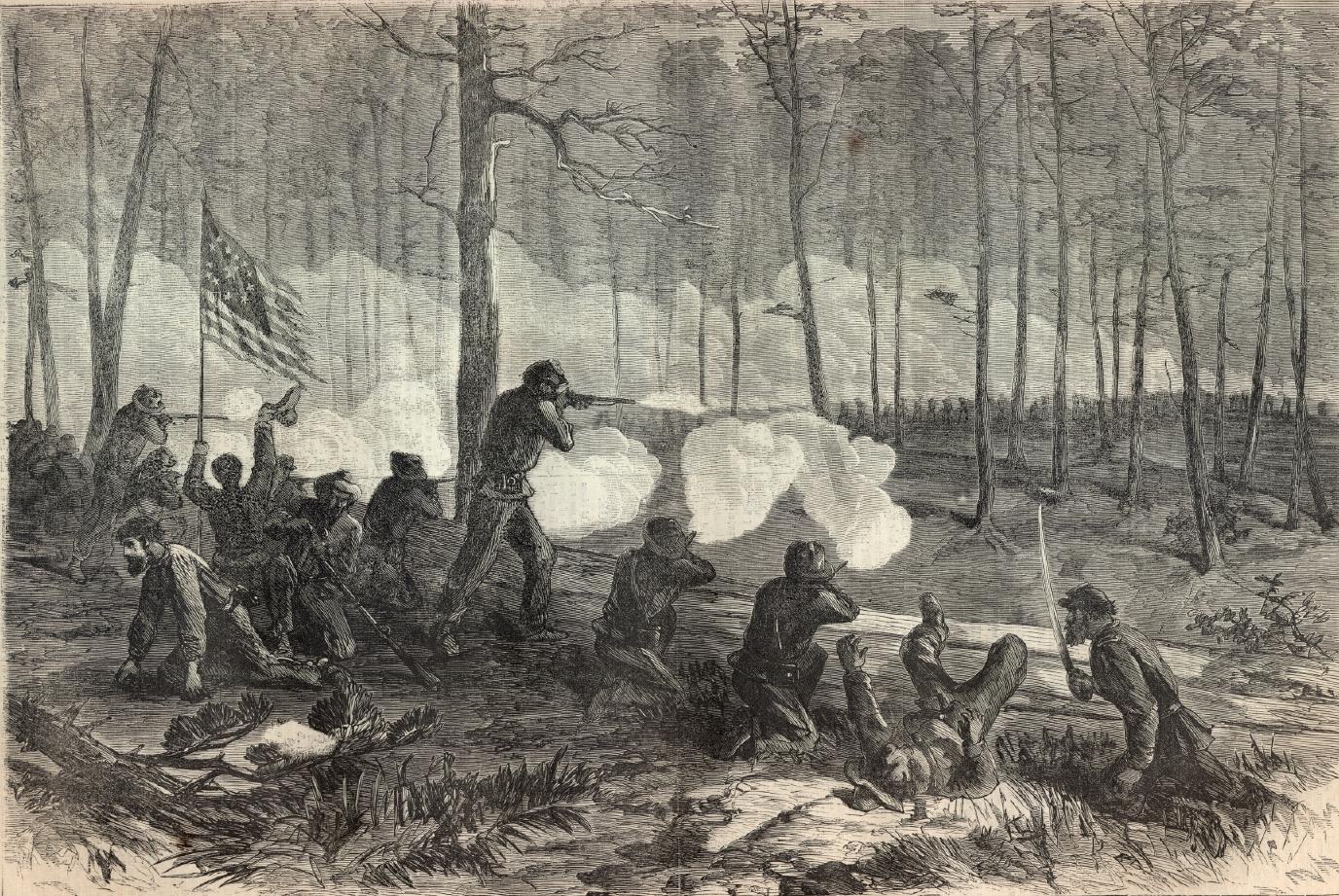
Battle of Jonesborough
Sherman jumped up and raised his right arm. The news had just reached him at Renfroe Place on the afternoon of August 31, 1864: Schofield's corps was squarely on the Macon and Western Railroad, Atlanta's last uncut rail connection to the outside world. Months of flanking, fighting, failed cavalry raids, and fruitless bombardments had all led to this moment south of Atlanta, in a small Georgia town called Jonesborough. Within 48 hours, five Union corps would converge on this place, Confederate defenders would mount one of the war's most disastrous assaults, and Hood would evacuate Atlanta in a fiery spectacle heard for miles.
The Railroad Lifeline
By late August 1864, William Tecumseh Sherman had spent months trying to force John Bell Hood out of Atlanta. Every approach had failed. Union cavalry raids against the Macon and Western Railroad -- the last railroad feeding Atlanta -- ended in disaster: McCook's troopers were surrounded at Newnan, Stoneman was captured trying to liberate prisoners at Andersonville, and Kilpatrick's division was ambushed at Lovejoy's Station after rain prevented his men from burning the rails. Infantry attacks at Utoy Creek fell short. Even a bombardment with 20-pounder Parrott rifles ended when the guns burst. Sherman needed a new plan. He would swing six of his seven infantry corps in a massive arc south of Atlanta, cut the railroad with overwhelming force, and let Hood's supply situation do the rest.
The Grand Sweep
On August 25, Sherman's army began pulling out of its siege lines. The XX Corps stayed behind to guard the Chattahoochee bridge while the rest -- some 60,000 men -- marched south. Hood detected the movement but misjudged its meaning. Some historians argue Hood was deluded into thinking Sherman was retreating; others contend he understood the threat but underestimated how quickly Sherman's forces would reach Jonesborough. Hood's fatal error was one of timing, not comprehension. By August 30, Howard's Army of the Tennessee had crossed the Flint River and entrenched on a ridge west of Jonesborough. Only 2,500 Confederates defended the town. Hood, finally grasping the danger at 6 pm, ordered Hardee to march through the night with two full corps and drive the Federals into the river by morning.
A Disgraceful Effort
The August 31 assault was a catastrophe. Hardee's and Lee's exhausted troops -- many had barely slept in two days -- arrived piecemeal and attacked entrenched Union positions in echelon from left to right. Lee's corps struck first, prematurely, after mistaking skirmisher fire for the signal. His men overran the picket lines and then were shattered by rifle and artillery fire. Much of Deas' brigade simply fled. On the Confederate left, Lowrey's division was accidentally diverted by Kilpatrick's dismounted cavalry, armed with Spencer repeating rifles and concealed behind fence rails. An entire Confederate division chased the Union horsemen across the Flint River instead of attacking the main line. Howard, observing from the Federal side, called it the best possible outcome, as if he had planned it himself. The Confederates suffered approximately 2,200 casualties; the Union lost 179. Hood himself called it a "disgraceful effort."
The Only Breakthrough
September 1 brought the Atlanta campaign's singular distinction: the only successful large-scale Union frontal assault of the entire campaign. Hardee, now reduced to 12,000 troops after Hood recalled Lee's corps to Atlanta, defended an overextended line. The XIV Corps under Jefferson C. Davis identified a vulnerable salient where Govan's Arkansas brigade held the apex. General Absalom Baird, stung by Sherman's criticism of his division's "lack of offensive spirit," rode forward on horseback with Estey's brigade of 1,139 men. At 5 pm, Estey's soldiers ascended the ridge, threw themselves flat to dodge a Confederate volley, then charged. The 10th Kentucky and 74th Indiana overran the breastworks on the right while Morgan's division struck from the west. In the melee, Govan and 600 of his men were captured, along with eight artillery pieces. Baird earned the Medal of Honor. But Cleburne and Granbury plugged the gap, and Hardee held.
Atlanta Is Ours
That night, Hardee's corps slipped out of Jonesborough undetected and marched to Lovejoy's Station. In Atlanta, Hood had already begun evacuating. Five locomotives and 81 boxcars, 28 of them loaded with ammunition, were set ablaze -- a pyrotechnic spectacle that would later inspire some of the most famous scenes in Gone with the Wind. Union troops under Slocum entered the city on September 2 and sent the telegram: "General Sherman has taken Atlanta." The fall of Atlanta reverberated far beyond Georgia. Grant's Overland Campaign had stalled at Petersburg, and the Democratic Party had just adopted a platform declaring the war a failure. Atlanta's capture proved that narrative wrong. Lincoln won reelection that November with 212 electoral votes to McClellan's 21. The battle that made it possible was fought not in Atlanta itself, but in the fields and along the railroad tracks of Jonesborough, 20 miles to the south.
From the Air
Located at 33.53°N, 84.36°W in Clayton County, Georgia, approximately 20 miles south of downtown Atlanta. The town is now called Jonesboro (modern spelling). From the air, the Macon and Western Railroad corridor -- the strategic prize of the battle -- runs north-south through the area. Hartsfield-Jackson Atlanta International Airport (KATL) lies about 12 nm to the north-northwest. The Flint River, which played a key role in the battle's geography, runs nearby to the west. The Patrick R. Cleburne Confederate Cemetery, where many of the fallen were reburied in 1872, is visible in the town. The battlefield area is largely developed today but historical markers and the cemetery preserve the memory of the engagement.