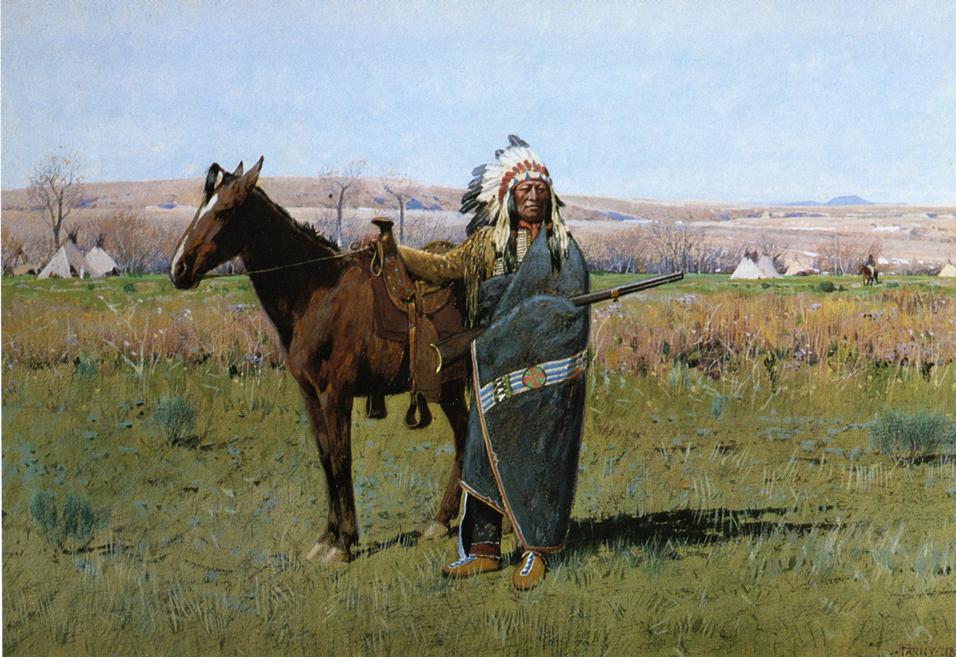
Battle of Julesburg
George Bent watched from the bluffs as Big Crow and nine decoys galloped toward Fort Rankin, then wheeled their horses and fled in feigned panic. The plan was elegant: lure the soldiers out, then spring a thousand warriors from behind the ridgeline. Bent, half Cheyenne and half white, had chosen his side. Six weeks earlier, his mother's people had been slaughtered at Sand Creek. Now, on this frozen January morning in 1865, near the Overland Trail station at Julesburg, Colorado, the reckoning had begun.
Ashes of Sand Creek
The Sand Creek Massacre on November 29, 1864, changed everything on the Colorado plains. Cheyenne and Arapaho camps flying American flags and white surrender banners were attacked by Colorado militia, leaving hundreds dead, mostly women and children. The survivors scattered north, carrying news that ignited fury across the Great Plains. On January 1, 1865, a council gathered on Cherry Creek near present-day St. Francis, Kansas. Cheyenne Dog Soldiers, Northern Arapaho, and two Lakota bands under Spotted Tail and Pawnee Killer agreed on a target: Julesburg, a prominent way station on the Overland Trail where stagecoaches, telegraph wires, and travelers all converged on the South Platte River. The warrior Roman Nose was likely among them. Together, they numbered roughly a thousand fighting men.
The Decoy Trap
What makes the Battle of Julesburg historically unusual is its primary source: George Bent, who participated in the attack and later recounted it to anthropologists George Bird Grinnell and George E. Hyde. His account provides a rare Indigenous perspective on frontier warfare. The plan called for classic decoy tactics. Big Crow selected ten warriors to draw Captain Nicholas J. O'Brien and his sixty cavalrymen from Fort Rankin into an ambush. The ruse nearly worked perfectly. O'Brien pursued the fleeing decoys three miles from the fort before young warriors, too eager for glory, fired prematurely from behind the bluffs. Alerted, O'Brien wheeled his command and fled back toward the stockade. The warriors caught them just 300 yards from safety. Fourteen soldiers and four civilians died in the pursuit. Bent claimed no Indians fell. The soldiers disputed this, but the victors controlled the ground and the narrative that day.
The Valley Burns
With the soldiers pinned inside Fort Rankin, the warriors moved freely through Julesburg. They looted the stagecoach station, the store, the warehouse, carrying away massive quantities of supplies while artillery rounds from the fort fell harmlessly around them. But this was only the beginning. The alliance decided to move north to the Black Hills and Powder River Country, and they would scorch the earth behind them. From January 28 to February 2, raiding parties struck 150 miles of the South Platte Valley between present-day Fort Morgan, Colorado and Paxton, Nebraska. Bent remembered the nights: 'The whole valley was lighted up with the flames of burning ranches and stage stations, but the places were soon all destroyed and darkness fell on the valley.' General Robert Byington Mitchell pursued with 640 cavalry but found only empty camps and returned with fifty soldiers suffering from frostbite.
Crossing the Ice
On February 2, 1865, the great caravan crossed the frozen South Platte west of Julesburg, heading north. Several thousand women, children, and livestock filed across the ice while the warriors made one final visit to the station. They took whatever remained and burned every building to the ground. The fifteen soldiers and fifty civilians inside Fort Rankin watched from behind their walls, unwilling to venture out. Captain O'Brien, returning from patrol with fourteen men, scattered some Indians with a howitzer round and dashed to safety inside the fort. The warriors continued north, with the Sioux leading because they knew the route. Skirmishes at Mud Springs and Rush Creek in Nebraska followed in early February, but the alliance had made its point. The Overland Trail, lifeline of western expansion, could be severed at will.
A Voice from Both Sides
George Bent's account of Julesburg matters because frontier history is typically told by the victors of the larger war. Bent straddled an impossible divide: educated in St. Louis, son of trader William Bent and Owl Woman of the Cheyenne, he chose to fight alongside his mother's people after Sand Creek. His detailed narratives, recorded decades later, provide tactical and emotional context that military reports cannot. The nine former soldiers who had participated in the Sand Creek Massacre and were killed by Cheyenne during the raids had their bodies mutilated in retribution. It was a brutal time of brutal arithmetic. The Battle of Julesburg was not the end but a beginning, igniting years of conflict across the northern plains that would culminate at Little Bighorn eleven years later.
From the Air
Located at 40.94°N, 102.38°W in the northeastern corner of Colorado, near where Colorado, Nebraska, and Wyoming meet. The terrain is flat prairie along the South Platte River. Best viewed at 2,000-3,000 feet AGL to appreciate the river valley and the openness of the landscape. Nearest airports: Sidney Municipal (KSNY) 20 miles north in Nebraska, Sterling Municipal (KSTK) 35 miles southwest. The original Julesburg site is now farmland; the town relocated multiple times following the railroad.