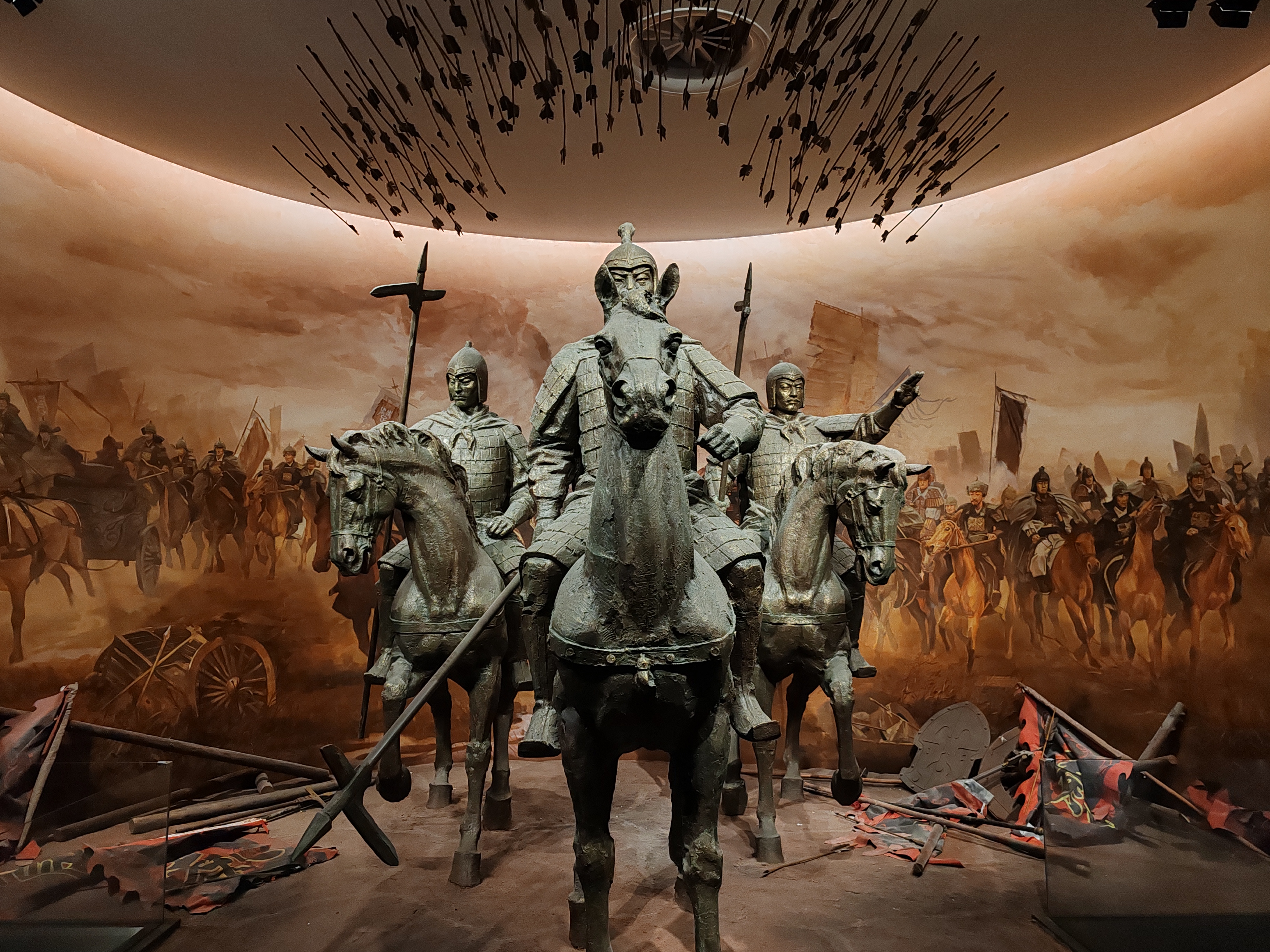
Battle of Julu
He smashed the cooking pots and sank the boats. In 207 BC, at the siege of Julu in present-day Pingxiang County, Hebei, the Chu rebel commander Xiang Yu made a decision that would echo through Chinese language and culture for more than two thousand years. Facing a Qin imperial army that vastly outnumbered his forces, he ordered his soldiers to carry only three days of food, destroy their cauldrons, and scuttle the boats they had used to cross the Yellow River. There would be no retreat, no resupply, no cooking hot meals. They would take what they needed from the enemy, or they would die.
A Dynasty Crumbling
The Qin dynasty, which had unified China under the First Emperor just fifteen years earlier, was disintegrating. Rebellions erupted across the empire, and the insurgent state of Chu emerged as one of the most powerful challengers. In 208 BC, the Qin general Zhang Han defeated the Chu commander Xiang Liang at the Battle of Dingtao, then wheeled north across the Yellow River to crush the rebel state of Zhao. Zhang Han's deputies Wang Li and She Jian besieged Handan, Zhao's capital, while Zhang himself secured supply lines to the south. Zhao's ruler sent desperate pleas for help to King Huai II of Chu, who dispatched two armies: one under Song Yi to relieve the siege, with Xiang Yu, Xiang Liang's nephew, as deputy commander; the other under Liu Bang to strike at the Qin heartland of Guanzhong.
Mutiny Before the Battle
Song Yi's army reached Anyang and stopped. For forty-six days, while Zhao's forces starved under siege at Julu, Song Yi refused to advance. He threw a lavish banquet to send his son off to the state of Qi. His soldiers, soaked by heavy rains and suffering from cold and hunger, seethed. Xiang Yu urged an attack and was rebuffed, with Song Yi issuing a thinly veiled threat about executing anyone who showed "barbaric, defiant behavior." On the forty-seventh morning, Xiang Yu walked into Song Yi's tent and killed him. He announced to the army that Song Yi had been conspiring with the Qi state and that he held a secret execution order from King Huai. The subordinate generals, terrified of Xiang Yu, accepted him as commander. The king, presented with a fait accompli, retroactively approved.
Every Soldier Against Ten
Xiang Yu sent an advance force of 20,000 under Ying Bu and Zhongli Mo across the Yellow River, winning initial skirmishes. Then he crossed with his main army and issued the famous order: destroy the supplies, smash the cauldrons, sink the boats. The message was unmistakable. His troops fought with extraordinary ferocity, each Chu soldier reportedly engaging ten Qin opponents. They won nine consecutive engagements, severed Wang Li's supply lines, and shattered the Qin army. Wang Li was captured. The general She Jian refused to surrender and threw himself into a fire. The Qin commander Su Jiao was killed in action. Forces from other rebel states had gathered near Julu but were too afraid of the massive Qin army to intervene. They watched from their camps. When Xiang Yu prevailed, their commanders came to meet him at his gates, sinking to their knees and refusing to look up.
Two Hundred Thousand Buried Alive
Zhang Han eventually surrendered with 200,000 men in the summer of 207 BC, betrayed by a Qin court where the eunuch Zhao Gao had turned the emperor against him. What followed was one of the most terrible acts of the era. At Xin'an in present-day Yima, Henan, Xiang Yu ordered all 200,000 surrendered Qin soldiers buried alive, fearing mutiny and unable to feed them. In 1912, workers building the Longhai Railway unearthed massive quantities of human remains at the site, confirming the ancient accounts. The place became known as the "Chu Pits." The Chinese idiom born from the battle, "breaking cauldrons and sinking boats," carries the same meaning as "crossing the Rubicon" in the West. But the full story includes both the desperate courage and the atrocity that followed it.
From the Air
The battle took place near present-day Pingxiang County, Xingtai, Hebei at approximately 37.07N, 114.48E. Flat terrain of the North China Plain. The Yellow River, which Xiang Yu's army crossed, lies to the south. Nearest airports: Xingtai Dalian Airport, Shijiazhuang Zhengding International (ZBSJ). Recommended viewing altitude: 3,000-5,000 feet. No terrain hazards.