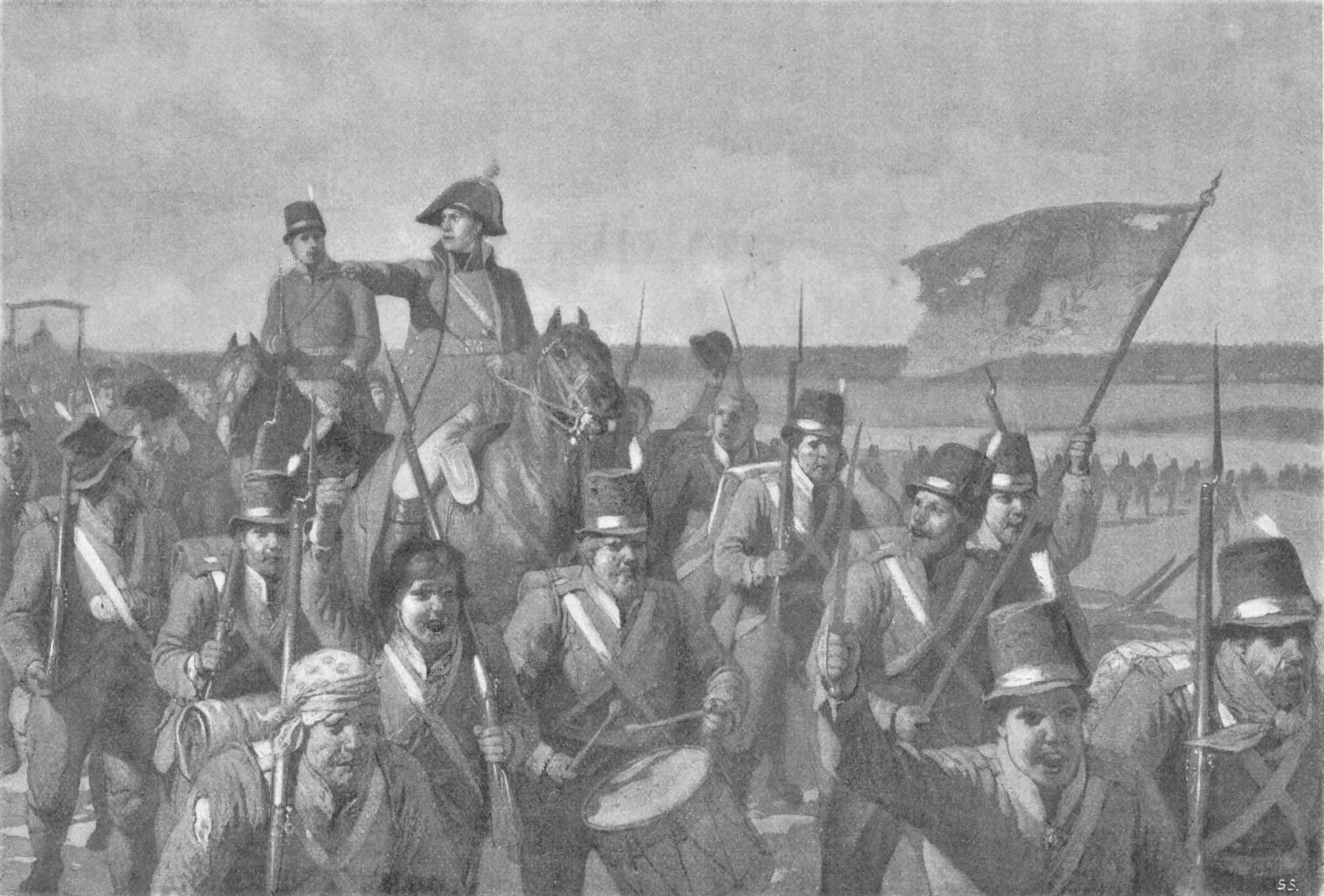
Battle of Jutas
The poem came first, at least for most Finns. Long before anyone could point to Jutas on a map, schoolchildren across the country knew the name from Johan Ludvig Runeberg's "Dobeln at Jutas," one of the most celebrated passages in the Finnish national poem Fanrik Stals Sagner. The real battle, fought on a Tuesday afternoon in September 1808 in the fields south of Nykarleby, was a small engagement in a losing war. But small engagements, when led by the right commander at the right moment, have a way of becoming legend.
A War Already Lost
By the autumn of 1808, the Finnish War between Sweden and Russia was going badly for the Swedes. Russia had invaded Finland in February, aiming to absorb the territory that Sweden had held for centuries. The Swedish campaign of the previous summer had failed to reverse the advance, and now the main Swedish force was in retreat, pulling back from Vaasa toward Nykarleby along the Ostrobothnian coast. The Russians, sensing an opportunity to end the campaign decisively, dispatched a flanking force to cut off the Swedish line of retreat. If successful, the Swedish army in Finland would be trapped between two Russian forces with nowhere to go.
Dobeln's Intercept
Georg Carl von Dobeln was given command of the force sent to stop the Russian flanking maneuver. A career officer with a reputation for personal courage -- he carried a bullet wound in his forehead from an earlier engagement, covered by a black bandage that became his trademark -- Dobeln moved south of Nykarleby to meet the advancing Russians. On 13 September 1808, the two forces collided at Jutas. The details of the battle are spare in the historical record: a sharp engagement, Swedish troops holding their ground, and a Russian withdrawal. The flanking attempt failed. The road north to Nykarleby remained open, and the main Swedish army could continue its retreat.
Victory Before Catastrophe
The timing of Jutas gives it a particular poignancy. Dobeln's success on 13 September kept the Swedish army alive -- but only for a day. On 14 September, barely twenty-four hours later, the main Swedish force fought the Battle of Oravais just to the south and was decisively defeated. Oravais was one of the largest and bloodiest engagements of the entire Finnish War, and its outcome effectively sealed Finland's fate. The territory that had been Swedish for over six hundred years would pass to the Russian Empire. Jutas, then, was not a turning point but a last bright moment -- a tactical victory swallowed almost immediately by strategic disaster.
The Poem That Made the Place
Johan Ludvig Runeberg, Finland's national poet, understood the power of noble failure. His epic work Fanrik Stals Sagner -- The Tales of Ensign Stal -- published between 1848 and 1860, drew from the Finnish War to craft a vision of Finnish courage and identity. "Dobeln at Jutas" became one of the collection's most beloved poems, transforming the bandaged officer into a symbol of defiance against impossible odds. For generations, Finnish and Swedish-speaking schoolchildren alike memorized the verses. The poem did what the battle alone could not: it made Jutas permanent. The fields south of Nykarleby, unremarkable in themselves, became sacred ground -- not because of what happened there, but because of how it was remembered.
From the Air
Located at 63.50N, 22.52E on the Ostrobothnian coastal plain south of Nykarleby in western Finland. The battlefield is in flat agricultural terrain along the Lapuanjoki river valley. Nearest airports: Kokkola-Pietarsaari (EFKK) approximately 20 km to the north, Vaasa (EFVA) approximately 60 km to the south. The town of Nykarleby is visible along the coast. Flat terrain with open fields; no significant elevation features.