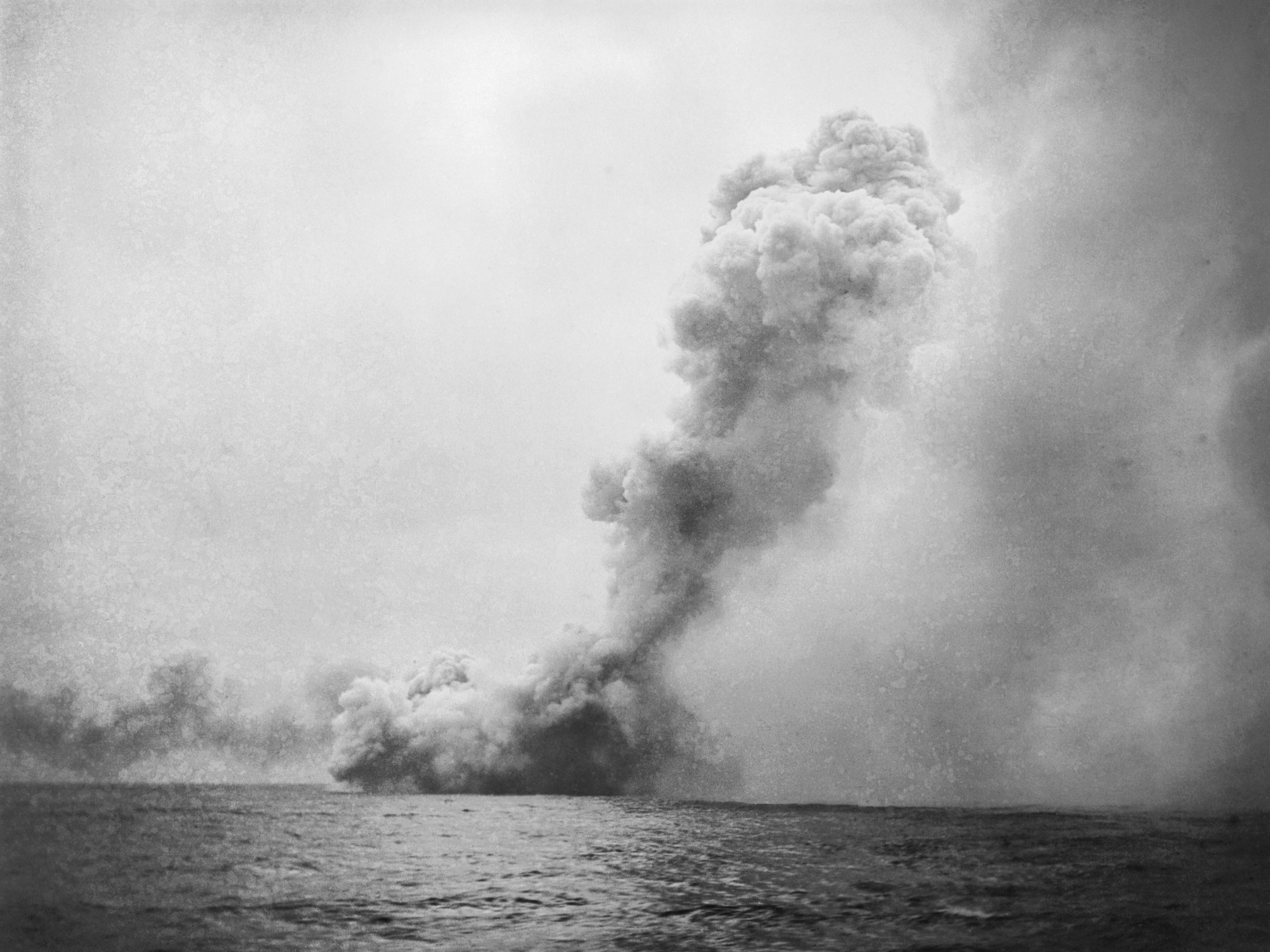
Battle of Jutland
On the afternoon of May 31, 1916, the North Sea off Denmark's Jutland Peninsula became the stage for something the world's navies had spent a decade preparing for and would never repeat: a full-scale clash of battleship fleets. Two hundred and fifty warships -- 151 British, 99 German -- converged in waters that were soon choked with smoke, shell splashes, and the debris of sinking steel. By the time darkness fell and the guns finally went quiet on June 1, fourteen British and eleven German ships had been sent to the bottom, and 9,823 sailors were dead or wounded. Both sides claimed victory. Neither was entirely wrong.
The Trap That Caught Both Sides
The German High Seas Fleet, with 16 dreadnoughts against Britain's 28, knew it could not win a straight fight. Vice-Admiral Reinhard Scheer's strategy was surgical: use Vice-Admiral Franz Hipper's fast battlecruisers as bait to lure a portion of the British fleet into the path of the full German force, then destroy it before reinforcements could arrive. Submarines were pre-positioned off British naval bases to thin the response. But the British had cracked the German naval codes. When intercepted signals revealed a major operation was imminent, Admiral Sir John Jellicoe sailed the Grand Fleet from Scapa Flow on May 30, passing over the German submarine picket lines before they were ready. Beatty's battlecruiser force departed the Firth of Forth at the same time. The hunters were about to discover they were also the hunted.
Ninety Minutes of Catastrophe
Hipper's battlecruisers spotted Beatty's force to the west at 15:20 on May 31. The Germans opened fire first at 15:48, and their gunnery was devastatingly accurate from the start. Within the first hour, two British battlecruisers -- Indefatigable and Queen Mary -- exploded and sank after their magazines detonated, taking all but 22 of their combined crews with them. Watching Queen Mary disintegrate, Beatty reportedly turned to his flag captain and said, "There seems to be something wrong with our bloody ships today." The problem was not merely bad luck. British shells often shattered against German armor without penetrating, while German shells punched through and detonated inside. British cordite propellant, stored in silk bags rather than brass cases, was catastrophically vulnerable to flash fires that raced from turret to magazine in seconds.
The Fleets Collide
Beatty's retreat northward -- the "Run to the North" -- succeeded in drawing Scheer's entire High Seas Fleet toward Jellicoe's Grand Fleet. Between 18:30 and nightfall at 20:30, with the setting sun backlighting the German ships and giving British gunners a clear advantage, the two main fleets engaged twice. Jellicoe executed a textbook deployment, crossing the German T and pouring concentrated fire into Scheer's van. Scheer, realizing his fleet faced annihilation, ordered an emergency battle-turnaway -- his ships reversing course simultaneously under a smoke screen and torpedo attacks by destroyers. He attempted the maneuver twice. Jellicoe, wary of torpedo attacks, turned away each time rather than pursuing aggressively. As darkness fell, the admiral positioned his fleet to cut off the German retreat, hoping to resume the fight at dawn.
Escape in the Dark
Scheer had other plans. Under cover of night, the High Seas Fleet drove through the British rearguard in a series of confused, close-range actions lit by searchlights and gunfire. British destroyers and light cruisers clashed with German battleships at point-blank range but failed to alert Jellicoe to what was happening. By morning, Scheer's battered fleet had reached the safety of its home ports. The Admiralty, which had been tracking German signals, did not pass critical intelligence to Jellicoe -- one of several communication failures that haunted the British for years afterward.
A Victory No One Could Celebrate
Germany lost 11 ships and 2,551 men. Britain lost 14 ships and 6,094 men -- more than twice the casualties. German newspapers trumpeted a great victory, and the British public was stunned. But the strategic arithmetic told a different story. One month after Jutland, the Grand Fleet was stronger than before the battle, with 23 dreadnoughts and four battlecruisers ready for action. The Germans had 10 operational dreadnoughts. Scheer himself concluded that further attrition battles would exhaust the High Seas Fleet long before they weakened the British. The German surface fleet sortied into the North Sea only three more times during the entire war, each time withdrawing quickly. Germany turned instead to unrestricted submarine warfare -- a decision that would draw the United States into the conflict. The wrecks of Jutland's lost ships, scattered across the seabed in Danish waters, are now protected as war graves under British law.
From the Air
Coordinates: 56.70N, 5.90E. The battle took place in the central North Sea, roughly 100 km west of the Jutland Peninsula. The sea surface reveals nothing of the 25 warships resting on the bottom. Nearest airports: Esbjerg Airport (EKEB) in Denmark, Stavanger Airport Sola (ENZV) in Norway. The area is open water with no visual landmarks aside from occasional shipping traffic. Best appreciated at medium altitude with clear visibility, knowing that below lies one of the largest naval graveyards in the world.