Battle of Kadesh
"No officer was with me, no charioteer, no soldier of the army, no shield-bearer." That is how Ramesses II described his moment of crisis at the Battle of Kadesh around 1274 BC -- alone, surrounded, his army scattered by a Hittite chariot ambush along the Orontes River in what is now western Syria. The pharaoh's own account is, of course, self-serving propaganda carved into temple walls across Egypt. But the sheer volume of documentation makes Kadesh the best-recorded battle of the ancient world, and beneath the bombast lies a real event: two Bronze Age superpowers colliding in a fight that neither could win.
The Trap on the Orontes
Ramesses II led four divisions north toward the fortified city of Kadesh, which the Hittite king Muwatalli II had seized from Egyptian control. The pharaoh's intelligence failed him catastrophically. Hittite agents, posing as deserters, convinced the Egyptians that Muwatalli's forces were far to the north. In reality, the Hittite army -- including thousands of chariots and troops drawn from allies across Anatolia and the Levant -- was concealed behind the city. As the Egyptian Ra division marched in column toward the pharaoh's camp, Hittite chariots crossed the Orontes and struck its exposed middle. The Ra division broke apart. Survivors fled northward into the camp of the Amun division, bringing chaos with them. The Hittite chariotry smashed through the camp's shield wall.
Ramesses Fights Back
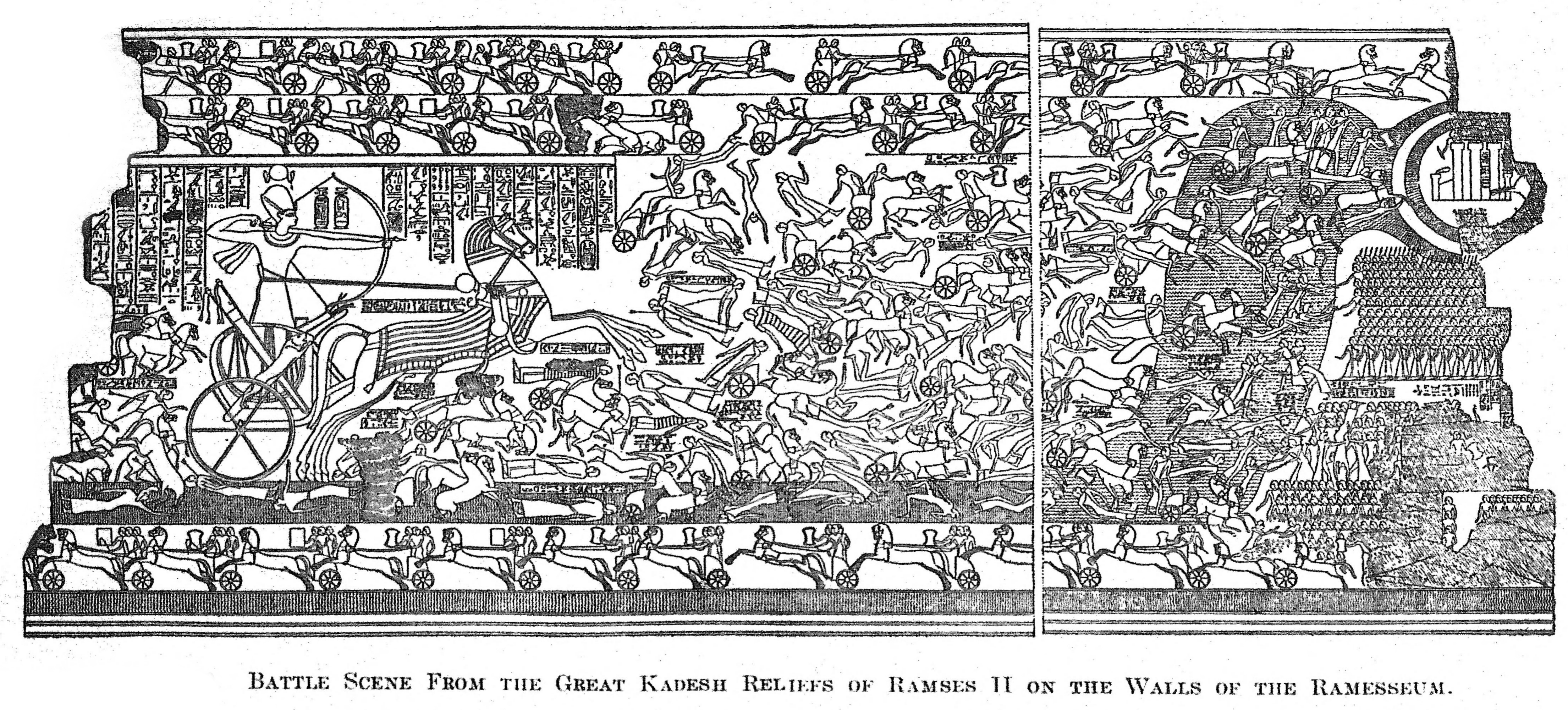
What happened next depends on whom you believe. In Ramesses's version, the pharaoh called upon the god Amun, mounted his chariot, and charged into the Hittite ranks with his personal guard and whatever survivors from the routed divisions he could rally. "I was before them like Set in his moment," he recorded. "I found the mass of chariots in whose midst I was, scattering them before my horses." The Hittite attack stalled as their heavier chariots became entangled in the obstacles of the large Egyptian camp. Egyptian chariots, lighter and more maneuverable, began to overtake the bogged-down Hittites in the counterattack. After six charges failed to break through, the remaining Hittite forces found themselves pinned against the Orontes. Many abandoned their chariots and tried to swim the river. Egyptian accounts say they crossed "as fast as crocodiles." Many drowned.
Two Versions of Victory
Ramesses declared Kadesh a personal triumph -- and he made certain the world knew it. The battle was recorded in two literary forms, the Poem and the Bulletin, inscribed at least fifteen times across temples in Abydos, Luxor, Karnak, Abu Simbel, and the Ramesseum. No other ancient battle comes close to this level of documentation from a single side. But Hittite records from their capital at Hattusa tell a different story: Ramesses was forced to withdraw from Kadesh in defeat. Modern historians generally conclude that the battle was a tactical draw. The Egyptians survived the ambush and inflicted serious casualties, but they failed to take Kadesh. Within a year, the territory Ramesses claimed to have won had returned to Hittite control. He had to march against the city of Dapur again in his tenth regnal year.
The First Great Peace
Neither empire could break the other. Muwatalli II campaigned as far south as the Egyptian province of Upi, placing his brother Hattusili (the future Hattusili III) in control. Egypt's Asian sphere of influence shrank to Canaan. The stalemate eventually produced something unprecedented: the Egyptian-Hittite peace treaty, one of the earliest known international agreements, preserved on both clay tablets and temple walls. Kadesh's legacy is therefore double-edged. It was the battle that demonstrated the limits of Bronze Age imperialism -- the point where the world's two greatest military powers realized that total victory was impossible. The chariot armies that clashed on the banks of the Orontes more than three thousand years ago fought to a standstill, and the peace they eventually negotiated outlasted both empires.
From the Air
Located at 34.555N, 36.498E in western Syria, near the modern village of Tell Nebi Mend along the Orontes River. The site sits in the Homs Gap, a strategic pass between the Lebanon and Anti-Lebanon mountain ranges that has been a military corridor for millennia. From altitude, the Orontes River is clearly visible winding through the valley. Nearest airports include Bassel Al-Assad International Airport at Latakia (OSLK), approximately 120 km northwest, and Damascus International (OSDI), about 160 km south. The terrain is relatively flat agricultural land along the river, flanked by rising terrain on both sides.