Battle of Kalijati
One pilot crept to his aircraft under enemy fire, climbed in alone, and took off from a runway that was already lost. That image -- a single plane lifting from Kalijati airfield as Japanese tanks rolled across the tarmac -- captures the desperation of 1 March 1942 in West Java. Colonel Toshinari Shoji's detachment had landed hours earlier at Eretan Wetan on Java's north coast, and by midmorning his forward units were already inside the airfield perimeter. The Dutch and British garrison, numbering about 350, never had a chance to mount a coherent defense. What followed over the next two days were counterattacks that came agonizingly close to retaking the field -- and then fell apart under relentless air power.
A Landing No One Expected
Japanese planners had identified Kalijati airfield as a critical objective for the invasion of Java. Controlling it meant forward-deploying air units close to Bandung, the military and political headquarters of the Allied forces in the Dutch East Indies. The invasion fleet, built around the Sixteenth Army, assembled at Cam Ranh Bay. On 27 February 1942, an Allied naval force tried to intercept the fleet and failed catastrophically in the Battle of the Java Sea. Four days later, at around 2 AM on 1 March, some 23,500 Japanese troops began landing across Java. Shoji's detachment -- about 3,000 men built around the 230th Regiment of the 38th Division -- came ashore at Eretan Wetan, in present-day Indramayu Regency. The Dutch had not stationed any defenders there. They considered the area unlikely for a landing because of seasonal high tides and shallow approaches. In a twist of irony, the Japanese had not expected opposition either, and Shoji's men were not equipped for a contested landing.
Eight Hours from Beach to Runway
Speed defined Shoji's operation. Major Shichiro Wakamatsu led the roughly 1,200-man assault group tasked with seizing Kalijati. His unit departed the beach by 6 AM and encountered the first KNIL positions by 10:30 AM. Japanese light tanks opened fire as they reached the airfield perimeter, and the garrison -- 180 KNIL troops under Lt. Col. J.J. Zomer, plus 170 British Army and RAF personnel who had arrived just two nights earlier -- found itself in an impossible position. Communications with Bandung had been severed by heavy rain, delaying any request for help until around 7 AM. RAF pilots had already been ordered to relocate their planes to the Andir airfield in Bandung, but some aircraft were still on the ground when the tanks arrived. The garrison broke under the armored assault. Those who held out in the last positions surrendered when their anti-tank ammunition ran out. Around 80 of these surrendering British and Dutch troops were executed by the Japanese -- one of several war crimes committed during the East Indies campaign.
The Counterattacks That Almost Worked
Dutch command in Bandung responded with urgency. By early afternoon on 1 March, they had assembled a counterattack force: 24 light tanks, armored vehicles, an infantry company, and three anti-tank guns. A larger formation, the Teerink Group of roughly 1,000 soldiers, was also committed, followed by KNIL's 2nd Infantry Regiment. But the first group did not reach its jump-off point by nightfall, delaying the assault to 2 March. When it came, around 8:15 AM, it overran the first Japanese defensive line near Subang. For a moment the momentum was real -- later Dutch assessments concluded the Japanese had barely held. Yet the attackers could not push through to the town itself and disengaged after two hours, having lost at least 14 killed and 13 tanks destroyed. The Japanese lost at least 20 killed. A second, larger attack was planned for 3 March using the reinforced 2nd Infantry Regiment, now numbering about 3,500 men under Major General Jacob Pesman.
Death from Above
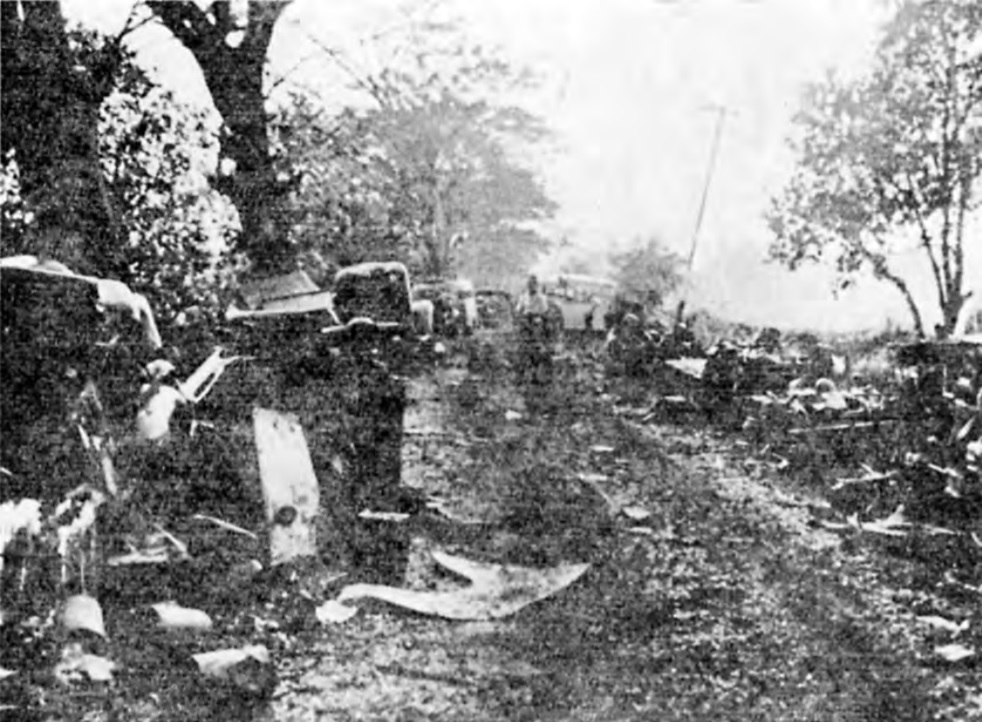
The 3 March counterattack never truly materialized. Japanese aircraft, now operating from Kalijati itself, intercepted the armored column heading north from Bandung. They destroyed over 150 vehicles and a significant quantity of guns and ammunition, inflicting more than 100 casualties. The bombing runs lacked anti-personnel munitions, but that hardly mattered. The real damage was psychological. KNIL soldiers -- most of whom had no combat experience -- broke under repeated strafing runs that prevented their officers from regrouping units between attacks. Non-European soldiers in particular dispersed and fled, a reflection of the colonial army's fragile cohesion under extreme stress. Some 300 men were ultimately recorded as dead, wounded, or missing. Only a single armored element reached the Japanese positions before being driven off. The Teerink Group, similarly battered from the air, failed to mount a serious assault. A separate Dutch attack on the landing positions at Eretan Wetan was pinned by Japanese artillery and withdrew after losing about 30 men.
Where Surrender Was Signed
The 2nd Infantry Regiment was finished as a fighting force. With the airfield secure and Allied counterattack capability destroyed, Shoji made a bold decision: rather than wait for the 2nd Division approaching from the west as his superiors expected, he would drive directly south toward Bandung through the Tjiater Pass. That assault, launched immediately after Kalijati, broke the last Dutch defensive positions in the mountains and triggered the surrender of all Allied forces in the Dutch East Indies on 9 March 1942. The formal surrender instruments were signed at Kalijati airfield -- the same strip that had changed hands so rapidly eight days earlier. Shoji and his air support units received citations of merit from Sixteenth Army Commander Hitoshi Imamura. Today the site is Suryadarma Air Force Base, an Indonesian military installation in Subang. The runway still functions. The events of March 1942 are remembered in military histories, though on the ground the landscape of rice paddies and scattered industry gives little hint of what the airfield once decided.
From the Air
Located at 6.53°S, 107.66°E in Subang, West Java, Indonesia. The former Kalijati Airfield is now Suryadarma Air Force Base (WIIS), an active Indonesian military installation -- exercise caution regarding restricted airspace. Bandung (Husein Sastranegara International Airport, WICC) lies approximately 40 km to the south. The flat coastal plain terrain gives way to volcanic foothills to the south toward Tjiater Pass. Best observed from 3,000-6,000 ft altitude to see the runway in context with the northern Java coastline and the mountain approaches to Bandung.