Battle of Kamdesh
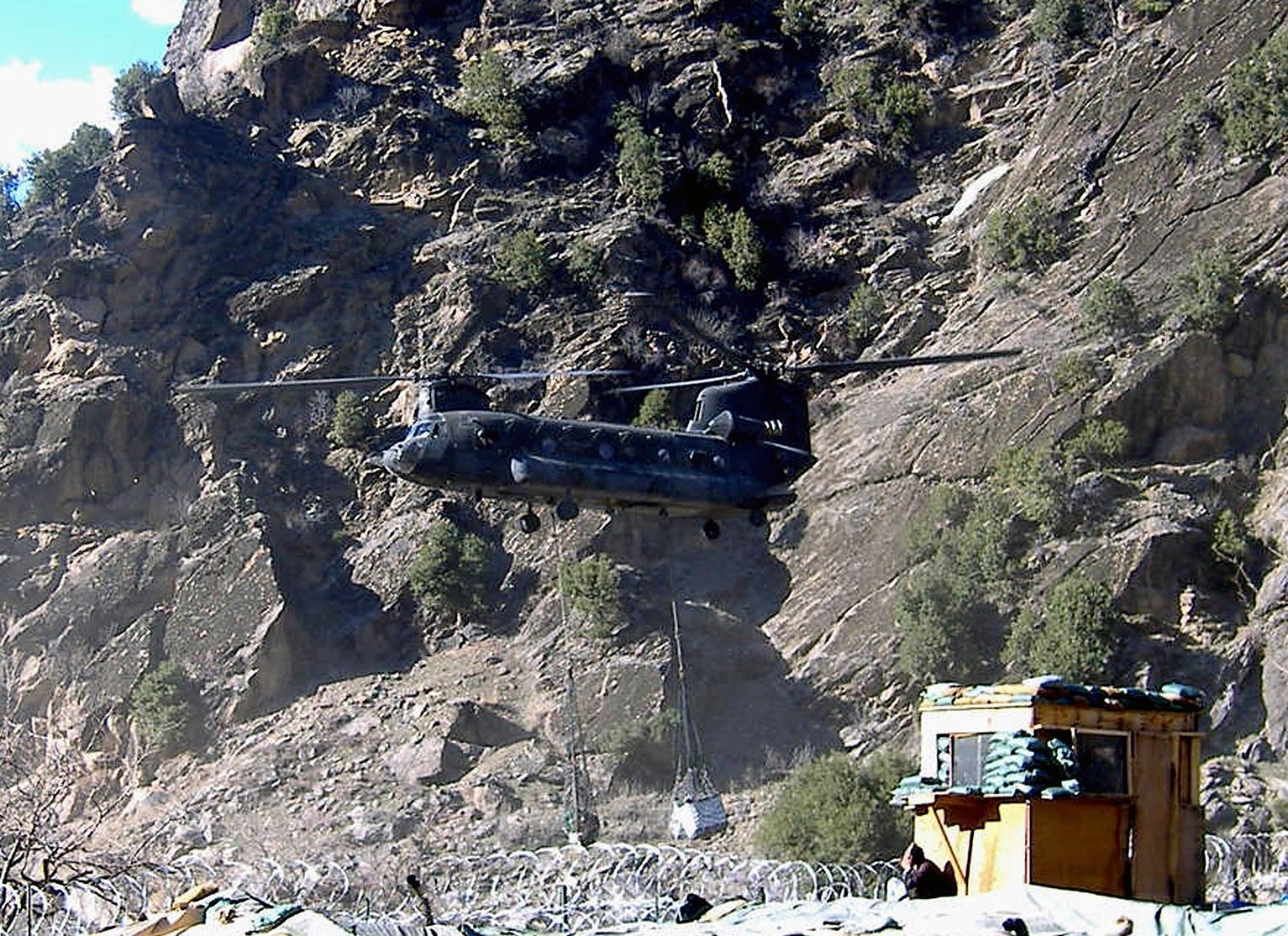
Combat Outpost Keating sat at the bottom of a bowl. Mountains rose steeply on three sides, and everyone who served there understood the problem: the terrain that was supposed to give American forces a strategic foothold at the convergence of three valley systems from Pakistan instead gave insurgents the high ground on every approach. By the summer of 2009, the outpost was scheduled for closure. Resupply convoys could no longer reach it by road, and helicopter flights were restricted to moonless nights. Three intelligence reports warned that an attack was imminent. Those warnings were discounted. On the morning of October 3, roughly 300 Taliban fighters proved them right.
The Logic of an Impossible Position
The outpost near Kamdesh in Nuristan Province existed because of a theory. In 2006, Allied commanders identified this remote junction -- where three valley systems from the Pakistan border converge -- as a chokepoint for the flow of weapons and fighters. Colonel John W. Nicholson Jr. of the 10th Mountain Division believed that a base here could disrupt those supply lines and extend the Afghan government's credibility into one of the country's most isolated provinces. Provincial Reconstruction Teams were the instrument. But Nuristan resisted simple strategy. The terrain was vertical, the population scattered and skeptical, and the insurgency grew more formidable each year. By 2007, anti-Afghan forces in the region had become broader and better organized than before the American invasion. The base that was supposed to project control instead required constant defense.
T-Shirts and Trust
Not every effort at COP Keating involved fortification. First Lieutenant Dave Roller tried something different: he stripped off his body armor, helmet, and weapons -- what soldiers called "battle rattle" -- and showed up to a meeting with village elders wearing a T-shirt and shorts. His reasoning was blunt. Encased in combat gear, Americans looked like machines built for killing, not partners in governance. Roller talked about families and communities instead. A local elder named Mawlawi Abdul Rahman was impressed enough to begin building consensus among village leaders in support of the Afghan government. Captain Joey Hutto, who took command of COP Keating in 2008 and had years of counterinsurgency experience from Central America, expanded the initiative through the summer and fall. But diplomacy and fortification were running on different clocks, and the clock that mattered was the one counting down to October.
Forty-Eight Minutes to Collapse
At 3:00 a.m. on October 3, 2009, insurgents ordered the villagers of Kamdesh to leave. Three hours later, fire erupted from every direction -- mortars, rocket-propelled grenades, and small arms from the ridgelines above. Observation Post Fritsche, which should have provided supporting fire, was attacked simultaneously. Within forty-eight minutes, attackers had breached the perimeter at three points: through a latrine area near the wire, through the main entrance where Afghan security guards were overwhelmed, and from the eastern side where Afghan National Army soldiers were stationed. Despite the efforts of two Latvian military advisors -- First Sergeant Janis Lakis and Corporal Martins Dabolins -- the Afghan soldiers broke and ran. None held their ground. The attackers poured in and set fire to the barracks. Within the first hour, the surviving American and Latvian defenders had collapsed to a perimeter around the two buildings that were not burning.
The Fight Back
From that desperate core, the defenders pushed outward. Staff Sergeant Clinton Romesha organized teams to retake sections of the outpost, expanding the perimeter back to the entry control point and the western buildings. Specialist Ty Carter braved heavy fire repeatedly to rescue a wounded soldier and deliver ammunition to isolated positions. Air support arrived -- A-10 Warthogs, Apache helicopters, a B-1 bomber, F-15 fighters -- directed by sergeants Armando Avalos and Jayson Souter and First Lieutenant Cason Shrode. The local mosque, from which some of the heaviest insurgent fire originated, was destroyed. The quick reaction force from the 1st Battalion, 32nd Infantry Regiment reached OP Fritsche by helicopter around 2:00 p.m. but had to descend to COP Keating on foot, fighting through an ambush on the mountainside. They entered the outpost at approximately 7:00 p.m., thirteen hours after the battle began.
Eight Names and a Reckoning
Eight American soldiers died at COP Keating that day: Staff Sergeants Justin Gallegos and Vernon Martin, Sergeants Christopher Griffin, Joshua Hardt, Joshua Kirk, and Michael Scusa, Specialist Stephan Mace, and Private First Class Kevin Thomson. They came from towns across America -- Tucson, Brooklyn, Thomaston, Manteca. Twenty-seven more were wounded. Specialist Ed Faulkner Jr., who survived the battle, died from a drug overdose a year later while struggling with post-traumatic stress. The subsequent investigation by U.S. Central Command concluded that "inadequate measures taken by the chain of command" had enabled the attack. Four officers were disciplined. But the investigation also praised the defenders for repulsing the assault "with conspicuous gallantry, courage and bravery." Both Romesha and Carter received the Medal of Honor from President Barack Obama in 2013 -- making COP Keating one of only a handful of engagements in the wars in Iraq and Afghanistan to produce two living Medal of Honor recipients.
From the Air
Located at 35.41N, 71.34E in Nuristan Province, eastern Afghanistan, deep in the Hindu Kush mountains. The former site of COP Keating sits at the convergence of three valley systems near the Pakistan border. Terrain is extremely mountainous with steep-sided valleys. The nearest significant airfield is Jalalabad Airport (OAJL), approximately 150 km to the south. Expect severe mountain turbulence, limited visibility in valleys, and rapidly changing weather. The site is approximately 20 miles from the location of the 2008 Battle of Wanat.