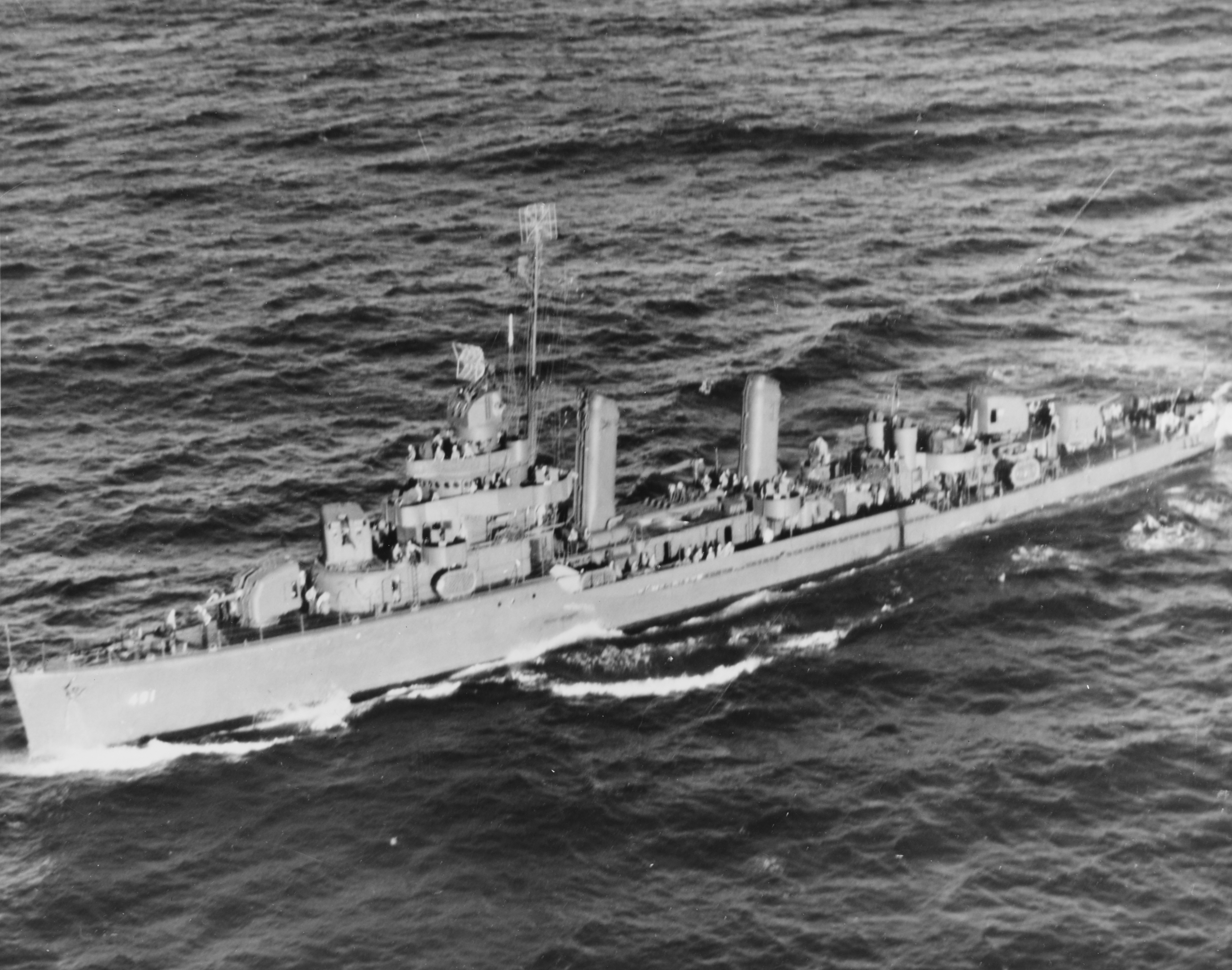
Battle of Karavia Bay
Moonrise was at 0050. Captain Rodger Simpson logged the time because in night combat a rising moon can turn invisibility into silhouette in fifteen minutes. Behind him, five American destroyers - Farenholt, Woodworth, Buchanan, Lansdowne, Lardner - were making thirty knots up St. George's Channel in calm seas under a low overcast, funnel smoke streaming black across their own wakes to confuse observers on shore. Ahead lay Karavia Bay, the southwestern mouth of the great natural harbor at Rabaul. No Allied surface force had ever raided here before. By the time the night was over, shore batteries on Praed Point, Raluana Point, and Cape Gazelle would all be silenced, and Simpson's squadron would be clear of St. George's Channel without a man lost.
The Fortress Left Behind
By February 1944, Rabaul was no longer the offensive springboard it had been. The Japanese had poured tens of thousands of troops and multiple airfields into the Gazelle Peninsula, planning from here the push toward Australia that the Coral Sea and Guadalcanal campaigns had blunted. Then Allied strategy shifted. Rather than assault Rabaul, Admiral Halsey's planners chose to bypass it - to isolate the fortress and let it wither. Heavy air raids had hammered Japanese aircraft from the skies; now the idea was to press in with warships and prove the place could no longer defend itself. Task Group 38.4 was the messenger. Their orders called it an anti-shipping and harassment sweep. The goal, as Simpson later wrote, was to hasten enemy evacuation.
Inside the Harbor Mouth
At 0107 Farenholt opened fire on Praed Point's shore battery. Eight minutes and 141 rounds later, Praed Point fell silent. Simpson shifted his guns to Raluana Point; 56 rounds silenced that battery too. Then came the torpedoes - low-speed runs fired through what American intelligence guessed was the channel in a Japanese minefield, aimed at the anchorage inside Karavia Bay where shipping lay vulnerable. At the same moment, heavy gunfire began coming out of Simpson Harbor from somewhere inside the bay. Simpson realized, later, it was from two Japanese destroyers sheltering inside. Woodworth and Buchanan swung broadsides onto them. The engagement was chaotic - American torpedo wakes running alongside American destroyers, Japanese salvos landing fifty yards off the starboard bow of the Farenholt. One bloomer canvas on a 5-inch gun mount caught fire and was beaten out. A hang-fire had to be unloaded through the muzzle. Combat is always, up close, small problems of this kind.
Cape Gazelle's Answer
Then Cape Gazelle opened up. Heavy-caliber shells began passing overhead, continuing to arc over the American formation as Simpson shifted fire to silence that battery too. Black funnel smoke now mingled with white chemical smoke - FS, the petroleum-based curtain destroyers laid behind them to break the firing solutions of shore guns. An observation plane from one of the American ships dropped a stick of bombs on Cape Gazelle. By 0159, having expended 284 rounds at that last battery, Farenholt ceased firing. At 0155 Cape Gazelle was abeam to starboard, receding. Simpson increased speed to thirty knots and turned for home. Until 0515, unidentified aircraft - bogies, in radio parlance - shadowed the retreating ships. One dropped flares at 0310. None attacked. The overcast and the rain squalls Simpson had been glad for at the start held long enough for his force to be clear.
The First of Its Kind
The Battle of Karavia Bay was, the Navy later noted, the first surface engagement ever fought in the Rabaul area during the Solomon Islands Campaign. It marked a psychological pivot as much as a tactical one. The Japanese had occupied Rabaul as the anchor of their South Pacific defense; now an American squadron had walked up to the harbor mouth, destroyed two transports, silenced three shore batteries, and walked away. Two Japanese destroyers inside the bay did not pursue. The port remained blockaded for the remainder of the war. Tens of thousands of Japanese troops on New Britain - the ones who would never be evacuated, who would wait out the war eating garden vegetables in tunnels under the volcanoes - would spend the next eighteen months not as the tip of the spear, but as its garrison.
What the Bay Remembers
Karavia Bay today is part of the broader Simpson Harbor system, still one of the most striking natural anchorages in the Pacific, still ringed by the volcanic cones that have defined Rabaul's history for longer than any war. The 1994 eruption of Tavurvur destroyed the old town and coated much of the Gazelle Peninsula in ash - a burial, in some ways, of the battlefields. But divers still find the wrecks. Local historians still tour the shore battery positions at Praed Point, where concrete emplacements crumble back into the tropical growth. Simpson's report survives as it is - a long, numbered, precise record of one night's work, the kind of document in which combat is always reduced to bearings, courses, and rounds expended.
From the Air
Karavia Bay lies at the southern end of Simpson Harbor on the Gazelle Peninsula of New Britain, approximately 4.30 degrees S, 152.18 degrees E. Tokua Airport (ICAO: AYTK) is the nearest operational airfield, about 15 nautical miles east-southeast. Rabaul's active volcanoes - Tavurvur and Vulcan - dominate the skyline; Tavurvur is usually steaming and should be given vertical separation on any approach. Best viewing altitude for seeing the caldera ring that contains Simpson and Karavia Bays is 6,000 to 10,000 feet. The Duke of York Islands, which sheltered Simpson's approach, lie to the east in St. George's Channel. Ash plumes from Tavurvur can reach 5,000 to 10,000 feet and are an active hazard.