Battle of Kasserine Pass
General Omar Bradley called it "the worst performance of the U.S. army in their whole proud history." In February 1943, a gap in the Grand Dorsal chain of the Atlas Mountains became the classroom where American soldiers learned what modern warfare actually looked like. The lesson cost 300 dead, 3,000 wounded, and 3,000 captured in just five days. But what happened at Kasserine Pass was not simply a disaster. It was the crucible that forged a different kind of army.
The Desert Fox and the Untested
Generalfeldmarschall Erwin Rommel saw opportunity in the green American troops. The U.S. II Corps, commanded by Major General Lloyd Fredendall, had never faced a full-scale armored assault. Rommel's forces -- the Afrika Korps Assault Group, the Italian Centauro Armored Division, and two Panzer divisions from the 5th Panzer Army -- struck between February 19 and 24, driving the initial American battalions back over 50 miles from their positions west of Faid Pass. British forces fared little better, losing all 11 of their tanks in the process. Fredendall's troops were scattered across defensive positions that their commander had selected from maps, never having personally walked the ground he was ordering men to hold.
A Catalog of Hard Lessons
The post-battle analysis reads like a textbook of everything that can go wrong. American soldiers, exasperated by Tunisia's rocky soil, dug shallow slit trenches instead of deep foxholes. They bunched together in groups visible to German artillery observers. They positioned themselves on ridgelines where their silhouettes made perfect targets. The 1st Armored Division drove straight into German anti-tank screens without understanding the tactics that experienced British units had already learned to fear. Overhead, the Luftwaffe controlled the skies, strafing and bombing with impunity while Allied reconnaissance aircraft stayed grounded. Every attempt to organize defensive artillery fire was neutralized by German close air support. The Americans were fighting a 20th-century war with 19th-century instincts.
The Tide Turns at Thala
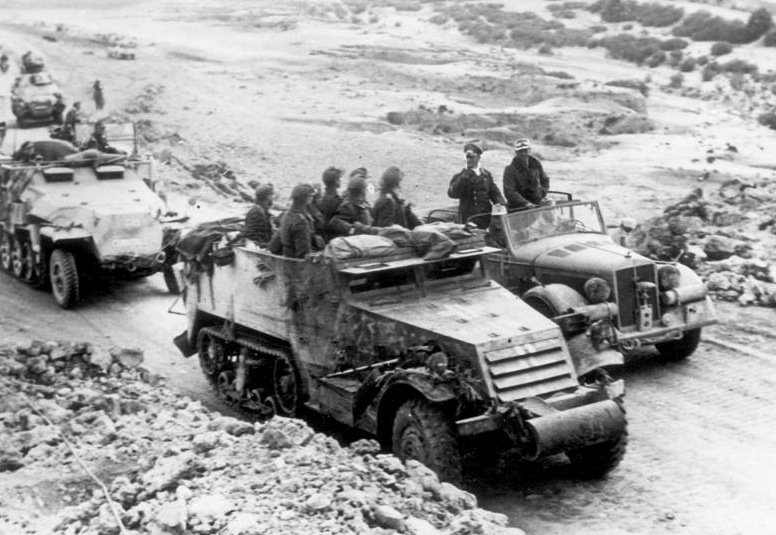
Yet the Axis offensive overextended itself. At Sbiba, along the Hatab River, and at Thala, German and Italian forces failed to crack the Allied line. Allied reinforcements with strong artillery support halted Rommel's advance, pinning down his forces. On February 23, a massive American air attack on the pass hastened the German retreat. By February 24, the Kasserine Pass was back in Allied hands, followed quickly by Feriana, Sidi Bou Zid, and Sbeitla. Rommel himself later conceded admiration for his enemy's rapid adaptation: he praised how quickly American commanders came to understand mobile warfare and noted that "British experience has been put to good use in American equipment." The sturdy M3 half-track impressed the Germans so much that they deployed large numbers of captured ones in their own units.
The Reckoning That Changed Everything
General Dwight D. Eisenhower acted decisively. He created the 18th Army Group under General Sir Harold Alexander to tighten coordination among the three Allied nations. Fredendall was relieved of command -- his own subordinates had lost confidence in him, and Major General Ernest N. Harmon bluntly called him "both a moral and physical coward." The U.S. Army instituted sweeping changes in unit organization, tactics, and command philosophy. The soldiers who staggered out of Kasserine Pass were not the soldiers who would later storm the beaches of Sicily and Normandy, but they carried the lessons that made those victories possible. Tunisia's mountain passes taught America how to fight a world war.
From the Air
Located at 35.26°N, 8.74°E in the Grand Dorsal chain of the Atlas Mountains, west-central Tunisia. The pass is visible as a narrow gap between rugged mountain ridges. Recommended viewing altitude: 5,000-8,000 feet AGL to appreciate the terrain's tactical significance. Nearest airports: Tozeur-Nefta International (DTTZ) approximately 100 km southwest, Kasserine (no ICAO code). The mountainous terrain creates turbulence; approach with caution in windy conditions.