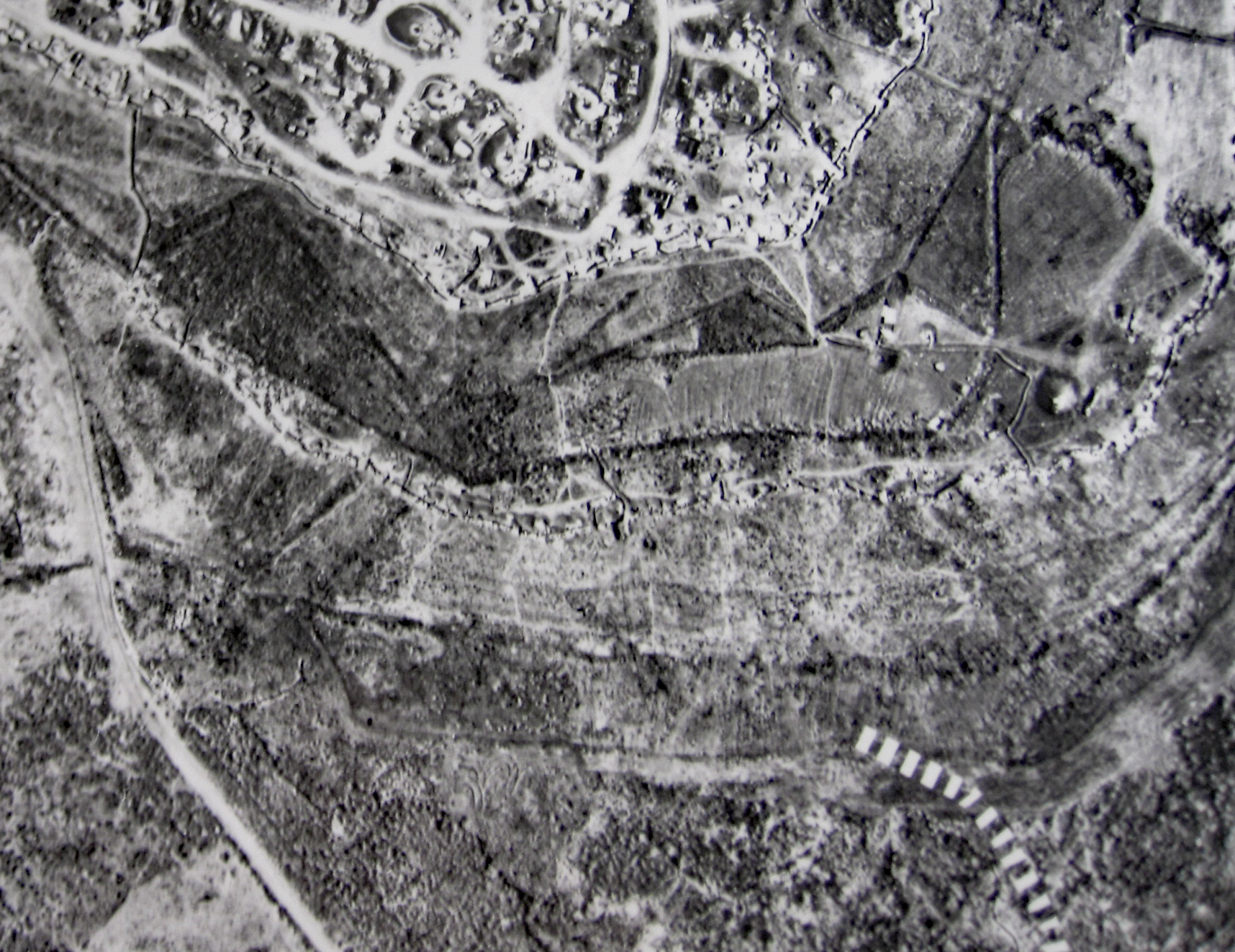
Battle of Khe Sanh
President Lyndon Johnson kept a terrain model of the Khe Sanh Combat Base in the White House Situation Room. He made his military commanders sign a written guarantee that the base would not fall. "I don't want any damn Dinbinfoo," he told them, mangling the name of the French defeat that haunted every American decision in Vietnam. For 77 days in early 1968, a remote Marine outpost near the Laotian border absorbed one of the most concentrated bombardments of the war -- while 500 kilometers to the south, the real offensive was already beginning.
An Outpost at the Edge
Khe Sanh sat in the western highlands of Quang Tri Province, about seven miles from the Laotian frontier along Route 9, the northernmost east-west road in South Vietnam. The area was home to Bru Montagnard villages and coffee plantations, and the combat base had its origins in a US Army Special Forces airfield built in August 1962 at an old French fort. By late 1967, intelligence indicated that North Vietnamese forces were massing in the surrounding hills -- two, possibly three divisions of the People's Army of Vietnam. General William Westmoreland saw an opportunity. If the enemy concentrated, American firepower could destroy them in the open. He envisioned Khe Sanh as "Dien Bien Phu in reverse" -- this time, the besieged side would have overwhelming air power. The roughly 6,000 Marines dug in and waited.
Seventy-Seven Days Under Fire
The siege began on January 21, 1968, when North Vietnamese forces attacked the base's ammunition dump and overran the nearby village of Khe Sanh. Over the following weeks, PAVN artillery and mortar crews poured an estimated 10,908 rounds into Marine positions. The base's only lifeline was air resupply -- the USAF delivered 14,356 tons of supplies, more than half by paradrop, while the 1st Marine Aircraft Wing added another 4,661 tons. In return, American aircraft dropped over 100,000 tons of bombs on the surrounding area by mid-April, roughly 1,300 tons daily -- five tons for every one of the estimated 20,000 North Vietnamese soldiers committed to the fight. B-52 Arc Light strikes from Guam, Okinawa, and Thailand "bombed the jungles surrounding Khe Sanh into stubble fields," as one account put it. On February 7, the PAVN overran the nearby Special Forces camp at Lang Vei using tanks for one of the first times in the war, and more than 6,000 refugees fled to the base's perimeter.
The Riddle
The question historians call "the riddle of Khe Sanh" is deceptively simple: who was distracting whom? On January 30, 1968 -- nine days into the siege -- the Tet Offensive erupted across South Vietnam. Viet Cong and North Vietnamese forces attacked cities and military installations throughout the country simultaneously. Was Khe Sanh a genuine attempt to replicate Dien Bien Phu, or was it bait designed to fix American attention in the remote highlands while the real blow fell elsewhere? Westmoreland insisted until his death that Tet was the diversion and Khe Sanh the true objective. Other analysts concluded the opposite: that the siege diverted roughly 30,000 US troops away from the cities that were the main targets of Tet. John Prados and Ray Stubbe framed the paradox succinctly -- "Either the Tet Offensive was a diversion for Khe Sanh, or Khe Sanh was a diversion to mesmerize Westmoreland in the days before Tet." Both sides claimed victory. Neither conclusion has settled the debate.
Relief and Abandonment
On April 1, 1968, Operation Pegasus launched the overland relief of Khe Sanh. The 1st Cavalry Division, supported by ARVN forces, fought along Route 9 and broke through to the base within two weeks. MACV estimated North Vietnamese casualties between 10,000 and 15,000, though precise numbers remain unknown -- 1,602 bodies were counted on the battlefield. American losses were significant: official Marine Corps records counted 205 killed during Operation Scotland (the main siege period), though broader tallies including all US forces and associated operations bring the figure to roughly 274 or higher, with additional deaths in follow-on operations through June. The 26th Marines received a Presidential Unit Citation from Lyndon Johnson himself. Then, on June 19, the Marines began destroying the base they had fought so hard to hold. Khe Sanh Combat Base was officially closed on July 5, 1968. The decision to abandon the position -- just weeks after declaring its defense a triumph -- struck many as an admission that the strategic value had been overstated all along.
The Ground Remembers
Khe Sanh was briefly reoccupied in 1971 as a staging base for Operation Lam Son 719, South Vietnam's disastrous incursion into Laos, then abandoned again on April 6 after coming under renewed attack. Military historian Ronald Spector concluded that recording the fighting as an American victory was impossible. Journalist Michael Herr's reporting from the siege helped inspire the surreal "Do Long Bridge" sequence in Apocalypse Now. Marine General Rathvon Tompkins, commander of the 3rd Marine Division, offered a pointed observation about the siege's reality: had the North Vietnamese truly intended to take the base, they could simply have contaminated the stream 500 meters outside the perimeter that served as the Marines' sole water source. The airlift could not have compensated. Today, the Khe Sanh area in Quang Tri Province bears the scars of the bombardment beneath regrown vegetation, and unexploded ordnance still claims casualties -- as a 1994 report noted, the battlefields of Khe Sanh were still producing roughly one casualty a day.
From the Air
Located at approximately 16.65N, 106.72E in the western highlands of Quang Tri Province, Vietnam, roughly 7 miles from the Laotian border. The terrain is hilly and heavily vegetated, with the old Route 9 running east-west through the area toward Laos. From altitude, the landscape shows the scars of heavy bombardment beneath tropical regrowth. Dong Ha Air Base (no longer operational) was the nearest major field during the war. Da Nang International Airport (VVDN) lies approximately 150 km to the southeast. The former combat base area sits in a valley surrounded by hills that once held North Vietnamese positions.