Battle of Kilimanjaro
The strategy was, as the historian Charles Miller later wrote, "faultless on paper." Two British columns would converge on German East Africa from opposite directions: one amphibious assault on the port of Tanga from the sea, and one overland strike at Longido, a settlement nestled on the slopes of Mount Kilimanjaro. Together they would crush the German Schutztruppe in a two-hundred-mile pincer. What actually happened in November 1914 was something closer to farce, at least on paper. In reality, for the Punjabi soldiers who climbed those slopes into fog and crossfire, it was anything but.
A Plan Designed in Mombasa
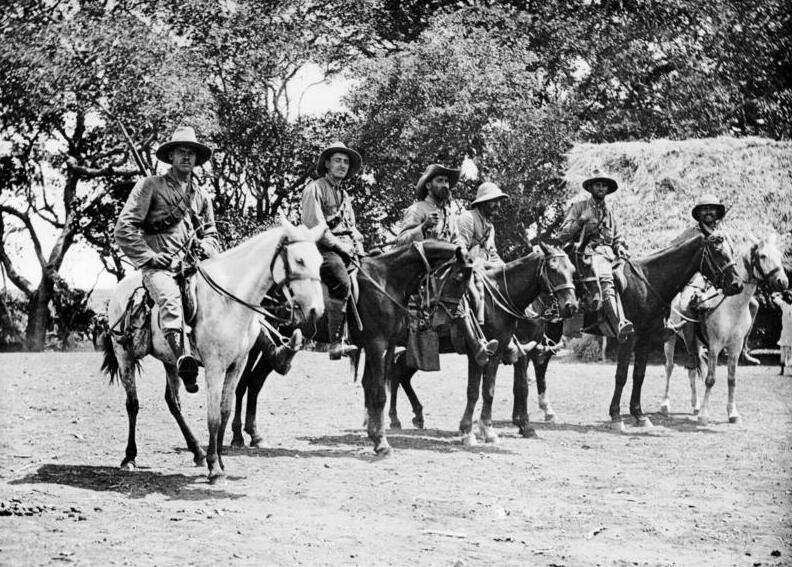
The British plan emerged from a staff conference in Mombasa, with Major-General Arthur Aitken in overall command. The main effort would be an amphibious assault on Tanga by Indian Expeditionary Force "B", some 8,000 men in two brigades. The secondary prong, more diversion than decisive thrust, would target the German defenses at Longido before swinging south to seize Neu Moshi and the western terminus of the Usambara Railway. The region mattered: German settlers had built plantations of sisal and coffee across the northern Usambara highlands, and small German raiding parties had already begun ambushing British detachments and harassing the Uganda Railway. By late October, Brigadier-General J. M. Stewart had assembled Indian Expeditionary Force "C" near the border with 4,000 men, including colonial volunteers calling themselves the East Africa Mounted Rifles. British intelligence estimated the German garrison at Longido at 200 soldiers. The actual number was 600 askaris in three Schutztruppe companies, plus an 8th Rifle Company of 86 German settlers on horseback.
Fog and Crossfire on the Mountain
On the night of November 3, 1914, approximately 1,500 Punjabi soldiers of the British Indian Army began climbing the slopes near Longido. They moved uphill through darkness, expecting to find a lightly defended position at the top. Instead, dawn revealed they had walked into a killing ground. Morning fog clung to the mountainside as the soldiers emerged into the crossfire of entrenched German positions. The Indian infantry fought hard when the Germans counterattacked, but they could gain no ground. The terrain favored the defenders absolutely, and the attackers spent the day pinned down, taking casualties they could ill afford in a fight that was supposed to be a diversion.
The Mules That Decided the Battle
By mid-morning, what remained of British momentum collapsed entirely. A mounted patrol from the 8th Rifle Company, those 86 German settlers on horseback, swept down and ambushed the British supply column trailing behind the assault force. Roughly 100 mules carrying water for the troops were stampeded and scattered. Some of the African carriers in the column dropped their loads of food, ammunition, and equipment in the panic. Without water, without resupply, with their troops scattered across an unfamiliar mountainside, the British commanders waited for darkness and then ordered a withdrawal. The force marched back down the slopes and retreated across the border into British East Africa. They had accomplished nothing. A force less than half their size had beaten them.
Diversion Becomes Disaster
The Longido attack had always been planned as the secondary effort. As Byron Farwell recounts, "the main effort was [the] ambitious amphibian assault on the port of Tanga." But the diversionary prong's failure freed the Longido garrison to act. The askari companies were loaded onto trains and shuttled south along the Northern Railroad to reinforce the defenders at Tanga, where they helped inflict an even more devastating defeat on the larger British force. The two-pronged strategy had not only failed to squeeze the Germans; it had allowed them to concentrate their strength against each British thrust in turn.
A War the World Forgot
The Battle of Kilimanjaro receives barely a footnote in most accounts of the First World War, yet it set the tone for an entire campaign. The defeat cooled British enthusiasm for war in East Africa, particularly among the colonial volunteers who had signed up expecting easy victories. It demonstrated that the Schutztruppe and their askari soldiers, African troops whose skill and loyalty are too often overlooked in European tellings of this war, could outfight a numerically superior force when defending prepared positions. Longido sits today in the shadow of Kilimanjaro, a quiet Tanzanian town where the slopes above still carry the memory of Punjabi soldiers who crossed an ocean to fight on a mountain they had never heard of, against an enemy who knew every rock and trail.
From the Air
Located at 3.08S, 37.35E on the northern slopes of Mount Kilimanjaro in Tanzania, near the Kenyan border. Mount Kilimanjaro (5,895 m / 19,341 ft) dominates the horizon. Kilimanjaro International Airport (HTKJ) is approximately 40 km to the southeast. The settlement of Longido sits at the base of a prominent hill visible from the air. Best viewed at 5,000-8,000 ft AGL. The Usambara Mountains are visible to the southeast, and the route south toward Tanga follows the old Northern Railroad corridor.