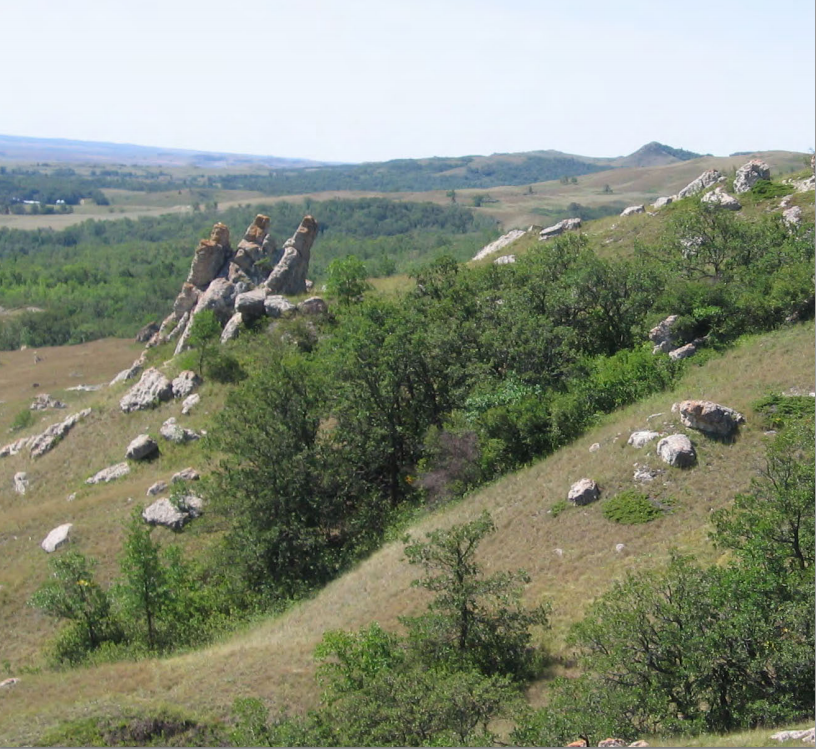
Battle of Killdeer Mountain
A Hunkpapa warrior named Lone Dog rode alone toward the massed soldiers, taunting them from just within rifle range. Brigadier General Alfred Sully ordered his sharpshooters to fire. Whether Lone Dog fell or escaped unscathed remains disputed, but those shots on July 28, 1864, opened the largest U.S. Army operation ever conducted against Native Americans. At the edge of the Dakota badlands, where Killdeer Mountain rises from broken terrain of deep ravines and rugged hills, over 2,200 soldiers faced an encampment of 1,500 to 1,800 tipis. Among the Lakota and Dakota warriors defending their families that day was Sitting Bull, not yet famous but already earning his reputation.
Revenge for Minnesota
The roots of Killdeer Mountain stretched back two years to the Dakota War of 1862 in Minnesota, when decades of broken treaties and starvation exploded into violence. The U.S. government's response punished all Sioux peoples, including bands that had taken no part in the conflict. Military expeditions in 1863 pushed most Sioux west of the Missouri River. By 1864, the desire to protect communication routes to newly discovered goldfields in Montana and Idaho added urgency. Steamboats carrying miners and supplies chugged up the Missouri through the heart of Sioux territory. Major General John Pope ordered Sully to establish forts, secure the goldfield routes, and eliminate the Sioux threat. Sully departed Fort Rice on July 19 with over 2,000 men, two artillery batteries with eight howitzers, and a wagon train of 200 gold-seeking emigrants he had reluctantly agreed to escort.
The Hollow Square
When scout Frank LaFramboise, a mixed-blood Santee, reported the massive Sioux encampment ten miles ahead, Sully assessed his tactical challenge. The badlands terrain made cavalry charges impossible. He dismounted his soldiers and formed them into a hollow square, each side stretching a mile and a quarter, with horses and artillery sheltered in the center. The Sioux gathered on hilltops and flanks - Hunkpapa, Sihasapa, Miniconjou, Sans Arc, Yanktonai, and a few Santee. Most were armed only with bows, arrows, and a few short-range muskets. Many of the Teton bands had never been hostile to the United States before this encounter. As the two forces faced each other across the broken ground, they exchanged insults before the shooting started.
Artillery Against Arrows
The battle's outcome was never in doubt. Sully's howitzers discouraged any massing of warriors, artillery shells scattering charges before they could reach the infantry. When Yanktonai and Santee forces struck Sully's right flank and Teton warriors attacked the left, Major Alfred Brackett's Minnesota Battalion mounted horses for a countercharge, scattering the Native forces with sabers and pistols at close quarters. Lieutenant George Northrup, a renowned frontier and Civil War hero, fell in that charge. As darkness approached, Sully halted near the Sioux village and continued bombardment through the night. The Sioux abandoned their encampment, fleeing or fighting delaying actions while their families escaped into the badlands. Sully reported three soldiers killed and ten wounded. He estimated 100 to 150 Sioux dead; the Sioux later claimed 31.
What the Soldiers Destroyed
The morning after revealed the cost beyond casualties. Sully detailed 700 men to destroy everything the Sioux had left behind: tipis, clothing, tools, and vast supplies of dried buffalo meat that would have sustained families through the coming winter. Up to 3,000 dogs were shot. A few Sioux left behind in the camp, including children, were killed by Winnebago scouts attached to Sully's force. When several Sioux appeared on a hilltop waving a white flag seeking negotiations, soldiers fired on them. That night, a Sioux war party killed two of Sully's picket guards. Another soldier died when his own guards mistook him for an enemy in the darkness.
Into the Badlands
The Sioux scattered west through the maze of ravines and buttes toward what is now Theodore Roosevelt National Park. Sully, despite dwindling rations, pursued them. A Blackfoot scout claimed to know a route through the badlands passable by wagon train. After two days of rest, Sully plunged into the unknown terrain, where the Sioux harassed his passage in the subsequent Battle of the Badlands. Today, a sandstone slab monument at Killdeer Mountain Battlefield State Historic Site marks the ground where this chapter of the Plains Wars unfolded. Two headstones honor Sergeant George Northrup and Private Horace Austin, soldiers of Brackett's Minnesota Cavalry. The site lies 8.5 miles northwest of the town of Killdeer, a quiet memorial in a landscape that still carries the scars of deep ravines and the memory of a day when the largest American army ever assembled against Native peoples advanced across this broken ground.
From the Air
Located at 47.43N, 102.92W in Dunn County, North Dakota. The battlefield site is 8.5 miles northwest of the town of Killdeer. From the air, Killdeer Mountain is visible as a prominent butte rising from badlands terrain cut by deep ravines. Theodore Roosevelt National Park's North Unit lies approximately 40 miles to the southwest. Lake Sakakawea extends to the north. The terrain shows the same broken, dissected landscape that made cavalry charges impossible in 1864. Nearest airport is Dickinson Theodore Roosevelt Regional Airport (KDIK), approximately 60 miles southwest. Best viewed at 3,000-5,000 feet AGL to appreciate the rugged terrain and the tactical challenges Sully faced.