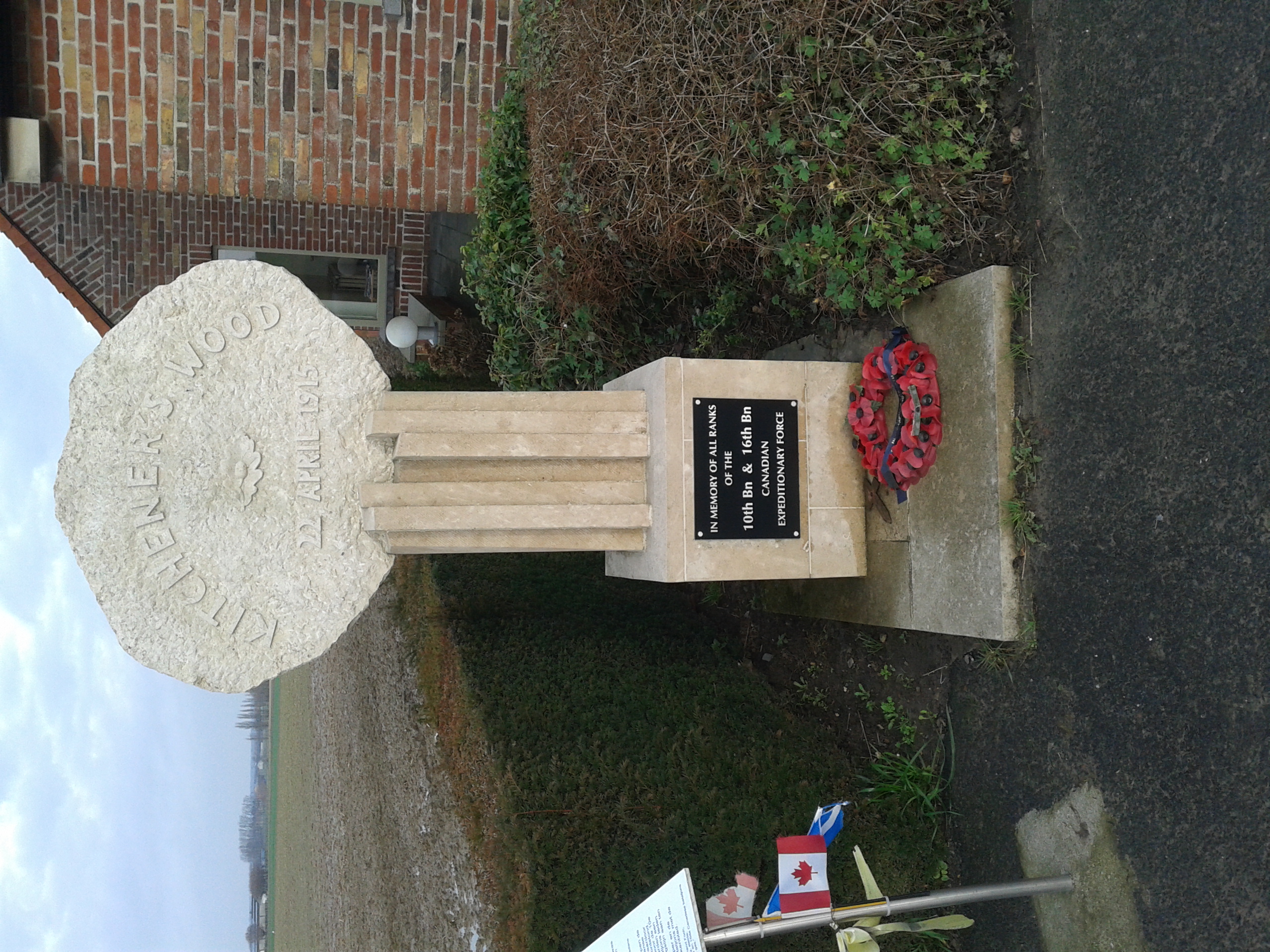
Battle of Kitcheners' Wood
The wood was named for cooks. French soldiers had set up their field kitchens here in the early months of the war, and the locals called it the Bois-de-Cuisinieres - the cooks' wood - which the British, careless with French, turned into Kitcheners' Wood, with the apostrophe in the plural place because there had been more than one cook. The name had nothing to do with Lord Kitchener. By midnight on 22 April 1915 it had nothing to do with cooks, either. Two Canadian battalions, formed up in a wheatfield in the dark with no map and no reconnaissance, were about to walk into it through machine-gun fire and across barbed wire because somebody had to close a six-kilometre hole in the Allied line, and they were the men closest to the hole.
A Yellow-Green Cloud
On the evening of 22 April 1915, the Germans opened the cylinders of their Disinfection Regiment 35 on a four-mile front north of Ypres and released 168 tons of chlorine. The yellow-green cloud rolled south on a light wind into the trenches of the French 45th (Algerian) Division and 79th Territorial Division. The Algerian division was made up of conscripts from the Tirailleurs Algeriens and Zouaves, mostly from villages in the Kabylia mountains. The Territorial division was older Frenchmen in second-line uniforms. Neither had any protection against chlorine: there was no protection in April 1915 because no army had ever used it. Men dropped where they stood, coughing up the linings of their lungs, drowning slowly in the air. The two divisions broke and ran. A six-kilometre gap opened in the line through the village of St Julien, with nothing behind it but Ypres.
Calgary and the Canadian Scottish
The 1st Canadian Division had been in France since February. It was a volunteer army from a country with no peacetime army to speak of, mostly young men in their twenties who had answered the call of August 1914: ranchers from Alberta, longshoremen from Vancouver, students from Toronto, Highland-Canadian regimental men in kilts and cap badges with thistles. The 10th Battalion of the 2nd Canadian Brigade had been raised mostly in Calgary - about sixty per cent of its original men came from that one prairie city. The 16th Battalion (Canadian Scottish) of the 3rd Brigade came from Victoria, Vancouver and Winnipeg, the Scottish regiments amalgamated into one battalion when the war began. They were told just before eleven at night on 22 April that they were to attack at midnight. Their objective was Kitcheners' Wood, on the German left flank of the new gap. No one had walked the ground. No one had a map of the wood. There were over 800 men in each battalion, formed up in waves of two companies each.
Eleven Forty-Six
The order to advance was given at 11:46 p.m. The two battalions moved across open Belgian wheatfield in the dark, in lines, in silence. Halfway to the wood they ran into a thick hedge interlaced with barbed wire that no one had known was there. They smashed through it with rifle butts and bayonets while German machine guns, 180 metres away across the open, opened up on them. The lead companies of the 10th Battalion lost most of their men in those minutes against the hedge. Lieutenant-Colonel Russell Lambert Boyle of the 10th, a 35-year-old rancher from Crossfield, Alberta, was hit by machine-gun fire in the opening rush. He died of his wounds a few days later. The survivors charged the last 180 metres, threw the Germans out of the wood at the bayonet, and held it. When the two battalions counted heads at dawn, they had lost more than seventy-five percent of their men. A small party of French Zouaves, eager to get back the field guns their division had abandoned in the wood that evening, had attacked with them.
Foch's Sentence
After the war, Marshal Ferdinand Foch, the Allied Supreme Commander, said that the assault on Kitcheners' Wood by the 10th and 16th Battalions had been "the greatest act of the war." The official British and Canadian battle honours later granted for the Second Battle of Ypres and for St. Julien did not include Kitcheners' Wood by name, and the regiments that perpetuated the two battalions - the Calgary Highlanders, the Winnipeg Light Infantry, the Canadian Scottish - lobbied for years to have the omission corrected. In the 1930s they were given dress distinctions instead: a small brass acorn and oak leaf, worn on the shoulder, in memory of the oak trees that had been in their way. By 1917 the trees were gone, levelled by two more years of shellfire. The wood does not exist on the ground any more. Open fields lie where it was.
A Hundred Years Later
The fighting continued for several days. The 1st Canadian Division as a whole lost about sixty percent of its men before being relieved. The 10th and 16th Battalions were reduced to less than twenty per cent of their pre-battle strength, which means that of every five men who walked into that wheatfield at 11:46 p.m. on 22 April 1915, four did not walk out. On 22 April 2015, exactly a hundred years to the day, soldiers of the Calgary Highlanders and the Canadian Scottish Regiment (Princess Mary's) marched from Mouse Trap Farm to the place where the wood used to be, led by their joint pipes and drums. At sunset they held a service of remembrance at the small oak-leaf memorial that marks the site. Then they sat down to dinner together on the field, exactly where their grandfathers and great-grandfathers had attacked across the wire in the dark.
From the Air
Located at 50.89N, 2.92E, about 6 km north of Ieper (Ypres), Belgium, in the area near St-Juliaan (St. Julien). The wood no longer exists on the ground; the site is open Flanders farmland with a small oak-leaf memorial near the corner of Hanebeekstraat and Kitchener Drive. Nearest airport is Wevelgem (EBKT, 24 km E); Ostend (EBOS, 53 km NW). Surrounding terrain is flat agricultural land at about 20 m elevation. Mouse Trap Farm, the assembly point, is about 1 km south.