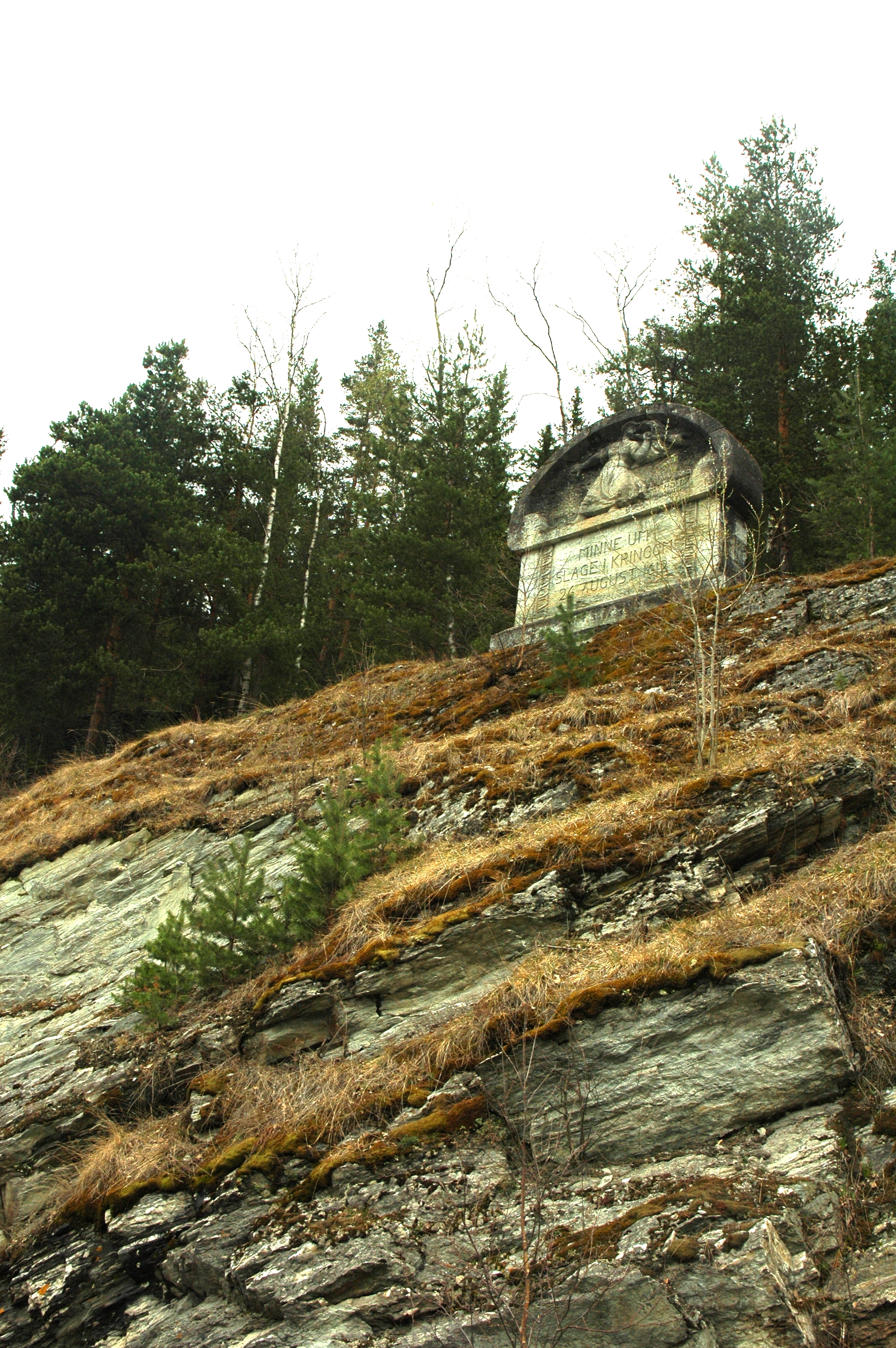
Battle of Kringen
Legend says the sheriff of Dovre walked into the parish church carrying a battle axe, struck it against the floor three times, and shouted: "Let it be known -- the enemy has come to our land!" Whether Lars Gunnarson Haga actually did this in August 1612 is uncertain. What is certain is that the farmers who answered the call -- from Vaga, Lesja, Lom, Dovre, Fron, and Ringebu -- marched into the Gudbrandsdal valley and destroyed a column of Scottish soldiers so thoroughly that the battle became the defining story of the region for the next four hundred years.
Scotsmen on the Wrong Side of a War
The Kalmar War between Denmark-Norway and Sweden created the conditions for the disaster. Scottish mercenaries, partly recruited and partly pressed into service by Sir James Spens, were bound for the Swedish army. King James VI of Scotland actually favored the Danish-Norwegian side, making the expedition awkward from the start. Two ships sailed from Dundee and Caithness in early August, rendezvoused at the Orkney Islands, and headed for Norway. Because Dano-Norwegian naval forces had blocked the sea routes to Sweden, the Scots decided to march overland -- a route other Scottish and Dutch forces had used successfully. They landed at Isfjorden in Romsdal on August 20 and began marching up through the Romsdalen valley and down into the Gudbrandsdal. The Norwegians, already furious about a massacre of their conscripts at Nya Lodose earlier that summer, were not inclined toward hospitality.
The Narrowing Valley
Oral history gives us two figures following the Scottish column on horseback, possibly on the opposite side of the valley. One was a woman named Guri -- Prillar-Guri to posterity -- and the other an unnamed man who rode his horse backward, distracting the marching troops. When the Scots reached the narrowest point of the Gudbrandsdal at Kringen, Guri blew her horn. The terrain was a trap by nature: steep slopes rising on one side, the river running hard against the only passable road on the other. The Scots had nowhere to go. Folklore says the Norwegians rolled logs and boulders down the hillside onto the marching column. What is documented is that they opened fire with crossbows and muskets. George Sinclair, a nephew of the Earl of Caithness and the officer whose name would become most associated with the battle, was among the first to fall, reportedly shot by a militiaman named Berdon Sejelstad.
No Quarter Given
Close combat followed. The Norwegian militia fought with swords, axes, scythes, and whatever else they had. Historians estimate the Scottish force numbered roughly 300 men -- far fewer than the 900 to 1,100 that folklore claims -- against perhaps 500 Norwegian militia. More than half the Scots died in the fighting. Those who survived the battle fared little better: all but 14 of approximately 300 were executed at Kvam, in what is now Nord-Fron Municipality. The dead were thrown into a mass grave at the local cemetery, north of a barn called the Skottelaven where captured soldiers had been held. The site became known as Skottehaugen -- the Scottish barrow. The surviving officers, including Alexander Ramsay, Sir Henry Bruce, James Moneypenny, and James Scott, were sent to Christiania for imprisonment and eventually repatriated.
Four Centuries of Memory
The battle wove itself into the valley's identity so deeply that traces appear everywhere. A statue of Prillar-Guri stands in the town of Otta, and the peak where she allegedly blew her horn bears her name. Place names along the route recall the Scottish incursion. Sinclair's grave became a local landmark, though the Norwegians of 1612 buried him deliberately outside the church walls as an insult. Captured Scottish weapons -- a pistol, a Lochaber axe, a broadsword, and several basket-hilted claymores -- are displayed at the Gudbrandsdal War Museum at Kvam. The local bunad design, known as rutaliv, echoes the Sinclair red tartan. Poets Edvard Storm and Henrik Wergeland wrote about the battle, and Edvard Grieg composed Sinclair's March as one of his Norwegian Dances. There is now a Sinclair's Club in Otta, and regular reenactments bring Scots and Norwegians together on the same ground where their ancestors fought.
From the Air
Located at 61.65N, 9.72E in the Gudbrandsdal valley near Otta, Innlandet county. The battle site at Kringen is in the narrowest section of the valley where the river runs close to the road and steep slopes rise on the opposite side -- the natural ambush terrain is still clearly visible from the air. Nearest airport is Fagernes Leirin (ENFG), approximately 75 km south-southwest. Best viewed at 2,000-4,000 feet AGL. The Prillar-Guri statue in Otta and the memorial at the battle site are ground-level landmarks.