Battle of Kuhmo
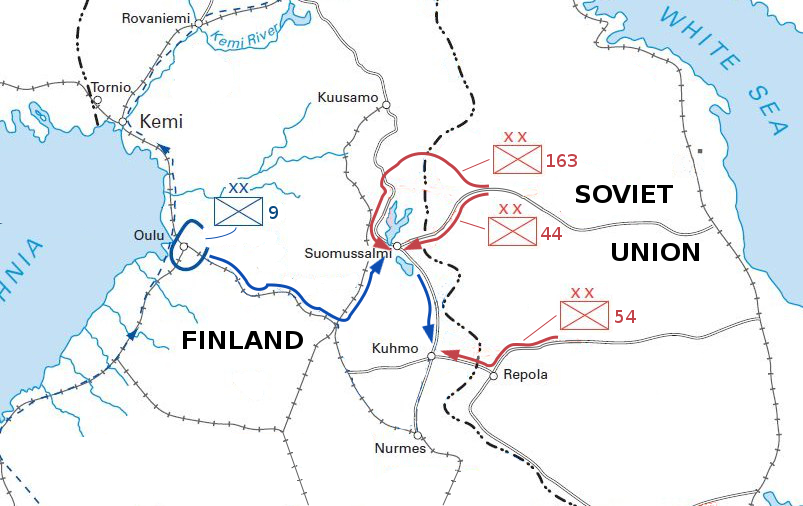
General Nikolai Gusevsky had time to think. By New Year 1940, his 54th Rifle Division had advanced to within 15 kilometers of the town of Kuhmo, deep in eastern Finland, and there it stopped. The Finns facing him were outnumbered, and for weeks they could not mount a serious counterattack. So Gusevsky fortified. He dug in along the approach road, stretched his division into an elongated column, and even built a makeshift airfield on a frozen lake. It was a sensible decision. It also turned his entire force into one long target.
A Supporting Act Gone Wrong
The 54th Division's mission was never the main event. It was supposed to support the advance of the 163rd and 44th Divisions on Oulu by cutting south to sever Finnish reinforcement routes from the heartland. The broader Soviet objective was breathtaking in scope: conquer northern Finland, cut the country's traffic routes to its neighbors, and force a capitulation. But the Finnish army had stationed only small border units in this sector—nobody expected a major attack through the northeastern wilderness. When the 54th Division crossed the border and began pushing toward Kuhmo, the Finnish High Command under Mannerheim scrambled to respond. On 3 December 1939, they sent the 14th Independent Battalion to slow the advance. It was a stopgap, and it held just long enough.
Siilasvuo Arrives
The turning point came in late January, after the stunning Finnish victories at Suomussalmi and Raate Road had freed up Hjalmar Siilasvuo's 9th Division. Between 20 and 23 January, the 9th Division reached the Kuhmo area and joined Regiment JR 25. On 28 January, Siilasvuo launched his counterattack against Gusevsky's fortified column. The Finns applied the same motti tactics that had destroyed the 163rd Division: ski troops carved the Soviet supply road into isolated pockets, cutting the column at multiple points. By 30 January, Finnish forces had captured Löytövaara, trapping the Soviets along a 28-mile stretch of road between Rasti and the border.
The Division That Would Not Die
Here is where Kuhmo diverges from Suomussalmi. The 54th Division did not collapse. Gusevsky's earlier fortification work, that frozen-lake airfield, and stubborn Soviet resistance kept the encircled pockets alive. The Finns hammered at the mottis for weeks—from late January through 13 March 1940—but could not deliver the decisive blow. Finnish casualties mounted: 1,340 dead, 3,123 wounded, and 132 missing. Soviet losses were comparable at 2,118 dead, 3,732 wounded, and 573 missing. In the sector where Colonel Dolin's ski brigade fought, Finnish troops later found the bodies of 720 Soviet soldiers. The 54th Division was battered, immobilized, and cut off, but it held out until the war ended on 13 March.
Victory and Frustration
The assessment of the Battle of Kuhmo is deliberately double-edged. The Finns blocked the Soviet advance—Kuhmo never fell, and the plan to sever Finland's internal reinforcement routes failed completely. But the Finnish high command had hoped for a quick repeat of Suomussalmi, intending to destroy the 54th Division rapidly and transfer the 9th Division south to the critical fighting on the Karelian Isthmus. That hope was thwarted. The 9th Division remained tied down at Kuhmo for the rest of the war, unable to contribute to the desperate defense of southern Finland where the outcome of the entire conflict was being decided. Kuhmo proved a lesson that the motti tactic, devastating as it was, had limits. Some encirclements produce annihilation. Others produce siege.
From the Air
Located at 64.85°N, 29.33°E near the town of Kuhmo in the Kainuu region of eastern Finland. The landscape is boreal forest, marshland, and scattered lakes. The former Soviet approach road runs east toward the Russian border, roughly 50 km away. Recommended viewing altitude: 3,000–8,000 ft AGL to see the road corridor and lake system. Nearest airport: Kajaani (EFKI), approximately 120 km southwest.