Battle of Kuwait International Airport
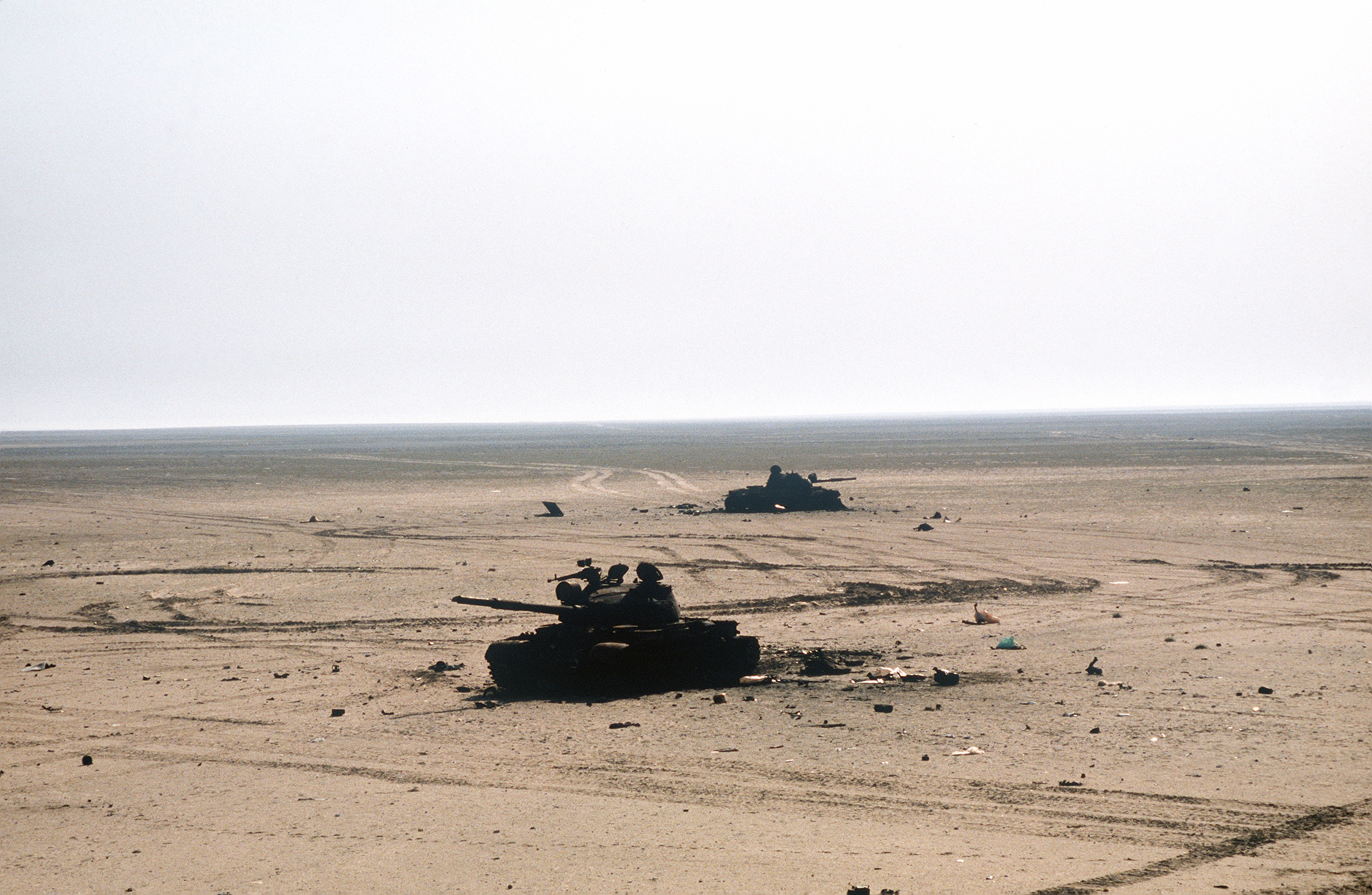
Thirteen M1A1 Abrams tanks against thirty-five Iraqi Republican Guard tanks. Outnumbered three to one. Ninety seconds later, every Iraqi tank was burning. The "Reveille Engagement" of February 25, 1991, earned its name because Bravo Company, 4th Tank Battalion woke to find an enemy armored column angling across their front in the pre-dawn darkness. What followed became the biggest and fastest tank battle in the entire history of the United States Marine Corps, and it was only the opening act of a three-day fight for Kuwait International Airport that would involve elements of 18 divisions from both sides.
Three Days Across the Desert
The battle for the airport did not begin at the airport. It began in the minefields. On February 24, 1991, the 1st and 2nd Marine Divisions punched through Iraqi defensive belts south of Kuwait City, losing M60A1 tanks to mines as they breached the obstacles. The 2nd Marine Division alone lost nine M60A1 tanks in the process. What awaited beyond the minefields was worse: Iraqi armored counterattacks, artillery barrages, and the burning oil fields of Burgan. Near Burgan, the 1st Marine Division destroyed around 60 Iraqi tanks without suffering a single loss. The flat, featureless terrain offered no cover for the defending Iraqi armor, and Marine M60A1 tankers proved devastatingly effective against the older T-55 and T-62 tanks opposing them. Task Force Shepherd lost 14 killed in action during the advance. The Iraqi 449th Artillery Brigade proved the most dangerous opponent, its accurate fire killing one Marine and wounding twelve others.
The Reveille Engagement
Early on February 25, Bravo Company of the 4th Tank Battalion, a Marine Reserve unit attached to the 2nd Marine Division, was resting in a coil formation with 25 percent of the crew on watch. The sentries spotted movement: a column of 35 Iraqi tanks rolling across their front, apparently unaware of the Americans' position. The company commander ordered his 13 M1A1 Abrams tanks online. In less than 90 seconds, all 35 Iraqi tanks were destroyed. The engagement demonstrated the lethal advantage of the Abrams' thermal sights and 120mm smoothbore cannon. By the end of the campaign, Bravo Company alone had destroyed 59 tanks, 32 armored personnel carriers, 26 unarmored vehicles, and an artillery piece. The speed and lopsidedness of the Reveille Engagement made it unique in Marine Corps annals, but it was part of a broader pattern: every Iraqi armored counterattack during the three-day battle was shattered before it could develop.
Fight at the Terminal
When the 1st Marine Division finally reached Kuwait International Airport on February 27, they found the remnants of the Iraqi 12th Armored Brigade, part of the 3rd Armored Division, dug in among the runways and terminals. The defenders had T-62 tanks in dispersed, understrength positions. Marines knocked them out with BGM-71 TOW missiles at long range. Inside the airport complex, U.S. Army Special Forces cleared the terminal buildings room by room, hunting snipers and holdout defenders. Meanwhile, Company I of the 3rd Battalion, 9th Marines broke an assault by the Iraqi 5th Mechanized Division's 22nd Brigade using Dragon anti-tank guided missiles and handheld anti-armor weapons at close range. Company C of the 1st Tank Battalion destroyed 18 Iraqi vehicles during that single engagement. Bravo Company tallied 119 enemy vehicles destroyed and captured over 800 prisoners of war.
Cutting the Escape
On the third day, the 2nd Marine Division liberated Al Jahra and seized the high ground on Mutla Ridge, severing the main Iraqi escape route from Kuwait to Basra. M1A1 tanks destroyed the majority of the 166 Iraqi tanks claimed by the division that day. The 1st Tank Battalion's final tally stood at 50 Iraqi T-55 and T-62 tanks and 25 armored personnel carriers. The 3rd Tank Battalion claimed 57 T-55s and T-62s plus five T-72s, seven APCs, and 10 trucks. The 8th Tank Battalion destroyed more than three dozen tanks and numerous other vehicles. Across the three days, the Marines lost five killed and 48 wounded. Iraqi General Ra'ad Hamdani later reflected on the outcome with brutal honesty: "We had a problem of inflexibility of usage with the armored forces. We always favored tying the infantry to tank divisions." The airport itself bore witness to the lopsided nature of the engagement, its runways littered with destroyed armor.
The Overlooked Battle
Despite its scale, the Battle of Kuwait International Airport remains one of the Gulf War's least-known engagements. The Highway of Death, the Battle of 73 Easting, and the air campaign dominate public memory. Yet the airport battle involved more divisions than almost any other engagement of the war and produced the single fastest armored engagement in Marine Corps history. Marines from Marine Air Traffic Control Squadron 38 established approach air traffic control services at the airport immediately after its capture, maintaining them until civilian controllers returned. The transition from battlefield to functioning airport happened with remarkable speed, a small symbol of how quickly Kuwait began rebuilding. Today the airport serves millions of passengers annually, its modern terminals revealing nothing of the three days when the runways served as a killing ground for Cold War-era tanks.
From the Air
Kuwait International Airport (ICAO: OKKK) sits at 29.24N, 47.97E, approximately 15.5 km south of Kuwait City center. The flat desert terrain surrounding the airport offers clear visibility of the battlefield area, including the Burgan oil field to the south. Nearby military airfields include Ahmad Al Jaber Air Base (OKAJ) to the south and Ali Al Salem Air Base (OKAS) to the west. The Mutla Ridge, where the 2nd Marine Division cut off the Iraqi retreat, is visible to the northwest. Approach from the south for the best perspective on the Marine advance route.