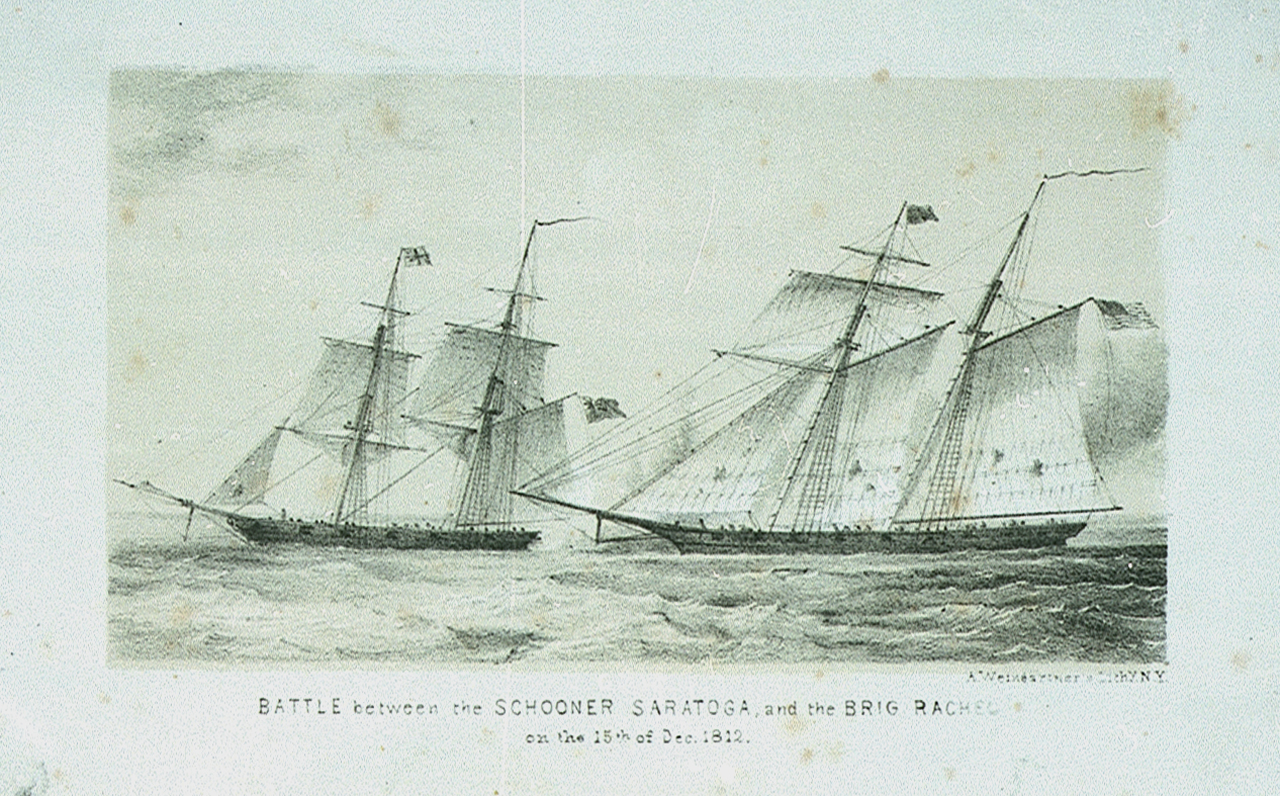
Battle of La Guaira (1812)
The War of 1812 is usually remembered as a conflict fought along the Canadian border and in the Chesapeake Bay. But on December 11, 1812, the war reached the Caribbean coast of Venezuela, where an American privateer named Saratoga tangled with a British brig off the port of La Guaira - a fight complicated by the fact that Spain, which controlled the port, wanted both of them gone.
An Unwelcome Guest
Captain Charles Whiting Wooster brought his schooner Saratoga into La Guaira on December 10, 1812, during a commerce-raiding cruise through the Caribbean. The Saratoga carried 16 guns and a crew of 140 men, making her a serious threat to merchant shipping. But La Guaira was a Spanish port, and Spain had no interest in hosting American privateers. The American consul delivered the warning bluntly: if Wooster remained in port, the Spanish garrison would use their shore batteries to sink his ship. Wooster withdrew beyond range of the guns but kept his position just offshore, watching the approaches. That same day, the Saratoga captured a British schooner and dispatched her as a prize back to the United States.
A Dead Captain's Ship
The next morning, December 11, a heavy fog blanketed the coast. When it began to lift, Wooster's lookouts spotted an incoming brig - a vessel that turned out to be a British letter of marque originally commanded by Captain N. Dalmahoy. She displaced 237 tons, mounted fourteen long 9-pounder guns, and carried a crew of thirty-six. But Dalmahoy himself had died two weeks earlier at sea, leaving command to his first mate, a man identified only as Alexander. The ship had been sailing for 57 days. A letter of marque was a privately owned vessel authorized by the British Crown to capture enemy merchant ships, making her both a combatant and a commercial venture. For Wooster, she was a prize worth taking.
Two Hours to Close
Immediately after spotting the British brig, Wooster set sail to intercept. But the wind and sea conditions that morning were uncooperative, and it took the Saratoga two full hours to close to firing range. The engagement that followed was decided by weight of numbers: the Saratoga's 16 guns and 140 men against the brig's fourteen 9-pounders and a crew already weakened by weeks at sea under substitute command. The details of the fight itself are sparsely recorded, but the outcome was clear: Wooster took the British vessel as a prize.
Prizes Lost and Won
The aftermath was messy, as War of 1812 naval engagements in distant waters often were. A 12-man American prize crew was placed aboard one of the captured vessels, but the British managed to retake the Americans and bring them aboard the Fawn. The British put their own six-man prize crew on the Rachel and sent her to Jamaica, where a Vice Admiralty court condemned her as a lawful capture. Fawn, meanwhile, sailed into La Guaira itself - the same port that had threatened to fire on the Americans the day before - and picked up Rachel's original crew. All of them agreed to serve aboard Fawn, though some deserted soon after. It was the kind of tangled, improvised warfare that characterized the War of 1812 at sea: loyalties shifting, prizes changing hands, and a Spanish port caught uncomfortably between two belligerents it wanted nothing to do with.
From the Air
Located at approximately 10.60N, 66.93W off the coast of La Guaira (now part of La Guaira state, formerly Vargas). The port of La Guaira sits at the base of steep coastal mountains, directly north of Caracas. Simon Bolivar International Airport (SVMI/CCS) is at nearby Maiquetia, along this same narrow coastal strip. From altitude, the contrast between the deep blue Caribbean and the steep green mountains rising immediately behind the port is striking. The battle took place in the waters just offshore.