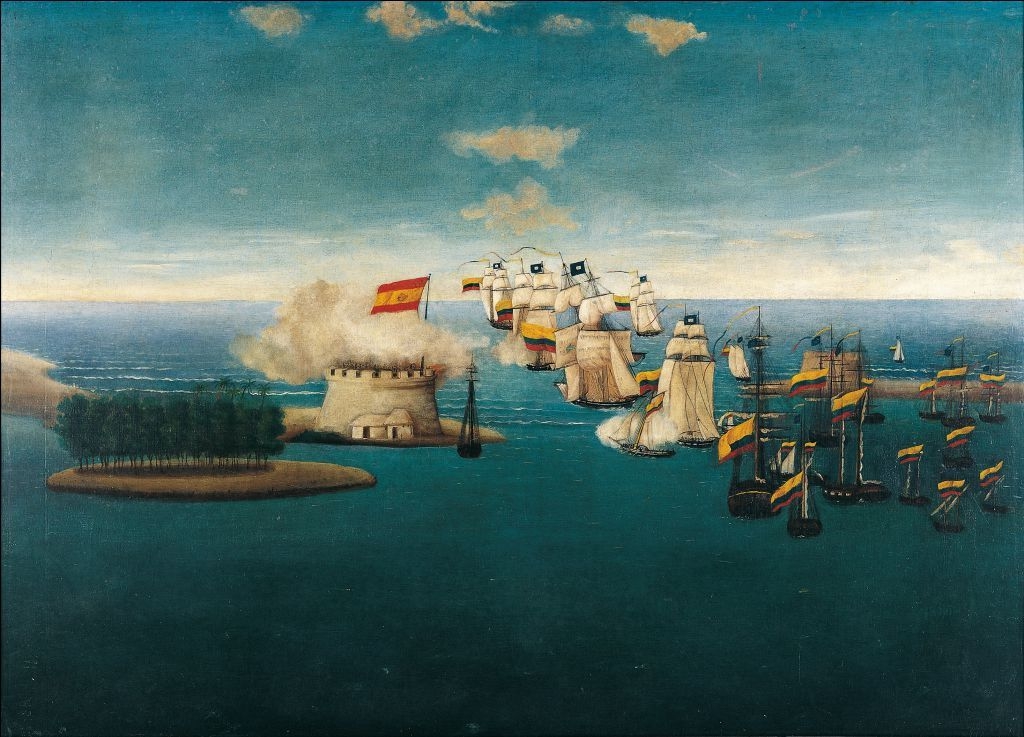
Battle of Lake Maracaibo
Admiral Jose Prudencio Padilla spent the morning of July 24, 1823, rowing between his warships. He boarded each one personally, speaking to every crew, stoking the fire he needed them to carry into battle that afternoon. It was an unusual gesture for a fleet commander -- most would have issued orders from the flagship and waited. But Padilla understood that the fight ahead would be decided by nerve as much as by cannon, and nerve required the kind of conviction you could only kindle face to face. By the time he finished, his republican squadron was anchored in a line along the eastern shore of Lake Maracaibo, staring across the water at the royalist fleet that stood between Venezuela and independence.
A War That Refused to End
Most historians mark the Battle of Carabobo in 1821 as the moment Venezuela won its independence. But the Spanish Crown did not see it that way. Royalist forces still held western Venezuela, including the strategic city of Maracaibo and its lake -- the largest body of water in South America. As long as Spain controlled Lake Maracaibo, it had a foothold from which to mount a counteroffensive. The republican forces of Gran Colombia, led by Simon Bolivar, recognized that the war could not truly end until that foothold was destroyed. The task fell to Padilla, a Colombian-born admiral of African descent who had risen through the republican navy on sheer ability and fearlessness. His opponent was Captain Angel Laborde, commanding a royalist squadron anchored in a defensive line along the western coast of the lake.
Two Fleets, One Afternoon
The wind would not cooperate. Through the morning and into early afternoon, Padilla waited for a favorable breeze, his fleet poised but unable to advance. At 14:00 he gave the order to sail west and strike the enemy's northern flank. By 14:28 his ships had formed a battle line, driving straight at the anchored royalist vessels. Captain Nicholas Joly commanded the northern wing, tasked with cutting off any Spanish retreat into the bay, while Padilla led the southern wing personally. The republicans closed the distance without firing, enduring the opening salvos of the royalist guns. At 15:45, the Spanish opened fire in earnest. Padilla's fleet absorbed the punishment and kept advancing. When the brig Independiente, its bowsprit shattered by cannon fire, crashed into the royalist ship San Carlos and grappled alongside, the battle turned. What had been an exchange of broadside fire became a close-quarters melee, and in that chaos, the republicans had the advantage.
Two Hours That Changed a Continent
The fighting lasted roughly two hours. Royalist vessels were destroyed or captured one after another. The brig-schooner Esperanza exploded. Most of the crew aboard the San Carlos abandoned ship, leaping into the lake. Only three schooners managed to escape, fleeing to shelter beneath the guns of the Fort of San Carlos. Republican losses were significant -- 8 officers and 36 crew killed, 14 officers and 150 crew wounded -- but the royalist fleet was shattered. Some 69 officers and 368 soldiers and sailors were taken prisoner. Commander Laborde managed to slip past the fort and reach the open sea, eventually sailing to Cuba. He would not return.
The Last Spanish Flag Comes Down
The consequences were swift and total. Within ten days, Spanish Captain General Francisco Tomas Morales was forced to surrender not only the remaining ships but the city of Maracaibo itself, the Fort of San Carlos, the Fort of San Felipe at Puerto Cabello, and every other Spanish-held position in Venezuela. On August 5, the last Spanish soldiers departed Venezuelan territory for good. Spain would not formally recognize Venezuela's independence for more than a decade, but it was a bureaucratic formality. The war was over. Today, July 24 is both a regional holiday in Zulia State and Navy Day in Venezuela and Colombia -- a double significance that owes everything to the coincidence that the battle fell on Simon Bolivar's birthday. For the people of Maracaibo, the date carries a particular weight: it was on their lake, beneath their sky, that the final act of liberation played out.
From the Air
Located at 9.82°N, 71.56°W on Lake Maracaibo in northwestern Venezuela. The lake itself -- 210 km long and 121 km wide -- is unmistakable from altitude, stretching between the Andes foothills and the Gulf of Venezuela. The city of Maracaibo lies on the western shore. Nearest major airport is La Chinita International (SVMC). The General Rafael Urdaneta Bridge, spanning the lake's narrow northern strait, is a prominent visual landmark. Best viewed at 5,000-10,000 ft to appreciate the full scale of the lake where the battle unfolded.