Battle of Oland
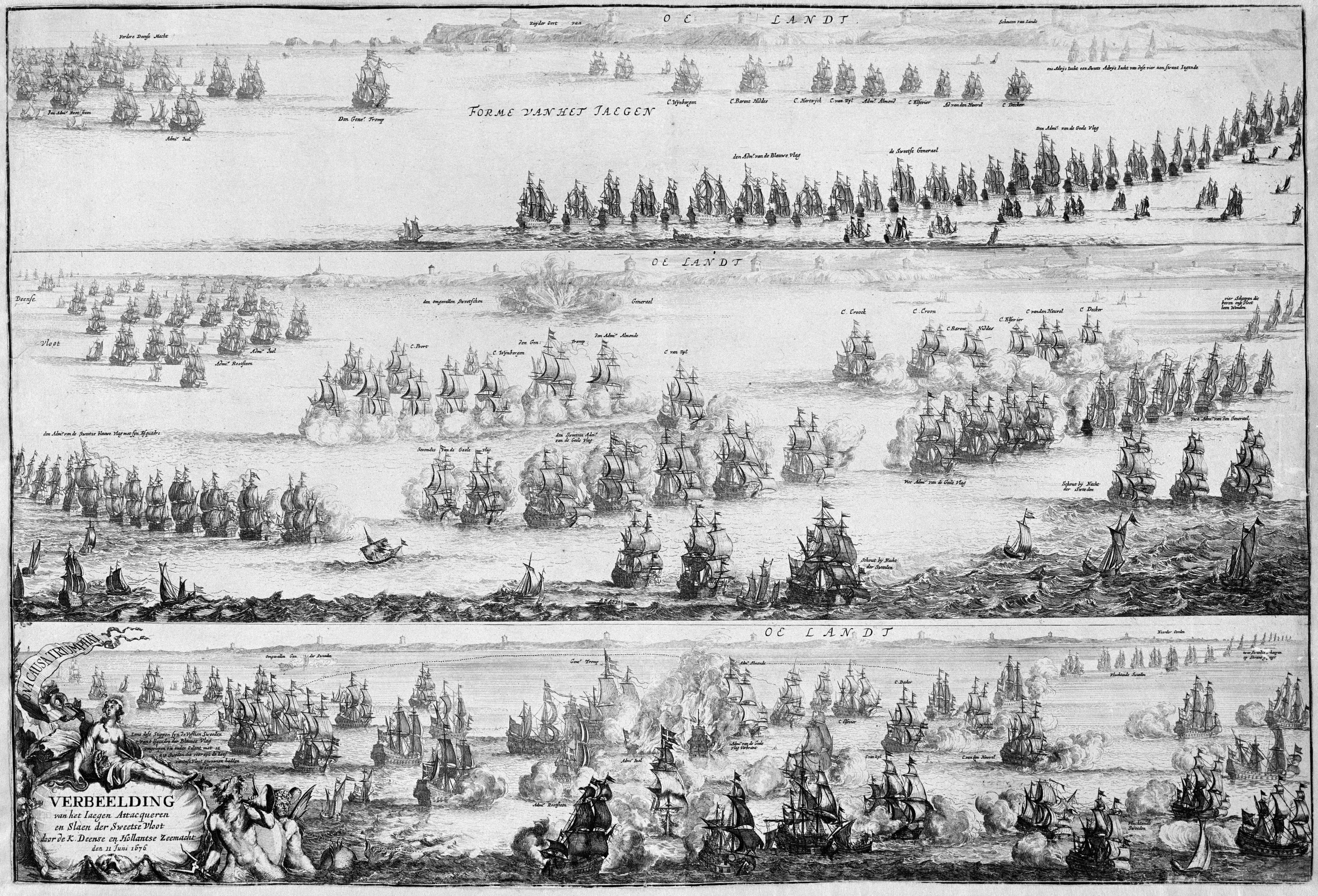
"Look how those dog cunts run," Admiral Claes Uggla reportedly shouted as he watched his fellow Swedish captains scatter, leaving him surrounded by enemy ships. Within hours, Uggla would be dead, his flagship ablaze, and the Swedish navy broken. The Battle of Oland on June 1, 1676, was not merely a naval defeat. It was a catastrophe that began when the massive flagship Kronan, carrying 124 guns and 850 men, capsized during a turn, exploded, and sank in minutes. The disaster killed Admiral of the Realm Lorentz Creutz and threw the Swedish fleet into chaos from which it never recovered that day.
The Stakes of Empire
By 1676, Sweden stood at the zenith of its power and the edge of disaster. The empire stretched from Finland across the Baltic states to German Pomerania, but maintaining it required constant warfare. Sweden had entered the Scanian War on France's side, and now faced a coalition of Denmark, the Dutch Republic, the Holy Roman Empire, and Spain. The southern Baltic was the crucial theater: Sweden needed it to reinforce troops in Germany, while Denmark needed it to invade Scania and reclaim territories lost in earlier wars. The Swedish fleet was numerically strong with 18 ships of the line, but older and poorly maintained. Rigging rotted, sails frayed, and crews lacked the professional seamanship of Danish and Norwegian sailors who had trained in the Dutch merchant navy.
A Turn Into Oblivion
The two fleets met off Oland's eastern coast on June 1st, racing northward in a strong gale. The Dutch ships in the allied fleet proved faster and seized the weather gage, the windward position that dictated the terms of battle. Around noon, poor coordination caused the Swedish line to turn unexpectedly toward the enemy. The flagship Kronan, one of the world's largest warships with her sails unreefed, heeled hard during the maneuver. Water flooded through open gunports. A gust pushed her further, masts touching the sea. Then the gunpowder magazine exploded, ripping the bow apart. Kronan sank so quickly that only a handful of her 850 crew survived. Admiral Creutz, the supreme commander of the Swedish navy, was among the dead.
The Second Admiral Falls
Command fell to Claes Uggla aboard Svardet, Sweden's second-largest warship. But Svardet was on collision course with Kronan's still-floating wreckage and had to jibe sharply to avoid it. Other ships interpreted this as a signal to turn, or to retreat, leading to confusion that scattered the fleet. Dutch Admiral Cornelis Tromp, Danish Admiral Niels Juel, and Vice Admiral Jens Rodsten converged on the isolated Svardet. For two hours, the 94-gun ship fought three enemy flagships simultaneously. When her mainmast crashed overboard, Uggla surrendered. But a Dutch fireship, either by accident or miscommunication, set the captured Svardet ablaze. Of 650 crew, only 50 survived. Admiral Uggla drowned trying to escape the flames.
Chickens in the Yard
The Swedish fleet disintegrated. Some ships fled toward Stockholm, others toward Kalmar Strait. Four smaller vessels were captured during the retreat. King Charles XI ordered an inquiry that produced damning testimony. Officer Anders Homman described his colleagues' actions as "chickens running about the yard, each in his own direction" and swore he had "been in seven battles, but had never seen our people fight so poorly." Yet the commission found no one guilty. Lieutenant Admiral Johan Bar and others were quietly stripped of commands, but the true cause ran deeper: an empire stretched too thin, ships maintained too carelessly, and an admiral whose role was administrative rather than tactical. The battle gave Denmark undisputed control of the Baltic and led Charles XI to establish a new naval base at what would become Karlskrona, an ice-free harbor closer to Danish waters.
From the Air
Located at 56.4494N, 16.6722E, off the eastern coast of Oland island in the Baltic Sea. The battle site lies approximately 10nm east of the island's southern tip. Kalmar-Oland Airport (ESMQ) is roughly 25nm to the west on the Swedish mainland. Clear Baltic weather allows excellent visibility of both Oland's limestone coast and the open waters where the Swedish fleet met disaster. The area is characterized by shallow waters and numerous sandbars.