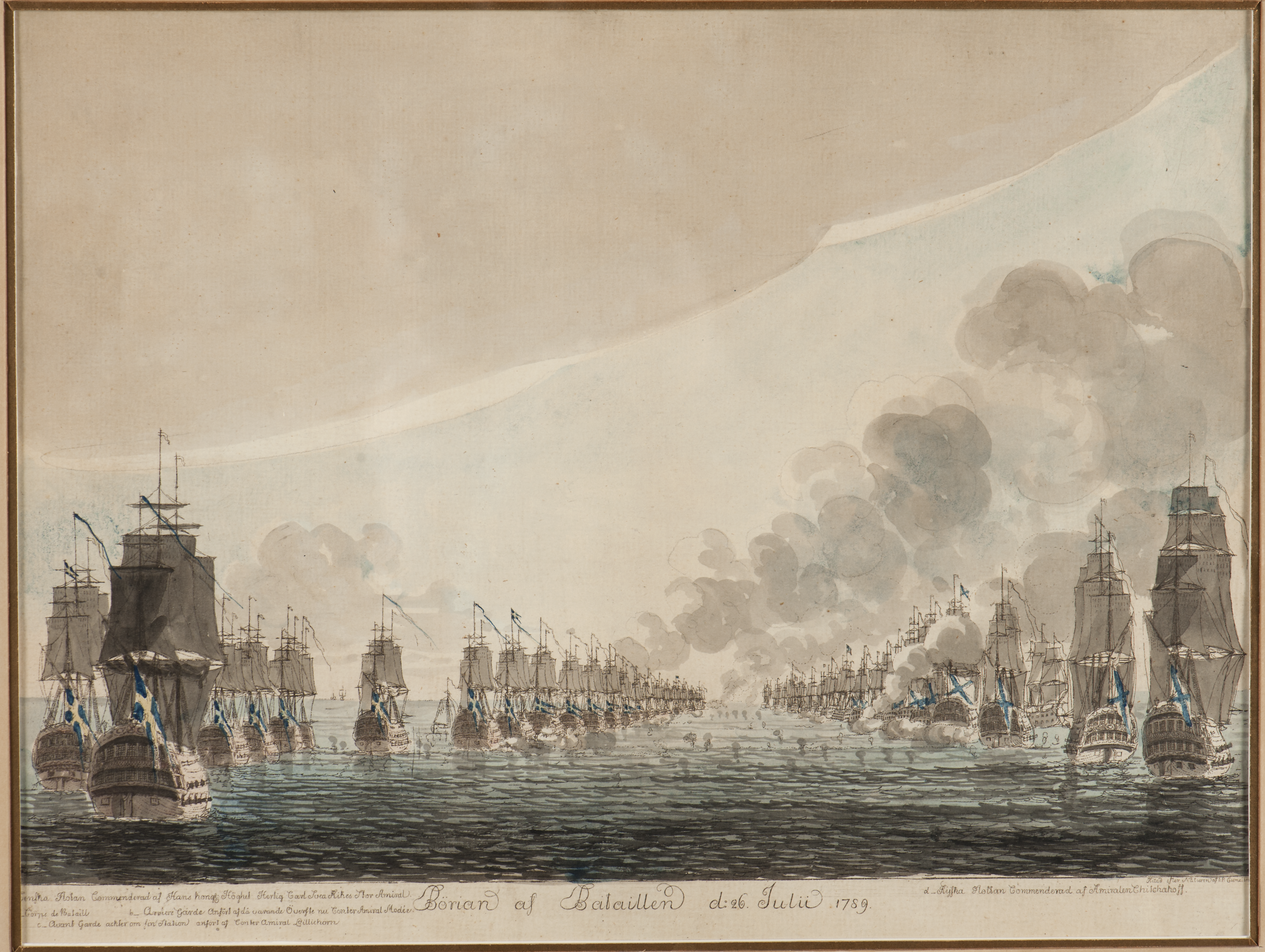
Battle of Oland (1789)
The captured Russian ship Vladislav carried more than prisoners back to Karlskrona in 1788. Hidden among the sailors was relapsing fever, a disease that would claim more Swedish lives than any enemy broadside. When the Swedish fleet finally limped out of port on July 6, 1789, to confront the Russians near the island of Oland, the real battle had already been fought in hospital wards and crowded berths. The engagement that followed would become a study in frustration, betrayal, and the limits of naval ambition when plague ravages a fighting force.
A Fleet Dying in Harbor
The epidemic's mathematics were staggering. From December 1788 to September 1789, naval hospitals at Karlskrona alone treated 26,249 sick sailors. Of these, 5,286 died within the hospital walls, while the total death toll across the fleet reached an estimated 15,000 lives. Ships sat ready at their moorings but without the men to sail them. Admiral Otto Henrik Nordenskiold performed a minor miracle simply getting 21 ships of the line and 8 frigates seaworthy by June, though many remained critically undermanned, some lacking more than a hundred sailors from their required complements. Thousands of infantrymen, men who knew nothing of working canvas and rope, were pressed into service to fill the gaps.
The Chase Through Baltic Waters
Prince Charles, Duke of Sodermanland, led his weakened fleet out with a desperate strategy: intercept the Russians before their scattered squadrons from Copenhagen, Reval, and Kronstadt could unite into an overwhelming force of 40 ships. For days the Swedes patrolled between Skane, Rugen, Bornholm, and Sjaelland, all while small dispatch vessels shuttled back and forth to Karlskrona, bringing healthy replacements and carrying away the ever-growing number of sick. On July 25, they finally spotted Russian sails near Gotland. The hunt was on, but the Russian Admiral Vasily Chichagov had no intention of fighting. His orders were clear: combine with the Copenhagen squadron first, then engage.
Cannons at Maximum Range
When battle finally came on July 26, it was an affair of frustrating distances. The Russians kept slipping away, trying to position themselves between the Swedes and Karlskrona. By 2 PM, the fleets had closed enough for cannon fire, but they remained so far apart that guns fired at maximum range achieved little. The greatest casualties came not from enemy shot but from misfiring cannons and barrel explosions aboard their own ships. Fighting paused when winds shifted between 4 and 6 PM, then resumed until 8 PM when the Russians turned east. The exhausted Swedish crews, too few to man both guns and sails simultaneously, could not pursue.
The Admiral Who Stayed Away
A darker story emerged from the battle's confusion. Admiral Per Lilliehorn, commanding the Swedish rear guard, had become separated from the main fleet and refused multiple orders to rejoin. When three Russian ships became isolated during the fighting, Swedish vessels were ordered to engage these easy targets. They turned away before reaching cannon range, their captains later claiming they acted on Lilliehorn's orders. The suspicion spread quickly: the Russians had bribed him. Lilliehorn was stripped of his rank before the fleet even returned to port. A court martial convicted him, though the government declined to execute him. Chichagov faced his own inquiry for avoiding battle, but his orders had explicitly required waiting for reinforcements.
Disease Claims Victory
By July 30, the real enemy had won. Roughly 2,500 more men had fallen sick since the fleet set sail. On July 31, with winds turning favorable for the approaching Copenhagen squadron, the Swedes retreated to Karlskrona rather than face two Russian fleets with fever-weakened crews. That same day, the Russian squadrons finally united. The Baltic Sea belonged to Russia for the remainder of the year. The epidemic that had never ended kept the Swedish fleet anchored through the autumn, its sailors dying of disease rather than at the hands of any foe. The Battle of Oland proved that navies fight not just against each other, but against time, weather, and the invisible armies of contagion.
From the Air
Located at 56.66N, 16.64E off the eastern coast of the island of Oland in the Baltic Sea. The engagement took place in open waters between Oland and Gotland. Nearest airports include Kalmar (ESMQ) on the Swedish mainland and Visby (ESSV) on Gotland. At cruising altitude, the Baltic appears as a vast gray-blue expanse; the long, narrow shape of Oland is unmistakable below, with the Swedish coast visible to the west.