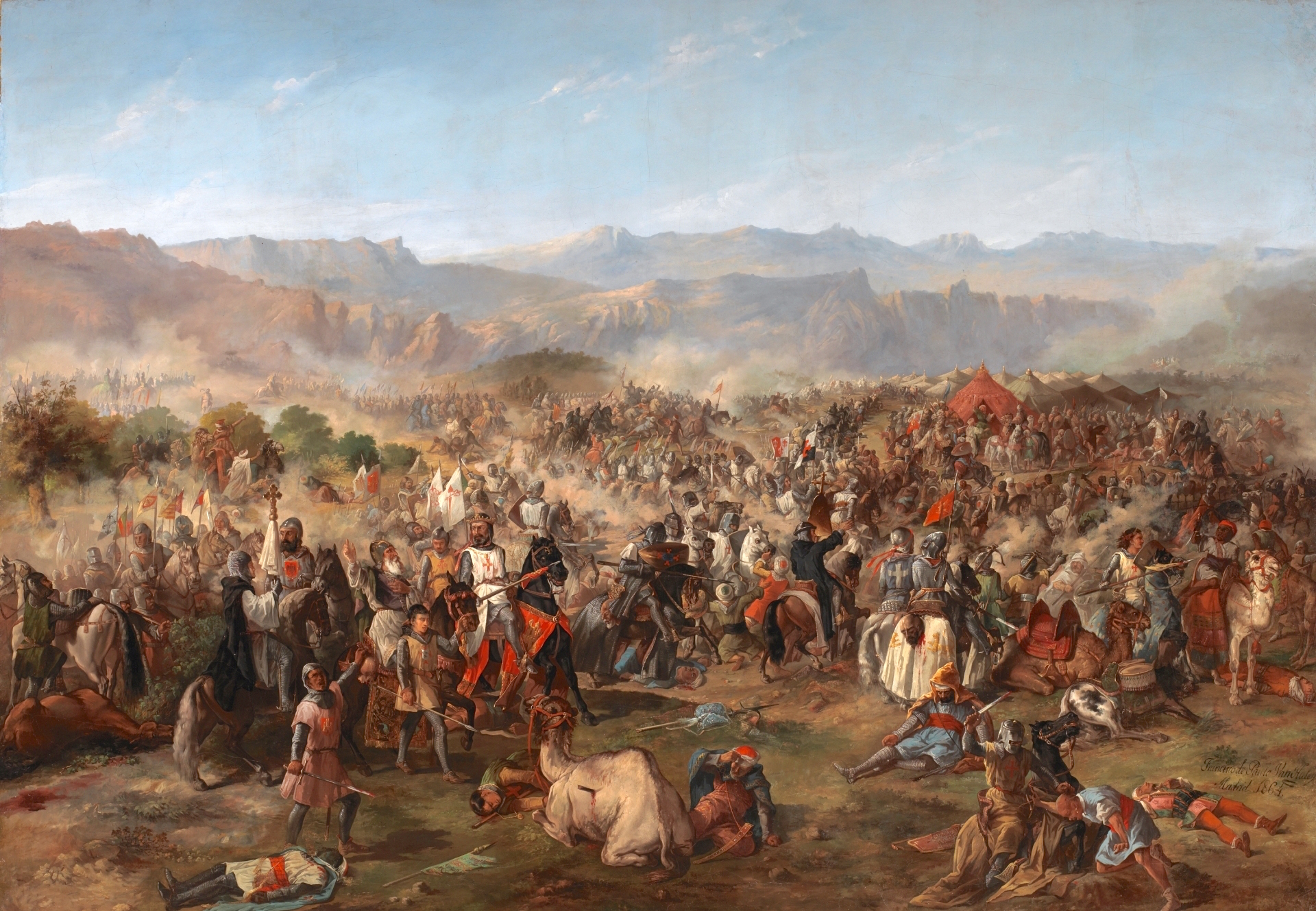
Battle of Las Navas de Tolosa
A shepherd named Martin Alhaja knew a path through the Sierra Morena that the Almohad army did not. On July 16, 1212, he led the combined armies of three Christian kingdoms through the Despeñaperros Pass, around the Muslim defensive positions, and into a battle that would break the power of the Almohad Caliphate in Iberia forever. For his service, Alhaja received the hereditary title Cabeza de Vaca -- Head of the Cow -- a family name that would eventually produce one of the first European explorers of the American interior. But on that July morning in the mountains of Jaén, such futures were unimaginable. What mattered was the gap in the ridgeline.
Rivals Against a Common Enemy
The Christian coalition at Las Navas de Tolosa was an unlikely alliance. King Alfonso VIII of Castile had been humiliated by the Almohads at the Battle of Alarcos in 1195, a defeat so devastating that the kingdoms of Leon and Navarre had briefly allied with the Muslims against Castile. Seventeen years later, the Almohad caliph Muhammad al-Nasir crossed the Strait of Gibraltar with an army drawn from across the caliphate and captured Salvatierra Castle, the stronghold of the Order of Calatrava. The threat was existential enough that Pope Innocent III declared a crusade, and Alfonso's former rivals -- Sancho VII of Navarre and Peter II of Aragon -- set aside their quarrels to join the fight. French and other European knights also arrived at the staging ground in Toledo, though some departed after disagreements over Alfonso's treatment of defeated Jews and Muslims.
Through the Mountains
The Almohad army had chosen its ground carefully, establishing a fortified camp behind the natural barrier of the Sierra Morena. The mountain passes were defended, and a direct assault up the narrow defiles would have been suicidal for the heavily armored Christian cavalry. This is where Alhaja entered the story. Whether he was a shepherd, a local hunter, or something else entirely, he knew a route through the Despeñaperros that bypassed the Almohad positions. The Christian army crossed the mountains and emerged on the southern side to find the Almohad camp still in place, its defenders caught by surprise. The battlefield near the hamlet of Navas de Tolosa, in the municipality of La Carolina in the province of Jaen, offered the kind of open ground where the Christian heavy cavalry could be used to devastating effect.
Breaking the Caliph's Guard
The battle was fought at close range, negating the advantage of Almohad archers. Spanish knights from the military orders -- Santiago, Calatrava, and the Knights Templar -- drove into the Muslim lines in a melee where their heavy armor and close-quarters training proved decisive. The Order of Santiago eventually broke the Almohad defensive line, opening gaps that King Sancho VII of Navarre exploited with a mounted charge aimed directly at the caliph's tent. Al-Nasir had surrounded himself with a bodyguard of slave-warriors in a densely packed formation -- the word "serried" was later mistranslated to suggest they were chained together, creating a persistent myth. The Navarrese force broke through this bodyguard. Al-Nasir escaped, but his army was routed. The caliph's tent and standard were sent to Pope Innocent III as trophies. Christian losses were around 2,000, with casualties concentrated among the military orders.
The Cascade
Al-Nasir never recovered. He retreated to Marrakesh and shut himself in his palace, dying within a year. His defeat set in motion a cascade of Christian conquests that would reshape the map of Iberia over the next two centuries. The Castilians immediately took the fortified cities of Baeza and Ubeda, opening the gateway to Andalusia. Alfonso VIII's grandson Ferdinand III captured Cordoba in 1236, Jaen in 1246, and Seville in 1248. James I of Aragon conquered the Balearic Islands and Valencia. By 1252, the Almohad empire was finished, succeeded by the Marinid dynasty, which later attempted to recover the lost territories but was decisively defeated at the Battle of Rio Salado in 1340. Only the Emirate of Granada survived as a Muslim state, paying tribute to Castile until its final fall in 1492.
A Turning Point Remembered
Historians have long debated whether Las Navas de Tolosa was truly the decisive moment of the Reconquista or merely one battle among many. The argument for its centrality is compelling: before 1212, the Almohad Caliphate could credibly threaten Christian Iberia's existence. After it, the question was not whether but when the remaining Muslim territories would fall. The battle also demonstrated that the fractious Christian kingdoms could cooperate when survival demanded it, a lesson that would be forgotten and relearned many times in the centuries ahead. The site itself, in the eastern Sierra Morena some 15 kilometers from the province of Ciudad Real, remains a quiet place of olive groves and dry hills -- the kind of landscape where armies could disappear into ravines and a shepherd's knowledge of a single mountain path could alter the trajectory of civilizations.
From the Air
Located at 38.34°N, 3.55°W in the Sierra Morena mountains near La Carolina, province of Jaén. The battlefield is in hilly terrain between the Sierra Morena and the Guadalquivir valley. The Despeñaperros Pass, critical to the battle, is visible from altitude as a dramatic gorge cutting through the mountains. Nearest airport: LEJR (Jaén). Best viewed at 5,000-8,000 ft AGL, where the mountain passes and valley approaches are clearly visible.