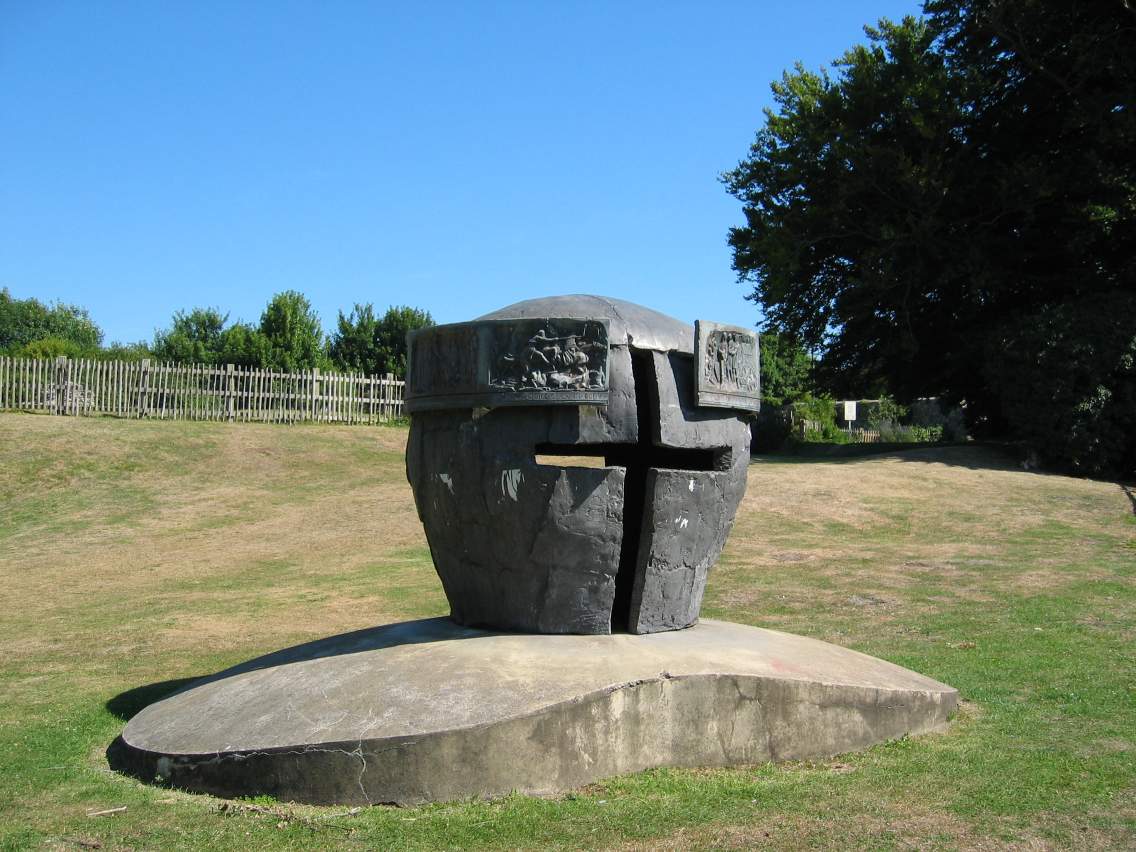
Battle of Lewes
The men who marched down from Offham Hill on the morning of 14 May 1264 wore white crosses stitched to their tunics -- not as crusaders, but to distinguish themselves in the chaos of battle from the king's soldiers below. Simon de Montfort, 6th Earl of Leicester, had led them through the night from Fletching, eight miles to the north, gambling that a surprise dawn assault on King Henry III's forces at Lewes could settle, in a single morning, a constitutional dispute that had consumed England for years.
A Kingdom's Grievance
Henry III was an unpopular king, autocratic in style and notorious for favouritism. In 1258, the barons had imposed the Provisions of Oxford, a set of reforms that included a thrice-yearly council to oversee governance, led by de Montfort. Henry chafed against these restrictions and appealed to Louis IX of France to arbitrate. Louis sided entirely with the king and annulled the provisions. De Montfort, enraged, raised an army. The resulting conflict, the Second Barons' War, was not initially fought in pitched battle -- both sides toured the country gathering support. By May 1264, Henry's forces had reached Lewes, intending to wait for reinforcements. De Montfort offered to negotiate. The king refused.
The Charge and the Rout
De Montfort divided his army into four divisions and occupied the high ground of Offham Hill, northwest of the town. Henry's son, Prince Edward, commanded the royalist right wing and launched a devastating cavalry charge that routed a contingent of Londoners in the baronial ranks. But Edward made a fatal error: he pursued the fleeing Londoners off the battlefield, leaving his father's centre exposed. Henry ordered his infantry uphill into the baronial line. The Earl of Cornwall's division on the left collapsed almost immediately. Henry's men fought on, but when de Montfort committed his reserves, the royalists broke and fled back to Lewes Castle and the priory of St Pancras. The battle was over by midday.
The Uncrowned King
Henry was forced to sign the Mise of Lewes, a document that has not survived but whose terms are clear from what followed: the king accepted the Provisions of Oxford, and Prince Edward was held hostage by the barons. For the next fifteen months, Simon de Montfort was effectively the ruler of England -- the "uncrowned king," as contemporaries called him. He summoned a parliament in January 1265 that, for the first time, included representatives of the towns as well as the nobility, a precedent that would echo through centuries of English governance. His power lasted until Edward escaped captivity and defeated him at the Battle of Evesham in August 1265, where de Montfort was killed and his body mutilated.
Where the Blood Was Shed
The precise location of the battle remains debated. Modern housing covers Offham Hill's eastern and lower slopes, and the current scholarly consensus places the main engagement on the site now occupied by HM Prison Lewes -- an ironic fate for ground where English liberty was arguably born. Contemporary sources suggest the initial clash took place along what is now Nevill Road. The upper slopes remain accessible via footpaths across agricultural land, and visitors can still walk the ground where de Montfort's men held the hilltop against the king's charge. The ruins of St Pancras Priory, where the defeated royalists took shelter, and Lewes Castle itself are open to visitors. In 2014, on the 750th anniversary, archaeologists noted that some skeletons found near the battlefield may date not from the battle but from the Norman Conquest, a reminder that this Sussex hillside has seen more than one reckoning.
From the Air
Located at 50.88N, 0.01W. Lewes sits in the valley of the River Ouse in East Sussex, with the distinctive chalk hills of the South Downs visible on approach. Offham Hill rises northwest of the town. The castle and priory ruins are visible in the town centre. Nearest airports: EGKA (Shoreham, 10nm west), EGLL (Gatwick, 18nm north). Best viewed at medium altitude for topographic context of the battlefield.