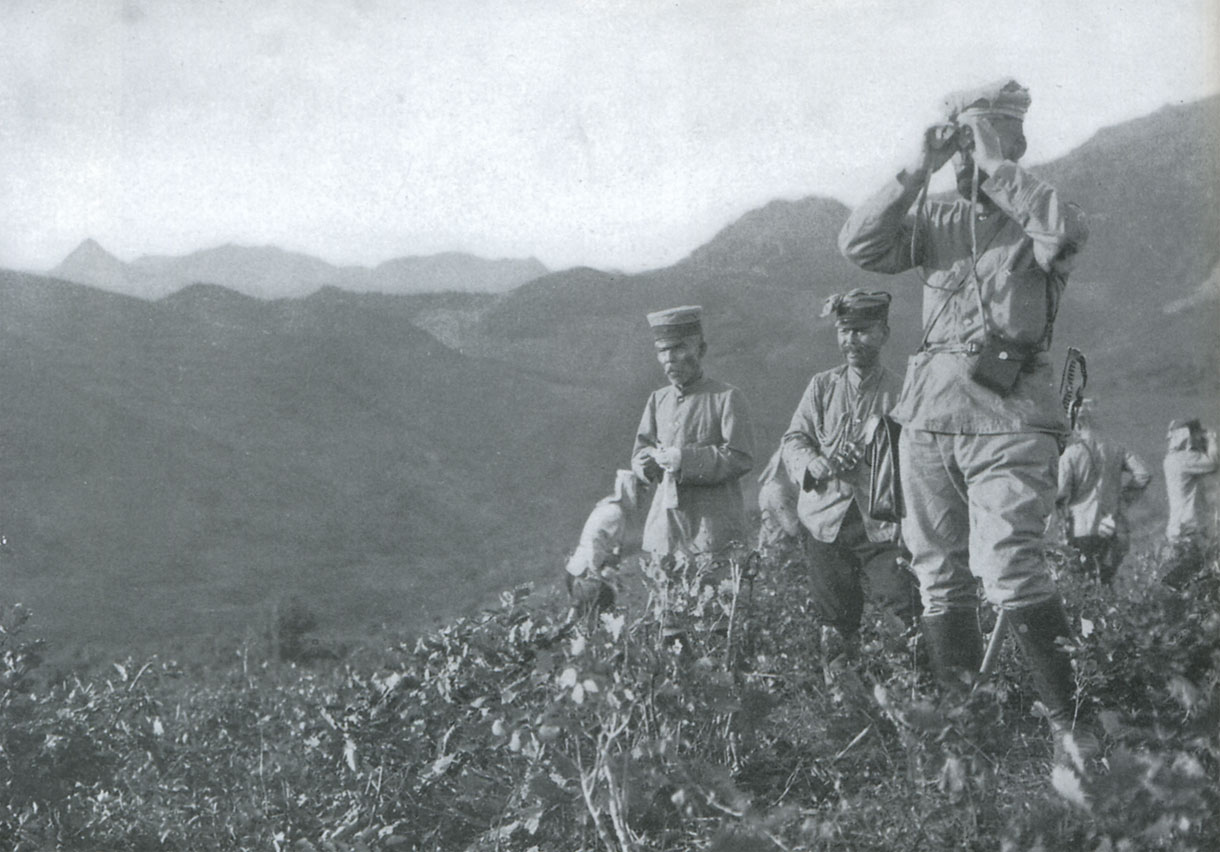
Battle of Liaoyang
Both sides chose Liaoyang for the same reason: it was supposed to end the war. The city sat at the heart of Russia's military infrastructure in southern Manchuria, a major population center straddling the rail line that connected Port Arthur to Mukden. The Imperial Russian Army had fortified it with three concentric rings of defenses. For General Aleksey Kuropatkin, it was the place to finally stop the Japanese advance. For Field Marshal Oyama Iwao, it was the prize that would break Russia's grip on Manchuria. In late August 1904, the two armies collided outside the city walls, and the collision changed the course of the war.
The Converging Armies
After Japanese forces landed on the Liaodong Peninsula, Oyama divided his strength into three armies moving on Liaoyang from different directions. General Kuroki Tamemoto's 1st Army approached through Motien Pass from the east, General Oku Yasukata's 2nd Army advanced along the railway from the south, and General Nozu Michitsura's 4th Army held in reserve to commit on the right flank at the decisive moment. Altogether, Oyama commanded eight divisions, roughly 120,000 men, supported by 170 artillery pieces. The strategy, developed by General Kodama Gentaro, was a coordinated squeeze designed to crack the city's defenses from multiple angles simultaneously.
Kuropatkin's Gamble
The Russian commander had a different strategy in mind, and it put him at odds with his own superiors. Kuropatkin planned a fighting retreat, trading territory for time while reinforcements arrived from European Russia via the newly completed Trans-Siberian Railroad. He calculated that patience would eventually deliver the numerical advantage he needed to crush the Japanese decisively. But Russian Viceroy Yevgeni Alekseyev, who outranked him politically, demanded immediate aggression and a quick victory. Caught between strategic prudence and political pressure, Kuropatkin attempted to hold Liaoyang's fortifications while keeping his options open for withdrawal.
Eyes in the Sky
One of the battle's more unusual features was the Russian use of observation balloons, which provided aerial monitoring of the Japanese troop movements across the Manchurian plains. Crews of balloon handlers managed tethered platforms that swayed above the battlefield, giving Russian commanders a panoramic view that their opponents lacked. The technology was crude compared to the aircraft that would dominate battlefields a decade later in World War I, but at Liaoyang it represented one of the earliest systematic uses of aerial observation in modern warfare. Despite this advantage, the intelligence gathered from the balloons could not compensate for the coordination problems that plagued the Russian command.
A Victory That Felt Like Defeat
The battle raged from late August into early September 1904, with the Japanese gradually tightening their grip on the city's outer defenses. Though Kuropatkin's forces fought hard and inflicted significant casualties on the attackers, the Russian commander ultimately ordered a withdrawal northward toward Mukden, abandoning Liaoyang's fortifications. Kuropatkin reported the outcome to Tsar Nicholas II as a victory, but the loss of Russia's primary military base in southern Manchuria was a strategic blow that would reverberate through the remainder of the war. The road to Mukden was now open, and the battles that followed along the Shaho River and at Sandepu would grow progressively larger and bloodier as both empires poured more men into the Manchurian plains.
From the Air
Located at 41.26°N, 123.18°E, on the outskirts of present-day Liaoyang in Liaoning Province. The flat terrain south and west of the city, where much of the fighting occurred, is visible from altitude. The South Manchurian Railway line, which was central to the battle's strategic importance, still runs through the area. Nearest major airport is Shenyang Taoxian International (ZYTX), approximately 70 km to the north.