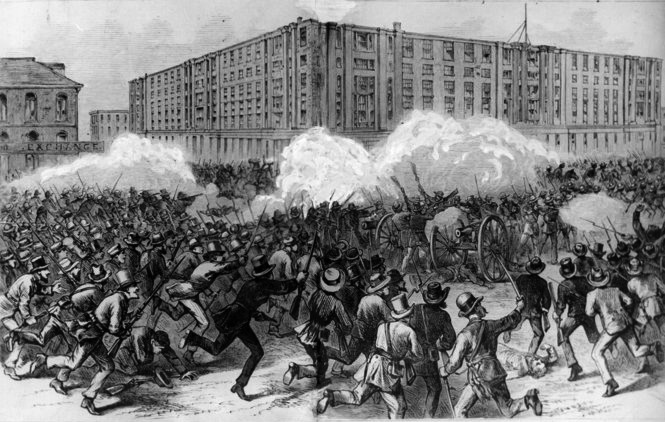
Battle of Liberty Place
On the morning of September 14, 1874, Canal Street in New Orleans was the widest boulevard in America and the commercial heart of the South's largest city. By four o'clock that afternoon, it was a battlefield. Five thousand members of the White League -- a paramilitary force composed largely of Confederate veterans -- had massed along the south side of the street, armed and waiting. Across from them stood 3,500 members of the racially integrated Metropolitan Police and state militia, commanded by former Confederate general James Longstreet, who had broken with his old comrades to align with the Republican Reconstruction government. When the shooting started, the police lines broke. The insurgents captured City Hall, the state armory, and one piece of artillery. They barricaded the streets with railroad cars. For three days, they held downtown New Orleans.
Two Governors, One Capital
The insurrection did not erupt from nowhere. It grew from the bitterly disputed 1872 Louisiana gubernatorial election, in which Democrat John McEnery and Republican William Pitt Kellogg both claimed victory. Two separate election boards issued conflicting results. Democrats accused Republicans of fraud; Republicans pointed to the violence and voter intimidation that had suppressed Black voting across the state. The legislature impeached outgoing Governor Henry C. Warmoth and removed him, installing Lieutenant Governor P. B. S. Pinchback -- the first African American to serve as governor of a U.S. state -- for the final 35 days of the term. Both McEnery and Kellogg held inaugural ceremonies. Both certified lists of local officeholders. The federal government ultimately recognized Kellogg, but McEnery's supporters refused to accept the decision. In April 1873, the dispute had already turned lethal at the Colfax massacre, where a white militia killed three whites and at least 150 Black citizens, at least 50 of them after surrendering.
The Barricades on Canal Street
By 1874, McEnery's allies had organized a rump legislature in New Orleans. The White League, funded and led by the city's planter elite, entered the city 5,000 strong to forcibly seat their man as governor. Self-proclaimed Lieutenant Governor D. B. Penn issued a proclamation calling on the militia to assemble "for the purpose of driving the usurpers from power." Frederick Nash Ogden was appointed provisional general. At four o'clock, Longstreet arrived with Metropolitan Police, cavalry, and artillery, ordering the armed crowd to disperse. Once firing began, however, the police broke and fell back. Longstreet was shot -- possibly by a spent bullet -- and fell from his horse. Governor Kellogg and other officials fled to the Custom House on Canal Street, a federal building protected by U.S. Army troops who did not intervene in the fighting. The White League seized the statehouse and armory, building barricades from street railroad cars along Poydras Street. At least 35 people were killed, including 21 White League members. Many more were wounded, including customs agent Rodolphe Lucien Desdunes, who later became a prominent civil rights activist and historian.
Three Days and a Telegram
Kellogg wired President Ulysses S. Grant for help. Within three days, federal troops were en route. General William H. Emory met with the opposition leaders -- McEnery, Penn, and others -- and offered a deal: no arrests in exchange for restoring the legitimate government, returning seized weapons, and standing down. The insurgents agreed, though they insisted Louisiana was "no longer a state, but a province without a democratic government." No one was prosecuted. Grant sent General Philippe Regis de Trobriand and the 13th Regiment to protect the statehouse. When Kellogg later asked Trobriand to eject uncertified legislators, the general escorted eight men out after each delivered a speech of objection. The Democrats never returned to the statehouse. Instead they set up an alternate legislature at the Odd Fellows Hall, committed to their own gubernatorial candidate, Francis T. Nicholls. Federal troops remained in New Orleans until January 1877, when they were withdrawn as part of the Compromise of 1877 that ended Reconstruction.
The Monument That Would Not Stay
In 1891, with white Democrats firmly in control of Louisiana and in the process of disenfranchising Black voters, the city erected a white marble obelisk on Canal Street praising the insurrection. In 1932, the city added a white supremacist inscription. In 1974, after the Civil Rights Movement, a new marker was placed nearby explaining that the inscription "did not express current philosophy." When Canal Street construction required the monument's temporary removal in 1989, officials relocated it to an inconspicuous spot and rewrote the inscription to honor "those Americans on both sides of the conflict." In July 2015, Mayor Mitch Landrieu proposed removing it entirely. In December 2015, the New Orleans City Council voted to take it down, along with statues of Robert E. Lee, P.G.T. Beauregard, and Jefferson Davis. On April 24, 2017, workers removed the Battle of Liberty Place monument under police escort, in the predawn darkness, wearing flak jackets and helmets because of threats from monument supporters. It was the first of the four to go.
From the Air
Located at 29.951N, 90.064W on Canal Street in downtown New Orleans. Canal Street is one of the widest and most prominent boulevards visible from the air, running from the Mississippi River northwest toward Lake Pontchartrain, dividing the French Quarter from the Central Business District. The Custom House (now a federal building) where Governor Kellogg took refuge still stands on Canal Street. Nearest airport is Louis Armstrong New Orleans International (KMSY), approximately 11 nm west. Lakefront Airport (KNEW) is about 7 nm northeast. Best viewed at 2,000-3,000 ft AGL to appreciate Canal Street's width and prominence in the city grid.
Sources
- Wikipedia - Battle of Liberty Place
- Wikipedia - P. B. S. Pinchback
- Wikipedia - Colfax massacre
- Wikipedia - Battle of Liberty Place Monument
- CNN - New Orleans votes to remove Confederate monuments
- NPR - Under Cover Of Night, New Orleans Begins Dismantling Confederate Monuments
- Wikipedia - Rodolphe Desdunes