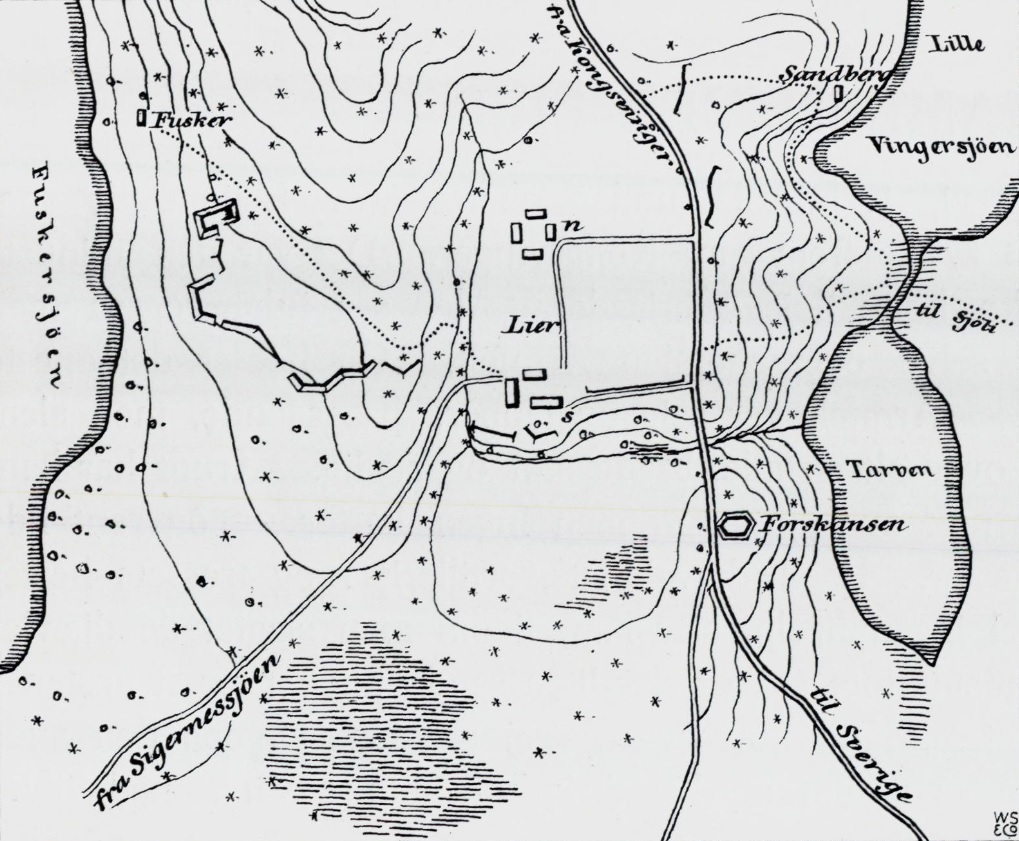
Battle of Lier (1808)
The frozen Glomma River gleamed under the April sky as Swedish soldiers trudged through waist-deep snow toward the Norwegian entrenchments at Lier. It was April 18, 1808, and Sweden found itself in an impossible position: enemies closing in from east, west, and south. The Russian Empire had invaded from Finland just weeks earlier. Denmark-Norway had declared war in March. Napoleon's Continental System threatened to strangle Swedish trade. General Gustaf Mauritz Armfelt led his exhausted brigade toward Kongsvinger Fortress, hoping that seizing Norway might compensate for the inevitable loss of Finland to the Russians. What awaited him at Lier would become one of the most tactically intricate battles of the entire Napoleonic conflict in Scandinavia.
A Kingdom Under Siege
Sweden's predicament in early 1808 defied simple solutions. King Gustav IV Adolf had refused to join Napoleon's Continental System, the emperor's attempt to strangle British trade across Europe. The consequences came swiftly. Russia invaded Finland in February. Denmark-Norway declared war in March. French and Danish forces massed in the south, threatening invasion across the narrow straits. Sweden faced a two-front war with potential for a third front opening at any moment. The Swedish response was audacious: rather than purely defend, they would counter-attack into Norway, hoping to capture territory that could be traded for Finland or force Denmark-Norway to negotiate. Armfelt crossed the border with four brigades, his first brigade of 2,000 men pushing toward the strategic fortress town of Kongsvinger.
The Impregnable Position
The Norwegian defenders had chosen their ground well. The Lier entrenchment stretched across the heights, its right flank protected by the frozen Fosker stream, its left by the Tarven and Vinger lakes. A swampy meadow turned to impassable bogland in front of the position, and dense coniferous forest covered the approaches. A crucial redoubt guarded the main road. Colonel Bernt Peter Kreutz commanded between 1,000 and 1,200 Norwegians with eight artillery pieces. Armfelt arrived with only 1,400 men and three guns. When he surveyed the defenses, he later wrote in his report: "This position is so strong that I would never have resolved to attack it with such an insignificant force, had it been revealed to me earlier." But by then, his men were already committed.
Feints in the Snow
Armfelt's attack on the morning of April 18 relied on deception. He ordered two diversionary strikes against the Norwegian flanks while his center prepared the main assault. At 8:30 AM, 200 men of the Varmland Jager Regiment under Major Matern advanced across the frozen Fosker, reaching a height just 100 meters from the Norwegian right. Deep snow slowed every movement to a crawl. On the opposite flank, 100 Jagers attempted to cross the frozen Tarven lake but were repulsed. The main Swedish force of 350 men began threading through the forest around 3:00 PM. The diversionary attacks served their purpose: Kreutz began shifting troops from his right to his threatened left, not realizing he was walking into Armfelt's trap.
The Redoubt Falls
By 5:00 PM, the Swedish center had captured the heights beside the road, and an intense firefight erupted. The infantry prepared to storm the key redoubt, but two failed flanking attacks convinced Armfelt to call a retreat. Then fate intervened. Colonel Cederstrom, whose division had found its assigned route impassable, suddenly arrived with 600 men and threatened to cross between the two Norwegian-held lakes. Kreutz panicked. He stripped his right wing of almost all troops to reinforce the left, and that was when Major Hard of the Uppland Regiment saw his opportunity. With a single cannon providing cover, his men stormed the redoubt in brutal hand-to-hand combat. Simultaneously, Matern's Jagers swept across the now-undefended Norwegian right. By 7:00 PM, the entire Norwegian position had collapsed, and Kreutz ordered a full retreat toward Kongsvinger.
Victory Without Reward
The casualty figures told the story of a hard-fought engagement: five Swedes killed, 66 wounded, against roughly 100 Norwegian casualties and nearly 100 captured. Armfelt had won, but he lacked the artillery to siege Kongsvinger Fortress. He fortified Lier and waited for the ice on the Glomma to break, planning to use the position as a forward base. The wait proved fatal to Swedish ambitions. Within days, isolated Swedish units were overwhelmed at Toverud and Trangen. On May 24, King Gustav IV Adolf ordered Armfelt to act defensively while the king planned a seaborne attack on Denmark. By June, the Swedes had retreated entirely from Norway, their invasion a strategic failure despite tactical success. The blood shed at Lier had bought nothing.
From the Air
Located at 60.15°N, 12.04°E in southeastern Norway near the Swedish border. The battlefield lies in the forested hills between the Glomma River and Kongsvinger, roughly 100 km northeast of Oslo. Visible landmarks include the Vinger and Tarven lakes that anchored the Norwegian defensive position. Nearest major airport is Oslo Gardermoen (ENGM), approximately 80 km southwest. Regional airfield Kongsvinger (no ICAO) lies 8 km north. Best viewed at 3,000-5,000 feet AGL to appreciate the terrain that shaped the battle.