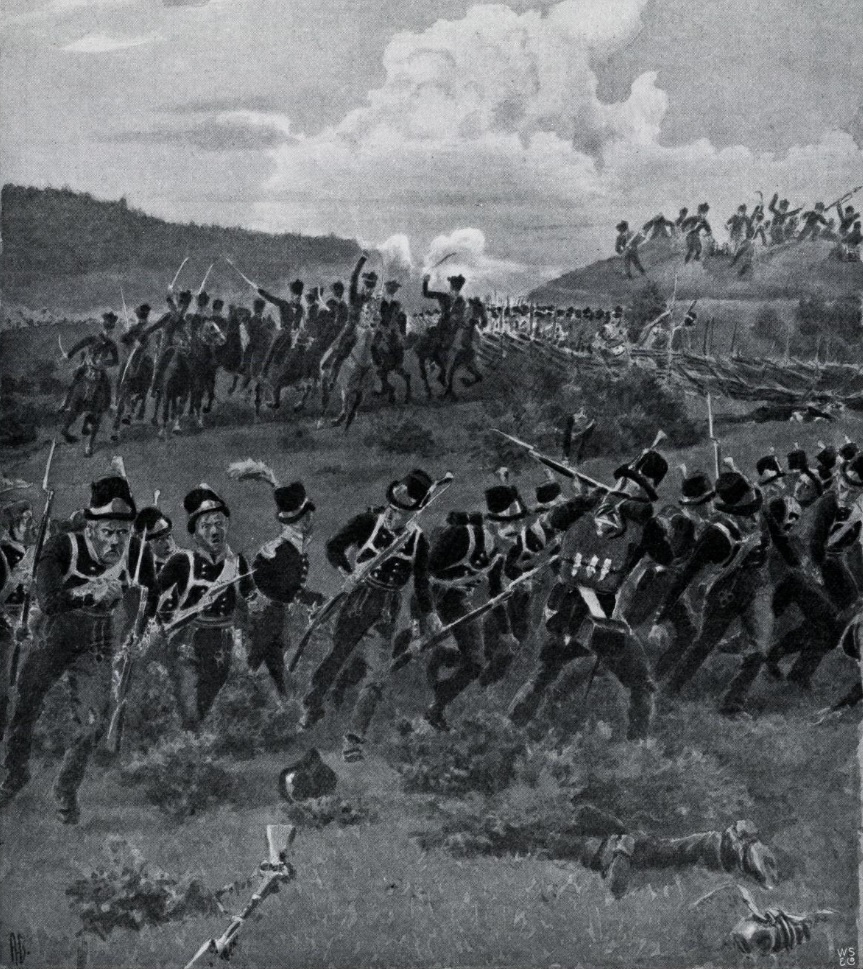
Battle of Lier (1814)
The same heights, the same entrenchments, but a completely different war. On August 2, 1814, Swedish soldiers again attacked the Norwegian positions at Lier, this time attempting to crush a newly independent nation. Just months earlier, Norway had declared independence from Denmark and written its constitution at Eidsvoll Manor. Now Crown Prince Jean Baptiste Bernadotte, the former French marshal who had become heir to the Swedish throne, was determined to force Norway into union with Sweden. The battle that followed would prove that history does not always repeat itself, and that the defenders of Lier had learned from 1808.
A Nation Born in Crisis
Norway's independence in 1814 emerged from the wreckage of Napoleon's empire. Denmark-Norway had backed the losing side, and the victorious allies forced Denmark to cede Norway to Sweden in the Treaty of Kiel. The Norwegians had other ideas. On May 17, 1814, they adopted a constitution at Eidsvoll Manor and elected Prince Christian Frederik as king. Sweden refused to accept this defiance. Bernadotte, himself a creation of the Napoleonic era who had switched sides to preserve his throne, assembled an invasion force. Major General Carl Pontus Gahn led 1,500 men across the border near Eidskog on July 31, tasked with advancing on Kongsvinger to draw Norwegian defenders away from other potential invasion routes. It was a strategic feint, but the Norwegians were ready.
The Road to Kongsvinger
Gahn's force consisted of one Jager battalion and three infantry battalions from the Vasterbotten Regiment, plus one battalion from the Varmland Regiment. The advance began promisingly. Norwegian outposts at Matrand were too weak to resist and fell back. The Swedish troops camped at Brenna, Malmer, and along the road to Pramhus. But the Norwegian vanguard had not panicked. Lieutenant Colonel Andreas Samuel Krebs rallied the retreating troops at Kongetorp and made a crucial decision: they would fall back to the Lier entrenchment, the same defensive position that had shaped the 1808 battle. Krebs understood what Gahn apparently did not, that attacking prepared positions uphill through restricted terrain rarely succeeds without overwhelming force.
The Assault Breaks Down
On August 2, the Swedish columns advanced. The main body followed Kongeveien from Skotterud while 800-900 men took the road through Pramhus. They reunited at Abogen for a rest before splitting again at Flygind: two companies toward Tarven, one following the main road, and a fourth attempting to flank the Norwegian right. The attack unraveled almost immediately. The companies striking toward Tarven ran into superior Norwegian forces and needed battalion-level reinforcement just to continue fighting. Even then, Norwegian artillery from the Lier positions intervened effectively and stopped the Swedish advance cold. At the main entrenchment, Swedish troops emerged from the forest edge into murderous fire. They were simply too weak to storm the position.
Repeated Failure
Major General Gahn reinforced the main attack with two additional companies. His men tried repeatedly to take the entrenchment, throwing themselves against the Norwegian defenses only to be stopped each time. When Norwegian reserves counterattacked, the exhausted Swedish troops had nothing left. By 9:00 PM, Swedish ammunition was nearly depleted, and Gahn had failed to secure any strategic position along the road to Kongsvinger. He ordered a retreat to Matrand. The casualty figures revealed the cost of attacking fortified positions: 28 Swedes dead or missing (including at least 8 prisoners) and 72 wounded, compared to far lighter Norwegian losses. The Norwegians had fought mostly from fortified lines or waited in reserve, giving them every advantage.
A Hero and a Nation
Lieutenant Colonel Krebs became a national hero. His victory at Lier was followed by another triumph at the Battle of Matrand three days later on August 5. These were the only Norwegian victories in an otherwise difficult campaign, but they proved invaluable at the negotiating table. When Norwegian envoys sat down with Swedish representatives, the battles of Lier and Matrand gave them leverage. The resulting agreement preserved the Norwegian constitution and its parliament, the Storting. Norway entered into personal union with Sweden, sharing a monarch but maintaining its own government. The union would last until 1905, when Norway peacefully became fully independent. The blood shed at Lier in 1814 had purchased something the 1808 battle never could: a foundation for national survival.
From the Air
Located at 60.15°N, 12.04°E in southeastern Norway near Kongsvinger. The Lier entrenchment occupies high ground between the Vinger and Tarven lakes, a natural defensive position exploited in both 1808 and 1814. The terrain remains largely forested. Oslo Gardermoen (ENGM) lies approximately 80 km southwest. The Swedish border is visible just 10 km to the east. Best viewed at 3,000-5,000 feet AGL to appreciate the defensive terrain and the lakes that anchored the Norwegian flanks.